
Universal Testing Machine Specifications: Capacity, Load Cell, Extensometer, Standards and Buying Guide
Jay Pal Singh
17 November 2026
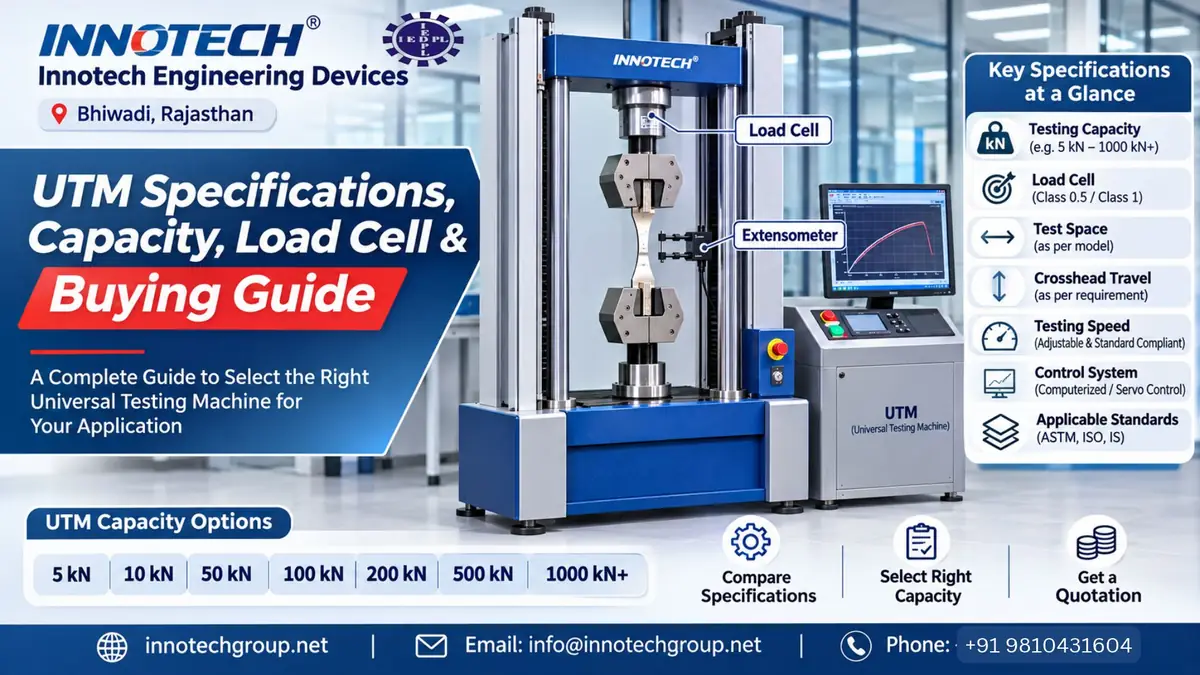
Universal Testing Machine Specifications: Capacity, Load Cell, Extensometer, Standards and Buying Guide
Buying a Universal Testing Machine (UTM) is an important decision for a manufacturing company, quality-control laboratory, research institution or engineering college.
A machine with the wrong capacity, grips, testing speed or measurement system may not perform the required test correctly—even when its advertised maximum load appears sufficient.
This guide explains Universal Testing Machine specifications, capacity selection, load-cell accuracy, extensometers, servo control, testing standards and price considerations in simple language.
Whether you are comparing a 5 kN, 10 kN, 50 kN, 100 kN, 200 kN, 500 kN or 1000 kN UTM, the objective is the same: select a machine that meets your actual testing requirements.
What Specifications Matter in a Universal Testing Machine?
A Universal Testing Machine is used for tensile, compression, bending and other compatible mechanical tests.
Before purchasing, compare the following specifications.
| Specification |
Why it matters |
| Testing capacity | Maximum force the machine can apply |
| Force accuracy | Reliability of force measurement |
| Load-cell range | Suitability for high-and-low force tests |
| Testing speed | Ability to follow the required test procedure |
| Crosshead travel | Available movement during testing |
| Test space | Clearance for specimens and fixtures |
| Extensometer | Direct strain and elongation measurement |
| Control system | Regulation of loading and movement |
| Software | Test setup, analysis and reporting |
| Grips and fixtures | Compatibility with the specimen |
| Calibration | Verification of measurement performance |
| Safety | Protection during machine operation |
The best UTM is not necessarily the one with the highest capacity. It is the machine whose verified performance matches the required tests.
How to Select Universal Testing Machine Capacity
UTM capacity is normally expressed in newtons (N) or kilonewtons (kN).
1 kN = 1,000 N
For practical comparison, 100 kN is approximately 10.2 tonne-force.
Common capacity categories include:
| Capacity |
Examples of potential applications |
| 1-5 kN | Thin films, fibers, light plastics |
| 10 kN | Rubber, plastics and smaller components |
| 20-50 kN | Polymers, composites and suitable metal specimens |
| 100-200 kN | Metal specimens and industrial components |
| 300-500 kN | Higher-force metallic and engineering tests |
| 1000 kN and above | Heavy-duty metallic and structural specimens |
These are broad application examples, not universal capacity recommendations. The actual force required depends on material strength, specimen cross-section and test geometry.
Example: Calculate the Required Tensile Force
Suppose a steel specimen has:
- Cross-sectional area: 100 mm²
- Expected ultimate tensile strength: 600 MPa
Since 1 MPa = 1 N/mm²:
Expected maximum force = 600 × 100 = 60,000 N = 60 kN.
A 50 kN UTM would not have enough rated force for this example.
A suitable higher-capacity machine should be selected, allowing for the verified measurement range, test setup and reasonable engineering margin.
Universal Testing Machine Load Cell: Capacity, Accuracy and Resolution
The Universal Testing Machine load cell is a critical measurement component.
It converts applied mechanical force into an electrical signal processed by the testing controller.
When comparing UTMs, ask three questions:
What is the rated force capacity?
A 100 kN load cell is intended for force measurement within its specified operating range.
What is the verified accuracy class?
Accuracy should be supported by calibration and verification results, not only by an advertising claim.
What is the usable measurement range?
A machine may have a large maximum force but still require another load cell for accurate measurement of very small forces.
For example, a laboratory testing both high-strength steel and thin plastic films may benefit from multiple calibrated force ranges.
Class 0.5 vs Class 1 UTM
ISO 7500-1 provides a framework for verifying and classifying the force-measuring systems of static uniaxial testing machines.
Class 0.5 and Class 1 indicate different performance requirements under the standard.
Buyers should request the verified class, measurement range and calibration documentation.
A large digital display count does not, by itself, establish high force-measurement accuracy.
Universal Testing Machine Extensometer: Why Is It Important?
An extensometer measures the change in length of a specimen over a defined gauge length.
It is particularly important when the required test results include:
- Young's modulus
- Yield properties
- Percentage elongation
- Strain
- Stress-strain behavior
Crosshead Displacement vs Specimen Strain
Crosshead displacement measures the movement of part of the machine.
However, this movement can include deformation of the machine frame, grips and other components.
An extensometer measures deformation at the specimen itself.
Therefore, crosshead movement should not automatically be treated as equivalent to specimen strain.
Types of Extensometers
Contact extensometer: Attached directly to the specimen for suitable strain measurement.
Long-travel extensometer: Useful for materials that undergo substantial extension.
Video extensometer: Uses optical measurement without physical contact with the specimen.
The appropriate type depends on the material, gauge length, strain range, required accuracy and testing standard.
Servo Controlled vs Electromechanical vs Hydraulic UTM
These terms are often confused by buyers.
A servo-controlled UTM uses feedback to regulate machine operation. Servo control describes the control approach rather than identifying one particular loading mechanism.
An electromechanical UTM uses an electric motor and mechanical drive system, commonly involving ball screws.
A hydraulic UTM uses hydraulic pressure to generate force.
A servo-controlled machine may therefore be electromechanical or servo-hydraulic.
| Machine type |
Typical consideration |
| Electromechanical UTM | Controlled crosshead movement and suitable force range |
| Servo Electromechanical UTM | Feedback-controlled motor-driven testing |
| Hydraulic UTM | High-force loading applications |
| Servo Hydraulic UTM | Hydraulic loading with feedback-based control |
| Computerized UTM | Digital control, measurement and reporting |
For detailed product options, explore Innotech's Universal Testing Machine range
https://innotechgroup.net/categories/universal-testing-machines.
Which Testing Speed Should You Select?
Testing speed affects how force and deformation develop during a test.
Some standards specify crosshead movement, while others require control of stress rate or strain rate.
Therefore, buyers should not select a machine based only on its maximum advertised speed.
Ask the manufacturer:
- What is the minimum and maximum testing speed?
- Is speed accuracy verified?
- Is the required speed achievable under the expected test load?
- Does the controller support the required control mode?
- Can the machine follow the intended testing standard?
For example, a servo-controlled system with an adjustable speed range may be suitable for different tests, but the required performance must be verified for the selected model.
Universal Testing Machine Grips and Fixtures
Incorrect grips are a common cause of testing problems.
The machine must hold the specimen securely without introducing excessive slipping, damage or unwanted bending.
Typical accessories include:
| Accessory |
Application |
| Wedge grips | Suitable metallic tensile specimens |
| Pneumatic grips | Films and other suitable materials |
| Roller grips | Selected rubber and flexible specimens |
| Compression platens | Compression tests |
| Three-points bending fixture | Flexural testing |
| Four-point bending fixture | Flexural testing |
| Shear fixture | Shear tests |
| Specialized adapters | Components-specific testing |
Before ordering, provide the specimen's dimensions, material and required test force.
A grip suitable for a steel rod may not be suitable for a rubber dumbbell specimen.
ASTM, ISO and IS Standards for Universal Testing Machines
Testing standards help define the specimen, test method, measurement requirements and reporting procedure.
Common examples include:
| Standard |
Application |
| ASTM E8/E8M | Tensile testing of metals |
| ISO 6892-1 | Metallic tensile testing |
| IS 1608 (Part 1) | Metallic tensile testing |
| ASTM D638 | Tensile testing of plastics |
| ISO 527 | Tensile testing of plastics |
| ASTM D790 | Flexural testing of plastics |
| ISO 178 | Flexural testing of plastics |
| ASTM D695 | Compression testing of rigid plastics |
| ISO 7500-1 | Force-measuring system verification |
| ASTM E4 | Force verification |
| ISO 9513 | Extensometer calibration |
A machine should not be advertised as compliant with every standard unless the relevant configuration and performance have been verified.
Universal Testing Machine Price in India
The Universal Testing Machine price in India depends on much more than its maximum force capacity.
Major price factors include:
- Electromechanical or hydraulic loading system
- Maximum testing capacity
- Accuracy class and force-measuring system
- Servo motor, drive and controller
- Frame size and test space
- Testing software
- Grips and fixtures
- Extensometer
- Calibration requirements
- Installation and commissioning
- Custom accessories
When comparing quotations, check whether both suppliers have included the same testing functions and accessories.
A lower-priced machine may become more expensive if essential grips, software or calibration services are excluded.
UTM Buying Checklist for Industrial Buyers
Before sending an enquiry to a Universal Testing Machine manufacturer, prepare the following information:
1. Material to be tested.
2. Specimen dimensions and shape.
3. Maximum expected testing force.
4. Tensile, compression, bending or other test requirements.
5. Applicable ASTM, ISO or IS standard.
6. Required force accuracy.
7. Testing speed and control requirements.
8. Extensometer requirements.
9. Required grips and fixtures.
10. Software and reporting needs.
11. Calibration and documentation requirements.
12. Delivery and installation location.
Providing this information helps manufacturers recommend a suitable machine instead of quoting an unsuitable standard configuration.
Universal Testing Machine Manufacturer in India, Rajasthan and Delhi NCR
Innotech Engineering Devices Private Limited is an Indian OEM manufacturer of Universal Testing Machines and laboratory equipment based in Bhiwadi, Rajasthan.
We receive enquiries from industrial buyers across India, including Bhiwadi, Neemrana, Alwar, Jaipur, Gurugram, Manesar, Delhi NCR, Faridabad, Noida, Haryana, Uttar Pradesh, Gujarat, Maharashtra, Karnataka, Tamil Nadu and Telangana.
Our product range includes:
- Computerized Electromechanical Universal Testing Machine https://innotechgroup.net/products/computerized-electromechanical-universal-testing-machine
- 50 kN Servo Controlled Electromechanical UTM https://innotechgroup.net/products/servo-controlled-electromechanical-universal-testing-machine-utm-50-kn
- 200 kN Servo Controlled Electromechanical UTM https://innotechgroup.net/products/servo-control-electro-mechanical-universal-testing-machine-200kn
- Four Pillar Computerised UTM https://innotechgroup.net/products/computerised-universal-testing-machine-utm-four-pillar-for-material-testing
Buyers searching for a Universal Testing Machine Manufacturer in India, UTM Machine Supplier in Rajasthan, Tensile Testing Machine Manufacturer in Delhi NCR or Servo Controlled UTM Manufacturer can contact Innotech for a technical and commercial quotation.
Frequently Asked Questions
What is the best UTM capacity for metal testing?
It depends on the material strength, specimen dimensions and required test. Calculate the expected maximum force before selecting capacity.
Is a servo-controlled UTM better than a hydraulic UTM?
Servo control and hydraulic loading describe different aspects of a machine. The correct choice depends on the required force, speed, control performance and application.
What is the difference between Class 0.5 and Class 1?
They are force-measurement accuracy classifications under applicable verification standards. Confirm the verified range and calibration certificate.
Is an extensometer necessary for tensile testing?
An extensometer is needed when the test requires accurate specimen strain measurements that cannot be obtained adequately from crosshead movement alone.
What is the HSN code for a Universal Testing Machine?
Universal Testing Machines generally fall under HSN heading 9024. The correct eight-digit classification should be confirmed for the supplied equipment.
How can I get a Universal Testing Machine quotation?
Share your required capacity, material, specimen dimensions, testing standards, accessories and delivery location with the manufacturer.
Request a Universal Testing Machine Quotation
Looking to buy a Universal Testing Machine for an industrial laboratory, manufacturing plant, engineering college or research project?
Innotech Engineering Devices Private Limited can review your requirements and provide a configuration-specific technical quotation.
Factory: H-307, RIICO Industrial Area, Karoli, Tapukara, Bhiwadi – 301707, Rajasthan, India.
Phone: +91 8929666430
Email: info@innotechgroup.net
Request a UTM Technical and Commercial Quotation
https://innotechgroup.net/contact
Category: Universal Testing Machine
Tags: universal testing machine specification, universal testing machine specifications, UTM machine specifications, universal testing machine capacity, universal testing machine load cell, universal testing machine extensometer, universal testing machine accur
Last Updated: 17 November 2026