
Types of Laboratory Furnaces and Their Applications: A Complete Guide
Jay Pal Singh
10 November 2026
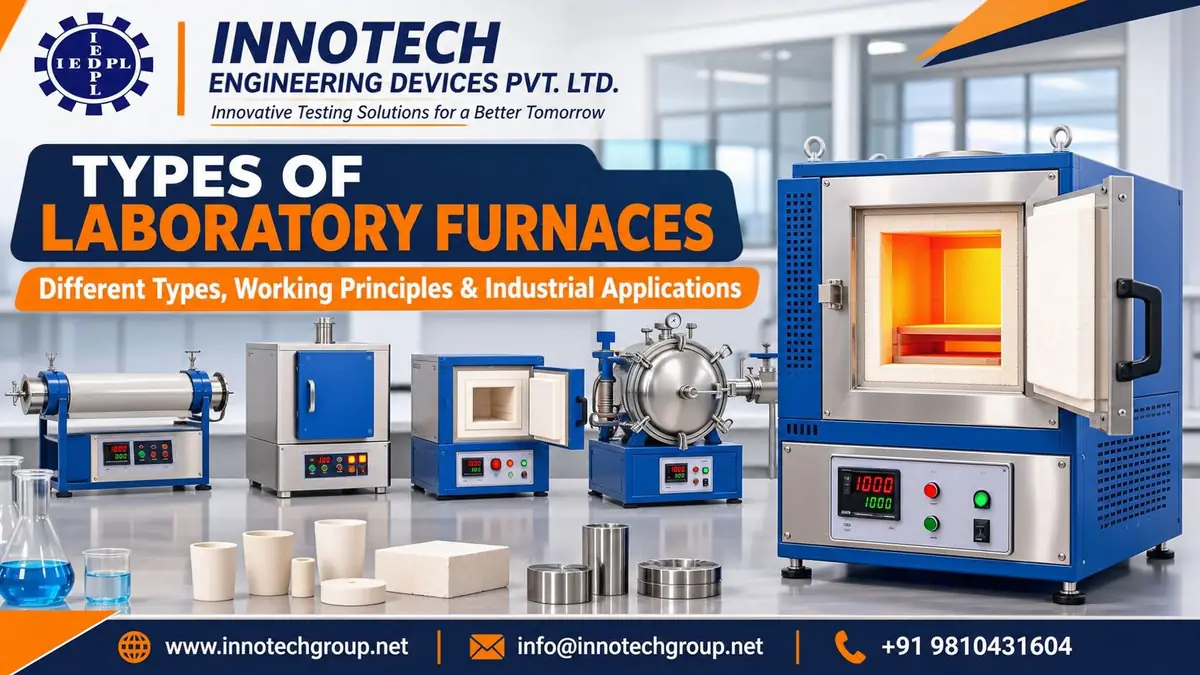
Types of Laboratory Furnaces and Their Applications: A Complete Guide
Laboratory furnaces are essential equipment used for heating, melting, ashing, calcination, sintering and heat treatment of different materials. They are widely used in material testing laboratories, research centres, universities, chemical laboratories, cement industries, metal industries and manufacturing facilities.
Different laboratory furnaces are designed for different heating requirements. Some are suitable for routine laboratory testing, while others are developed for high-temperature processing, controlled-atmosphere heating or specialised material research.
Understanding the types of laboratory furnaces and their applications helps laboratories and industrial buyers select suitable equipment for accurate, repeatable and efficient thermal processing.
What Is a Laboratory Furnace?
A laboratory furnace is a thermal processing machine designed to heat materials or samples at controlled temperatures for a specific period. It generally consists of an insulated heating chamber, heating elements, temperature sensors and a temperature control system.
Electrical energy is converted into heat through resistance heating elements or another heating technology. The controller regulates the temperature according to the selected programme.
Depending on the design and application, laboratory furnaces can be used for:
- Ash content and loss on ignition testing
- Heat treatment and annealing
- Calicination and material decomposition
- Ceramic and poder sintering
- Metal melting and sample preparation
- Thermal research and material development
10 Common Types of Laboratory Furnaces and Their Applications
1. Muffle Furnace
A muffle furnace is one of the most commonly used laboratory furnaces. It has an enclosed, insulated chamber in which samples are heated without direct contact with the heating elements or combustion flame.
Working principle: Electrical heating elements generate heat around the chamber. The heat transfers to the sample, allowing it to undergo controlled thermal treatment.
Applications:
- Ash content determination
- Loss on ignition (LOI) testing
- Gravimetric analysis
- Calcination of materials
- Heat treatment of small metal components
- Ceramic and glass sample processing
Muffle furnaces are commonly used in cement, chemical, metallurgy, environmental and material testing laboratories.
2. Laboratory Ashing Furnace
An ashing furnace is designed for determining the inorganic residue remaining after combustible or organic matter is removed from a sample.
Working principle: The sample is heated under specified conditions so that combustible components burn away, leaving ash for weighing or further analysis.
Applications:
- Coal and coke analysis
- Food and agricultural sample testing
- Plastic and polymer ash analysis
- Petroleum product testing
- Soil and environmental analysis
- Determination of inorganic residue
An ashing furnace may use a chamber design similar to a muffle furnace but can include specialised exhaust arrangements and temperature programmes.
3. High-Temperature Furnace
High-temperature furnaces are designed for thermal processes that require temperatures beyond the range of conventional laboratory chamber furnaces.
Depending on the design, heating elements may include silicon carbide (SiC) or molybdenum disilicide (MoSi₂).
Applications:
- Advanced ceramic processing
- Refactory material testing
- High-temperature sintering
- Powder metallurgy research
- Glass and mineral processing
- Advanced material development
The maximum temperature depends on the heating elements, insulation, atmosphere and furnace construction. Always distinguish the maximum rated temperature from the recommended continuous working temperature.
4. Tube Furnace
A tube furnace uses a cylindrical heating chamber or work tube. Samples are placed inside the tube, which can be made from quartz, alumina or another suitable material depending on the temperature and process.
Working principle: Heating elements surround the work tube and heat the sample inside it. Gas connections or vacuum arrangements can be incorporated in suitable models.
Applications:
- Controlled-atmoshere heat treatment
- Material synthesis
- Powder calcination
- Annealing of small components
- Chemical recations
- Research involving gas flow
Tube furnaces are useful when the experiment requires a defined working zone or a controlled environment around the sample.
5. Vacuum Furnace
A vacuum furnace heats materials inside a sealed chamber from which air and other gases are removed using a vacuum pumping system.
Working principle: The chamber is evacuated to a specified pressure before or during heating. Depending on the system, a selected gas may also be introduced for processing.
Applications:
- Vaccum annealing
- Specialised sintering
- Degassing of materials
- Brazing and heat treatment
- Processing oxidation-sensitive materials
- Advanced metallurgy research
Vacuum furnaces are useful when exposure to normal atmospheric conditions could affect the material. The required vacuum level and compatible materials must be specified before selection.
6. Controlled Atmosphere Furnace
A controlled atmosphere furnace is designed to heat samples under a selected gas environment instead of ordinary air.
Depending on the process, the atmosphere may include nitrogen, argon, hydrogen or another suitable gas.
Working principle: A sealed chamber or retort system maintains the required gas environment during heating. Gas flow, pressure and safety arrangements depend on the design.
Applications:
- Oxidation sensitive heat treatment
- Metal annealing
- Specilised sintering
- Material reduction studies
- Research involving gas-solid reactions
- Advaced material processing
This furnace is different from a standard muffle furnace, which generally operates in ambient air unless specifically designed with atmosphere-control features.
7. Box or Chamber Furnace
A box furnace, also called a chamber furnace, has a box-shaped heating chamber designed for processing samples or components in batches.
Working principle: Heating elements are positioned around the insulated chamber to provide controlled heating. Samples are placed on suitable trays, shelves or supports.
Applications:
- General laboratory heat treatment
- Annealing
- Calcination
- Ceramic firing
- Material conditioning
- Small-batch thermal processing
Box furnaces are suitable for laboratories that require convenient sample loading and a relatively larger working space.
8. Bottom-Loading Furnace
A bottom-loading furnace has a vertically movable platform that carries samples into the heating chamber from below.
Working principle: The loading platform moves upward into the furnace chamber, helping position samples for controlled heating.
Applications:
- Ceramic sintering
- Advanced material processing
- High-temperature research
- Applications requiring careful sample loading
This design can make loading and unloading more convenient, especially when samples are heavy, fragile or require careful positioning.
9. Rotary Tube Furnace
A rotary tube furnace uses a rotating cylindrical tube to move and mix material during the heating process.
Working principle: Material moves through or within the heated tube as it rotates. Rotation helps improve material movement and exposure to heat.
Applications:
- Powder processing
- Calcination of granular materials
- Thermal decomposition
- Material coating research
- Continuous or semi-continuous thermal processing
Rotary tube furnaces are useful when material movement during heating is an important part of the process.
10. Induction or Laboratory Melting Furnace
An induction furnace uses electromagnetic induction to generate heat in electrically conductive materials. Laboratory melting systems are used when controlled metal melting or alloy preparation is required.
Working principle: An alternating magnetic field induces electrical currents in the conductive charge material, generating heat.
Applications:
- Metal and alloy melting
- Metallurgical research
- Small-batch metal preparation
- Alloy development
- Foundry laboratory work
The suitable induction system depends on the metal, batch size, melting temperature and crucible arrangement.
Laboratory Furnace Comparison Table
| Furnace Type |
Main Purpose |
Common Applications |
| Muffle furnace | General high temperature heating | Ashing LOI, calcination |
| Ashing furnace | Residue determination | Coal, plastics, food samples |
| High-temperature furnace | Advanced thermal processing | Ceramics, refactoryy materials |
| Tube furnace | Heating inside a work tube | Sintering, annealing, research |
| Vaccum funace | Heating under reduced pressure | Degassing, vaccum annealing |
| Controlled atmoshphere furnace | Heating under selected gases | Oxidation-sensitive materials |
| Box Furnace | Batch heating | Heat treatment, ceramic firing |
| Rotary tube furnace | Heating with material movemnet | Powder processing calicination |
| Bottom loading furnace | Vertical sample loading | Sintering, heavy samples |
Note: Furnace categories can overlap. For example, a tube furnace may also be a high-temperature or controlled-atmosphere furnace.
Major Applications of Laboratory Furnaces Across Industries
Laboratory furnaces support different testing and research activities across several sectors.
1. Cement and construction materials
- Ignition loss testing of cement and minerals
- Calcination studies
- Thermal treatment of construction materials
2. Metal and metallurgy
- Annealing and heat treatment
- Alloy development
- Metallurgical sample preparation
- Metal melting and research
3. Plastic and polymer industries
- Ash content determination
- Thermal decomposition studies
- Residue analysis
- Material research
4. Ceramic and glass industries
- Ceramic firing and sintering
- Glass sample processing
- Refractory testing
- Material development
5. Chemical and research laboratories
- Calcination
- Sample preparation
- Thermal reactions
- Material synthesis
6. Educational institutions
- Material science experiments
- Metallurigical research
- Chemical analysis
- High-temperature laboratory studies
How to Choose the right Laboratory Furnace?
Selecting the right furnace depends on the material, heating process and laboratory requirements. Consider these important factors before purchasing:
| Selection factor |
What to Check |
| Maximum temeprature | Required process and continuous working temperature |
| Chamber Capacity | Sample dimensions and batch quantity |
| Temperature accuracy | Required measurement and control performance |
| Temperature uniformity | Consitency of temperature throughout the working zone |
| Heating elements | Suitable element material for the process |
| Temperature controller | Digital or programmable control |
| Atmosphere | Air, inert gas, reducting gas or vacuum |
| Insulation | Suitable insulation for the operating temeperature |
| Safety features | Over-temperature protection and electrical safety |
Before finalising a furnace, also consider the heating rate, holding time, cooling requirements, exhaust arrangement and frequency of operation.
Laboratory Furnace Manufacturer in India – Innotech Engineering Devices Pvt. Ltd.
Innotech Engineering Devices Pvt. Ltd. is an OEM manufacturer of testing machines and laboratory equipment based in Bhiwadi, Rajasthan, India.
Laboratory furnaces are used for different thermal processing and material testing requirements. Selecting the correct furnace design depends on the required temperature, chamber size, sample material and application.
For laboratories, research institutions and industrial buyers looking for a laboratory muffle furnace, high-temperature furnace or customised laboratory heating equipment, it is important to discuss the actual testing requirements before selecting a model.
Contact for product enquiries:
Email: info@innotechgroup.net
Phone: +91 9810431604
Location: Bhiwadi, Rajasthan, India
Contact the team to discuss your laboratory equipment requirements and suitable furnace configurations.
Frequently Asked Questions (FAQs)
1. What are the main types of laboratory furnaces?
Common types include muffle furnaces, ashing furnaces, tube furnaces, box furnaces, high-temperature furnaces, vacuum furnaces and controlled-atmosphere furnaces.
2. What is a laboratory muffle furnace used for?
A muffle furnace is commonly used for ash content determination, loss on ignition testing, calcination, gravimetric analysis and heat treatment of small samples.
3. What is the difference between a muffle furnace and a tube furnace?
A muffle furnace uses an enclosed box-shaped chamber, while a tube furnace heats samples inside a cylindrical work tube. Tube furnaces are particularly useful for experiments requiring controlled gas flow or a defined working zone.
4. Which furnace is suitable for high-temperature applications?
A high-temperature furnace is suitable for processes requiring elevated temperatures, such as advanced ceramic sintering and refractory material research. The required operating temperature must be checked against the furnace's specifications.
5. What is a controlled atmosphere furnace?
It is a furnace designed to heat samples under a selected gas environment, helping control reactions between the sample and surrounding atmosphere.
6. How do I select a laboratory furnace?
Consider the required temperature, chamber size, sample material, heating rate, atmosphere, temperature uniformity, controller and safety requirements before purchasing.
Conclusion
Different types of laboratory furnaces serve different heating, testing and research purposes. A muffle furnace is useful for routine laboratory analysis, a tube furnace supports controlled thermal experiments, and vacuum or atmosphere furnaces are suitable for specialised processing.
Understanding these differences helps laboratories choose equipment that matches their process requirements, improves testing consistency and supports reliable research and material development.
Category: Laboratory Equipment & Furnaces
Tags: laboratory furnace applications, laboratory muffle furnace, high temperature furnace, tube furnace, laboratory furnace manufacturer in India, muffle furnace applications, laboratory furnace types, ashing furnace, vacuum furnace, controlled atmosphere furn
Last Updated: 11 November 2026