
Thermal Shock Testing vs Temperature-Humidity Testing: Differences and Applications
Jay Pal Singh
02 October 2026
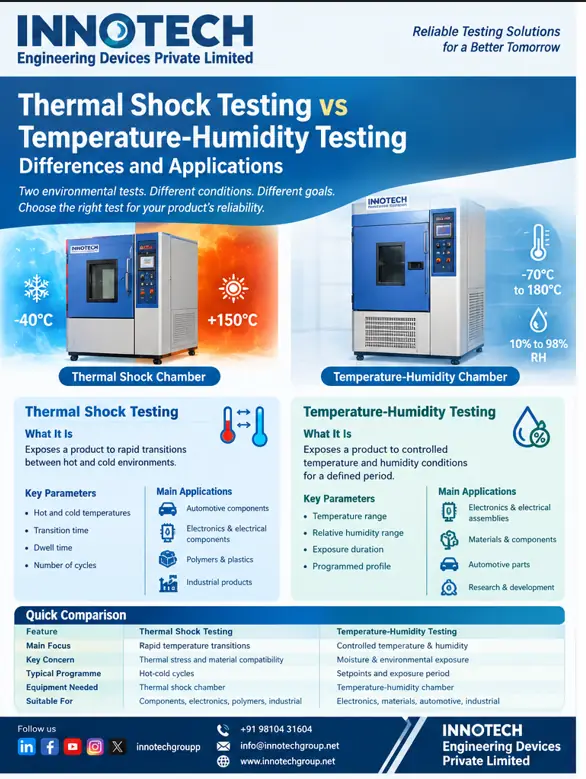
Thermal Shock Testing vs Temperature-Humidity Testing: Differences and Applications
A product may work correctly at room temperature but behave differently after exposure to sudden temperature changes or prolonged humidity. How can manufacturers investigate these risks before a product reaches the customer?
Two environmental testing methods that help answer this question are thermal shock testing and temperature-humidity testing. Although both involve environmental conditions, they are designed to investigate different types of exposure.
Choosing the correct method matters because a chamber suitable for controlled temperature and humidity exposure may not provide the rapid hot-to-cold transitions required for a thermal shock test.
What Is Thermal Shock Testing?
Thermal shock testing exposes a specimen to rapid transitions between specified hot and cold temperature environments. The aim is to evaluate how the product responds to abrupt temperature changes under the defined test conditions.
Different materials can expand or contract at different rates. When a product contains multiple materials, joints, seals or assembled components, rapid changes in temperature may create stresses that reveal potential weaknesses.
Thermal shock testing can help investigate:
- Cracking or other visible damage
- Changes in component dimensions
- Weakness in joints and connections
- Seal performance under secified conditions
- Material compatibility
- Temperature-related reliability concerns
The result depends on the specimen, temperature limits, transition conditions, exposure duration and number of cycles.
What Is Temperature-Humidity Testing?
Temperature-humidity testing exposes a product to controlled temperature and humidity conditions for a defined period. The purpose is to investigate how the product responds to the specified environmental exposure.
Depending on the test requirement, a programme may use a constant condition or a programmed temperature and humidity profile.
This type of testing may help investigate:
- Moisture-related deterioration
- Changes in dimensions or appearance
- Corrosion-related conerns, where relevant
- Effects or prolonged environmental exposure
- Material stability
- Product reliability under specified climatic conditions
Temperature-humidity testing is used for many products and materials, but the required profile must be selected according to the product and applicable procedure.
Thermal Shock Testing vs Temperature-Humidity Testing
The main difference is the environmental condition being investigated.
The correct test is determined by the product requirement. Neither method is automatically better; they investigate different environmental stresses.
How Does Thermal Shock Testing Work?
A thermal shock test typically involves several stages.
1. Specimen Preparation
The product is prepared, inspected and positioned according to the selected procedure.
2. Test Parameter Selection
The required hot and cold temperatures, exposure times, transition conditions and number of cycles are defined.
3. Hot and Cold Exposure
The specimen is exposed to the required temperature environments. Depending on the chamber design, the specimen may move between separate hot and cold zones or be subjected to another engineered transition arrangement.
4. Repeated Cycling
The required number of cycles is completed according to the test plan.
5. Post-Test Inspection
The specimen is examined for the specified signs of damage or changes in performance. Additional functional testing may be required for certain products.
Transition time and dwell time are different parameters: transition time concerns the temperature change, while dwell time concerns how long the specimen remains under a specified condition.
How Does Temperature-Humidity Testing Work?
The general process for temperature-humidity testing includes:
1. Define the Environmental Profile
Determine the required temperature, relative humidity, exposure duration and any changes during the test.
2. Prepare the Specimen
Inspect and position the specimen according to the applicable procedure.
3. Set the Chamber Conditions
The chamber is programmed or adjusted to achieve the required environmental conditions.
4. Maintain the Exposure
The specimen remains under the specified conditions for the required duration. Temperature and humidity monitoring should follow the test requirements.
5. Evaluate the Specimen
After exposure, inspect the product and perform any required measurements or functional checks.
The correct environmental profile depends on the product specification and intended evaluation.
Which Industries Use These Environmental Testing Methods?
Automotive Industry: Suitable components may be evaluated for their response to temperature transitions or controlled environmental exposure.
Electrical and Electronics: Testing can help investigate the environmental performance of suitable assemblies, connectors, housings and components.
Plastics and Polymers: Environmental testing can help assess selected material and component responses to temperature changes or humidity exposure.
Industrial Manufacturing: Manufacturers may use environmental testing during product development, design validation and quality-control investigations.
Research and Development: Laboratories can compare materials, components and designs under defined environmental conditions.
The exact method should be selected according to the product, its operating environment and the applicable test requirement.
Can One Chamber Perform Both Tests?
Not necessarily. Some environmental systems may be designed for multiple test profiles, but a conventional temperature-humidity chamber should not automatically be considered suitable for thermal shock testing.
Thermal shock testing may require rapid transitions and a particular chamber arrangement. Temperature-humidity testing requires the ability to control the specified humidity conditions as well as temperature.
Before purchasing a chamber, confirm whether the equipment can achieve the required temperature range, humidity range, transition conditions, specimen capacity, cycle programme and monitoring requirements.
How to Choose the Right Environmental Testing Chamber
Before selecting a chamber, identify the test objective and the environmental profile required by your product.
Consider these factors:
- Type and dimensins of the specimen
- Rquired minimum and maximum temperatures
- Required relative humidity range, if applivable
- Required transition conditions
- Dwell tie and number of cycls
- Chamber capacity and specimen arrangement
- Temperature and humidity control requirements
- Monitoring and data-recording needs
- Applicable test procedure
- Safety and operating requirements
If you are unsure which chamber is suitable, share the product details and required test conditions with the equipment supplier. Selecting a chamber from its name alone may lead to a mismatch between the equipment and the intended test.
Thermal Shock Chamber for Product Testing
A thermal shock chamber is used to expose suitable specimens to specified temperature transitions. Its design and configuration depend on the required hot and cold conditions, transition requirements, specimen dimensions and test cycle.
Innotech Engineering Devices Private Limited provides thermal shock testing equipment for industrial and laboratory applications. The required configuration should be discussed according to the intended test procedure and product requirements.
Explore the [Thermal Shock Chamber product page](https://innotechgroup.net/products/thermal-shock-chamber) for further information.
Frequently Asked Questions
What is the main difference between thermal shock and temperature-humidity testing?
Thermal shock testing focuses on rapid temperature transitions, while temperature-humidity testing evaluates a product under specified temperature and moisture conditions.
Is thermal shock testing the same as thermal cycling?
The terms are related but should not automatically be treated as interchangeable. The temperature profile, transition requirements and applicable procedure determine the type of test being performed.
Does a temperature-humidity chamber perform thermal shock testing?
Not necessarily. The chamber must be specifically capable of meeting the transition and temperature requirements of the intended thermal shock test.
Which products may require thermal shock testing?
Suitable automotive, electronic, polymer and industrial components may require thermal shock evaluation when their product requirements involve rapid temperature changes.
Why is humidity controlled during environmental testing?
Humidity can affect the response of certain materials and products. Controlling it allows a defined environmental exposure to be reproduced according to the test procedure.
What details are required when requesting an environmental chamber quotation?
Provide the specimen dimensions, required temperature range, humidity requirements if applicable, transition conditions, dwell time, number of cycles and relevant test procedure.
Consult Our Expert for Environmental Testing Equipment
Not sure whether your application requires a Thermal Shock Chamber or a Temperature-Humidity Chamber? Contact Innotech Engineering Devices Private Limited to discuss the test conditions and product requirements.
Share your product details, required temperatures, humidity levels and test cycle. Our team can discuss the appropriate equipment configuration for your application.
Call: 9810431604
Email: info@innotechgroup.net
Website: www.innotechgroup.net
Contact us to discuss your environmental testing requirements and request a quotation.
| Comparison |
Thermal Shock Testing |
Temperature-Humidity Testing |
| Main focus | Rapid changes between hot and cold environments | Controlled temperature and humidity exposure |
| Key Concern | Response to abrupt temperature transitions | Response to specified temperature and moisture conditions |
| Typical Programme | Hot-cold transitions and defined cycles | Setpoints, humidity levels nd exposure periods |
| Important parameter | Hot and cold temperatures, transition conditions, dwell times and cycles | Temperature, relative humidity, exposure duration and programmed profile |
| Possible applications | Suitable automotive, electronic, polymer and industrial components | Suitable electronics, materials, components and products sensitive to environmental exposure |
| Equipment selection | Requires a system capable of the specified temperature transitions | Required a chamber capable of the required temperature and humidity conditions |
Category: Environmental Testing Equipment
Tags: Thermal Shock Testing vs Temperature-Humidity Testing, Thermal Shock Testing, Thermal Shock Chamber, Temperature Humidity Chamber, Environmental Testing Chamber, Thermal Shock Testing Machine, Temperature and Humidity Testing, Environmental Chamber Applic
Last Updated: 02 October 2026