
Salt Spray Testing vs Real-World Corrosion: What Is the Difference?
Jay Pal Singh
01 October 2026
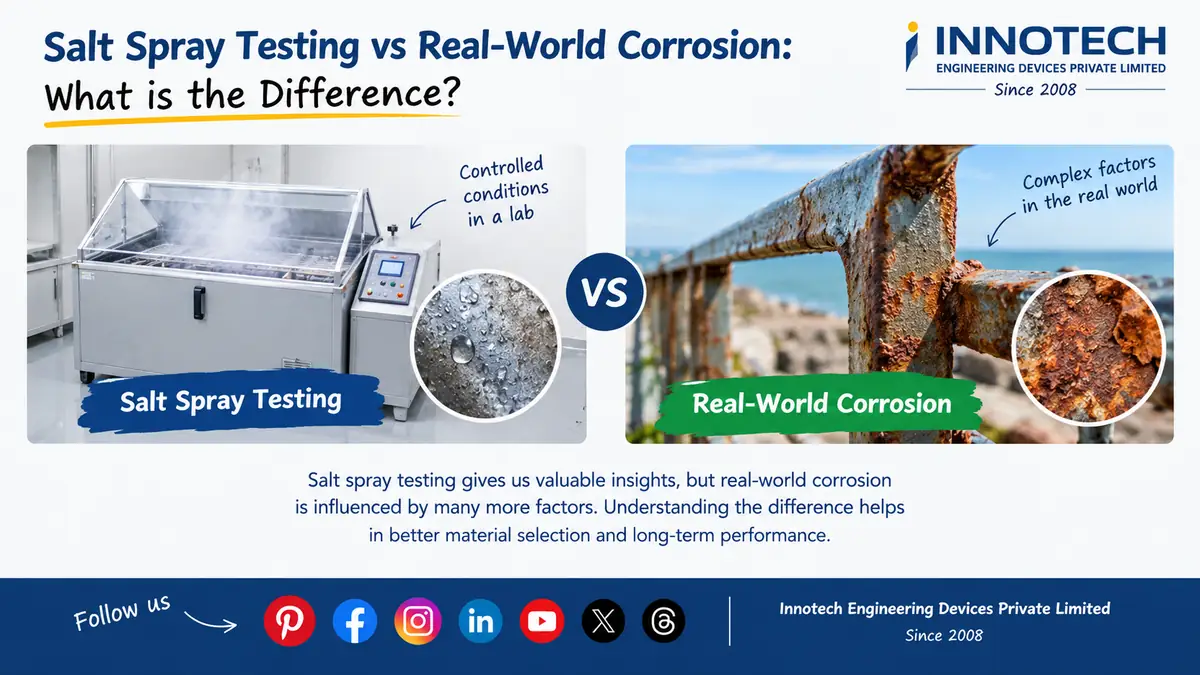
Salt Spray Testing vs Real-World Corrosion: What Is the Difference?
A metal component may perform well during a laboratory corrosion test but show a different level of corrosion after months of outdoor use. Why does this happen?
The answer is that laboratory salt spray testing and real-world corrosion exposure are not exactly the same.
Salt spray testing provides a controlled way to evaluate suitable materials and protective coatings under specified conditions. Real-world corrosion, however, can be affected by changing weather, moisture, pollution, sunlight, deposits and the way a product is used.
Understanding this difference helps manufacturers, engineers and quality-control teams select suitable testing methods and interpret results more carefully.
What Is Salt Spray Testing?
Salt spray testing is a laboratory method in which suitable specimens are exposed to a controlled environment containing a salt solution.
A Salt Spray Chamber is used to maintain the conditions required by the selected test procedure. After the specified exposure duration, the specimens are examined using the relevant evaluation criteria.
The test may be used to evaluate suitable:
- Painted metal components
- Protective coatings
- Plated metal surfaces
- Fasteners and hardware
- Coated industrial products
- Other specimens covered by the selected test method
The purpose is to evaluate corrosion-related performance under defined laboratory conditions.
What Is Real-World Corrosion?
Real-world corrosion occurs when materials react with their surrounding environment during actual use.
For example, a metal component installed near the coast may be exposed to salt deposits and high humidity. A component used outdoors in another location may experience rainfall, temperature changes, dust and sunlight.
Factors that can influence corrosion include:
- Moisture and humidity
- Temperature changes
- Salt deposits
- Airborne pollutants
- Chemical Exposure
- Sunlight and UV radiation
- Coating damage
- Contact with other materials
- Maintenance and cleaning practices
These factors can vary significantly between locations and applications. As a result, the corrosion behaviour observed in the field may differ from the results of a single laboratory test.
Key Differences Between Salt Spray Testing and Real-World Corrosion
1. Controlled Conditions vs Changing Environments
In a salt spray test, the environment is controlled according to the selected procedure.
In the real world, conditions can change throughout the day and across seasons. A component may experience wet and dry periods, sunlight, rainfall and different temperatures.
This difference can influence the corrosion process and the condition of the protective coating.
2. Defined Exposure vs Actual Service Conditions
Laboratory tests use a specified exposure period and defined test conditions.
Real-world exposure depends on where and how the product is used. A component installed indoors, near the coast or in an industrial environment may experience very different conditions.
Therefore, the laboratory exposure duration should not automatically be converted into a number of years of field performance.
3. Specific Test Results vs Overall Product Durability
Salt spray testing provides information about the specimen's performance under the selected test conditions.
Overall product durability can also depend on mechanical damage, coating thickness, surface preparation, product design, installation and maintenance.
A single corrosion test may not capture every factor affecting a product during its working life.
4. Laboratory Evaluation vs Field Observation
A laboratory test allows specimens to be evaluated using a defined procedure.
Field evaluation examines products under their actual operating or environmental conditions. Field observations may provide information that is not captured by a laboratory salt spray test alone.
For some applications, laboratory testing and field exposure data can be used together to support product evaluation.
Does Salt Spray Testing Predict the Exact Life of a Coating?
Salt spray testing does not provide a universal prediction of coating life.
For example, a result showing that a specimen completed 500 hours of salt spray exposure does not automatically mean that the coating will last for a specific number of years outdoors.
The relationship between laboratory results and service life depends on the coating system, substrate, exposure environment, failure criteria and supporting evidence.
If a manufacturer needs to estimate long-term performance, the assessment may require additional laboratory methods, field exposure data or application-specific studies.
The correct approach depends on the product and the decision being made.
Why Do Manufacturers Use Salt Spray Testing?
Although salt spray testing does not reproduce every real-world condition, it can still be useful when applied for an appropriate purpose.
Manufacturers may use it to:
- Compare suitable coating systems
- Evaluate corrosion related perfromance
- support product development
- Check compliance with specified test requiremens
- Investigate coating defecs
- Monitor production quality
- Compare specimens using the same test procedure
- Support internal quality control decisions
For meaningful comparisons, the specimens should be evaluated using the same relevant procedure and acceptance criteria.
When Should You Consider Other Corrosion Tests?
Salt spray testing is not the only method available for corrosion evaluation.
Depending on the intended application, other approaches may include:
Cyclic Corrosion Testing
Cyclic corrosion methods combine different exposure stages according to a defined procedure. These may include changes in moisture, temperature or other conditions.
Such methods may be appropriate when the specified test is intended to represent a more varied exposure cycle.
Humidity Testing
Humidity testing evaluates the response of suitable materials or products to specified moisture and temperature conditions.
It may be useful when moisture exposure is an important concern.
Outdoor Exposure Testing
Outdoor exposure allows specimens to be observed under actual environmental conditions over time. Results depend on the exposure location, duration and evaluation method.
Application-Specific Testing
Some products require tests designed around their materials, coatings, service environment or customer specifications.
The test method should be selected according to the intended use and relevant technical requirements rather than assuming that one method suits every product.
How to Choose the Right Corrosion Testing Method
Before choosing a corrosion testing method or purchasing equipment, consider these questions:
- What material or coating will be tested?
- What environmental conditions will the product experience?
- What failure or performance characeristic needs to be evaluated?
- Is there a customer specification or applicable test standard?
- What are the required exposure conditions?
- What acceptance criteria will be used?
- Is laboratory testing sufficiet, or is field exposure information also needed?
- Does the laboratory need one test method or several?
Discussing these requirements with the testing team or relevant technical specialist can help identify an appropriate approach.
Selecting a Salt Spray Chamber for Your Laboratory
If salt spray testing is part of your quality-control process, choose a chamber that matches your test requirements.
Consider chamber dimensions, specimen quantity, required exposure conditions, solution handling, controls, monitoring, cleaning and maintenance.
The equipment configuration should support the selected test method. Confirm the relevant operating requirements and available features with the supplier before placing an order.
Salt Spray Testing Equipment from Innotech Engineering Devices Private Limited
Innotech Engineering Devices Private Limited manufactures and supplies testing equipment for material testing laboratories and industrial applications.
Salt Spray Chambers can support the controlled evaluation of suitable specimens for corrosion-related performance under specified laboratory conditions.
If you are looking for corrosion testing equipment, share your test method, specimen dimensions, required conditions and intended application so that the equipment requirements can be discussed appropriately.
Contact Innotech Engineering Devices Private Limited
Website: https://www.innotechgroup.net
Email: info@innotechgroup.net
Phone: 9810431604
Frequently Asked Questions
What is the difference between salt spray testing and real-world corrosion?
Salt spray testing exposes suitable specimens to a controlled laboratory environment. Real-world corrosion occurs under changing environmental and service conditions that may include moisture, temperature changes, pollutants and mechanical damage.
Does salt spray testing accurately predict outdoor coating life?
It does not provide a universal prediction of outdoor service life. Any relationship between test results and actual durability depends on the product, environment, test method and supporting evidence.
Why do manufacturers use salt spray chambers?
Manufacturers use Salt Spray Chambers to evaluate suitable specimens under specified corrosion test conditions and to support product development, comparisons and quality-control activities.
Is salt spray testing suitable for every material?
No. Suitability depends on the material, coating, intended evaluation and selected test method.
Is cyclic corrosion testing the same as salt spray testing?
No. Cyclic corrosion testing can involve several defined exposure stages, while a conventional salt spray test follows its own specified exposure procedure. The methods should be selected according to the testing objective.
Can salt spray testing and outdoor exposure testing be used together?
Yes. Depending on the application, laboratory results and outdoor exposure observations can provide complementary information about corrosion performance.
Conclusion
Salt spray testing and real-world corrosion evaluation serve related but different purposes. A laboratory test provides controlled information about a specimen's performance under specified conditions, while real-world corrosion depends on the environment and how the product is used.
Understanding these differences helps laboratories and manufacturers choose suitable testing methods, interpret results carefully and avoid unsupported claims about product life.
For corrosion testing equipment and material testing solutions, contact Innotech Engineering Devices Private Limited.
Website: https://www.innotechgroup.net
Consul To Expert 9810431604
Category: Salt Spray Testing / Corrosion Testing
Tags: Salt Spray Testing vs Real-World Corrosion, salt spray testing vs real-world corrosion, salt spray testing, real-world corrosion testing, corrosion resistance testing, salt spray chamber, environmental corrosion testing, coating durability testing, metal
Last Updated: 01 October 2026