
Paper Testing Equipment: Types, Uses, Testing Methods and Buying Guide
Jay Pal Singh
09 October 2026
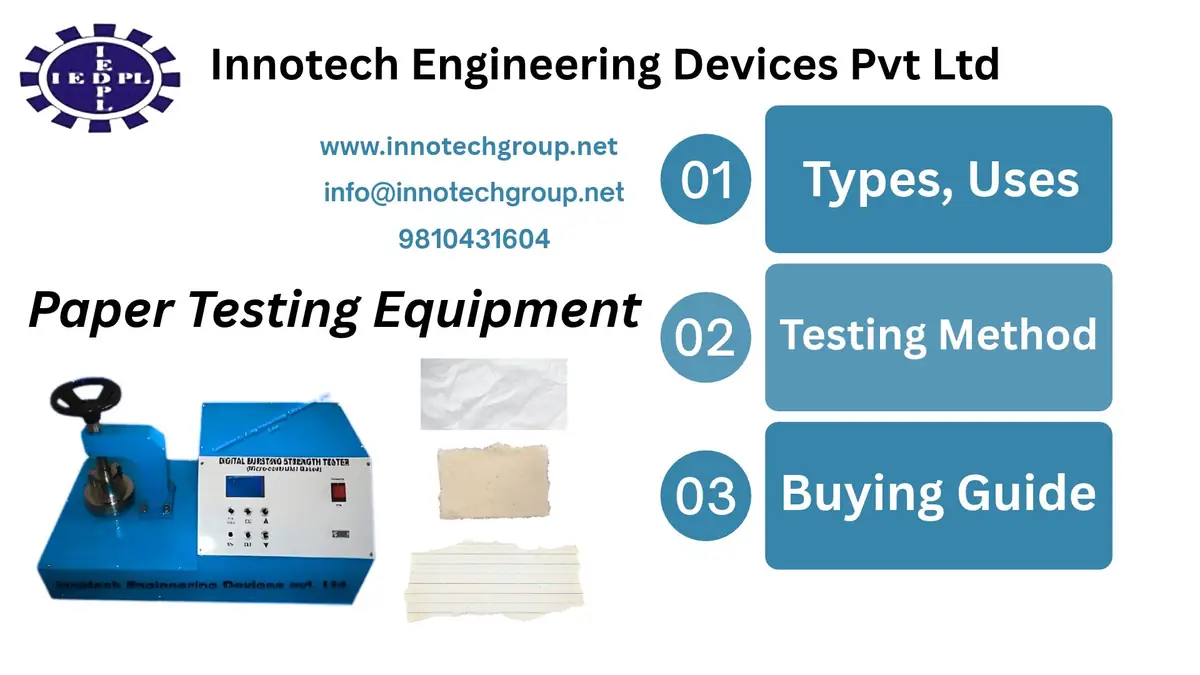
Digital Bursting Strength Testing Machine
Digital Opacity Tester Machine
Paper Testing Equipment: Types, Uses and How to Choose the Right Machine
Have you ever received a paper bag that tears too easily, a carton that gets crushed during transport, or a packaging box that cannot support the weight of the products inside?
These problems can start with the quality of the material. Paper may look good on the surface, but its actual strength, thickness, weight, and resistance to damage can vary.
This is why paper manufacturers, packaging companies, printing businesses, and quality-control laboratories test their materials before using them in production.
Paper testing equipment helps measure different properties of paper, paperboard, corrugated sheets, and related packaging materials. The results help manufacturers understand whether a material is suitable for its intended purpose.
For example, a packaging company may need to check the bursting strength of paperboard, the compression strength of a corrugated box, or the grammage of a paper sheet. Each test answers a different question, so selecting the right testing machine is important.
In this article, we will explain the common types of paper testing equipment, what each machine checks, why testing matters, how testing is performed, and what to consider when purchasing equipment from a manufacturer or supplier in India.
What Is Paper Testing Equipment?
Paper testing equipment includes machines and instruments used to evaluate the physical and mechanical properties of paper and paper-based products.
Depending on the test, the equipment may measure strength, thickness, grammage, tearing resistance, bursting resistance, folding endurance, or other properties.
The results help users compare materials, check production quality, investigate defects, and decide whether a paper grade is suitable for a particular application.
For example, the requirements for writing paper are different from those for corrugated packaging. A printing company may be concerned about paper thickness, grammage, and surface quality, while a packaging manufacturer may focus more on compression strength, bursting strength, and resistance to tearing.
There is no single machine that checks every property of paper. The correct equipment depends on the material and the test you need to perform.
Why Is Paper Testing Important?
Paper quality affects how a product performs during printing, handling, storage, packaging, and transportation.
Testing helps businesses identify problems before they affect finished products or reach customers.
Here are some common reasons for testing paper and packaging materials.
1. To Check Material Strength
Paper and paperboard must have suitable strength for their intended use. Testing can help evaluate whether the material meets the required specifications.
2. To Reduce Packaging Problems
Weak cartons may become damaged during stacking or transportation. Suitable testing helps manufacturers assess packaging performance under defined test conditions.
3. To Maintain Consistent Quality
Paper properties can vary between production batches. Regular testing helps quality-control teams identify variations and compare results with their acceptance limits.
4. To Select the Right Material
Different products require different paper grades. Test results help buyers compare materials before selecting them for a particular application.
5. To Support Product Development
Manufacturers can compare new raw materials, paper grades, and packaging designs to understand how changes affect performance.
6. To Investigate Customer Complaints
When paper tears, packaging collapses, or printed products show quality problems, testing can help identify possible material-related causes. Additional investigation may be needed to establish the actual reason.
Types of Paper Testing Equipment and Their Uses
Different tests measure different properties. Before choosing a machine, understand what you need to measure and how the result will be used.
| Equipment | What It Tests |
Common Application |
| Paper Grammage (GSM) Tester | Mass per unit area of paper | Paper production, printing and packaging |
| Paper Thickness Tester | Thickness of paper or paperboard | Material comparison and quality control |
| Paper Bursting Strength Tester | Resistance to bursting pressure | Paper, paperboard and suitable packaging materials |
| Paper Tensile Strength Tester | Resistance to tensile loading | Paper strength and elongation evaluation |
| Paper Tearing Strength Tester | Resistance to tearing under a specified method | Paper quality and material comparison |
| Folding Endurance Tester | Resistance to repeated folding | Suitable papers used in printing and other applications |
| Ring Crush Tester | Edgewise compressice resistancce of a prepared paper specimen | Paperboard and corrugated packaging evaluation |
| Box Compression Tester | Compression perfromance of a box or carton | Packaging and transport assessment |
| Cobb Tester | Water absorption under defined test conditions | Paper, paperboard and packaging materials |
Important: These machines do not perform interchangeable tests. For example, a GSM tester measures mass per unit area, while a bursting strength tester evaluates resistance to bursting pressure. Choose equipment based on the property you need to measure and the applicable test method.
What Is GSM Testing in Paper?
GSM stands for grams per square metre. It describes the mass of paper per unit area.
For example, two paper samples may have the same dimensions but different GSM values. The sample with the higher GSM has more mass per square metre, but that does not automatically mean it has greater strength.
GSM testing is useful when manufacturers need to check whether the paper meets the required grammage.
It is commonly used for:
• Writing and printing paper.
• Paper bags.
• Packaging paper.
• Paperboard and selected paper-based materials.
• Comparing paper batches during production.
GSM is only one part of paper quality. Thickness, fibre composition, moisture, and manufacturing conditions can also affect performance.
What Is Bursting Strength Testing?
Bursting strength testing evaluates the pressure a paper or suitable paperboard specimen can withstand before it bursts under a specified test method.
This test is useful when manufacturers want to compare the bursting resistance of materials used in paper products and packaging.
It may help with:
• Comparing different paper grades.
• Checking material consistency.
• Evaluating selected packaging materials.
• Supporting incoming-material inspection.
• Investigating material performance issues.
The correct test method, specimen preparation, and equipment configuration depend on the material and applicable standard. A bursting strength result should not be treated as a direct substitute for a box compression result.
What Is Box Compression Testing?
Box compression testing evaluates how a box or carton responds when a compressive load is applied under controlled conditions.
Think about cartons stacked on top of one another in a warehouse or during transport. The lower cartons must support the load placed above them. If a box is too weak for its intended use, it may deform or collapse.
A box compression tester helps measure the load response of a box and determine when it reaches a defined failure condition.
It is useful for:
• Corrugated box manufacturers.
• Packaging companies.
• E-commerce packaging suppliers.
• Warehousing and logistics operations.
• Quality-control and packaging laboratories.
The result depends on the box design, dimensions, board construction, moisture condition, and test procedure. It should be interpreted according to the intended packaging application.
How Is Paper Testing Performed?
The testing procedure depends on the machine and the property being measured. However, most paper testing follows a few basic steps.
Step 1: Identify the Material
Determine whether the sample is paper, paperboard, corrugated board, or another paper-based material.
Step 2: Select the Required Test
Decide whether you need to measure grammage, thickness, tensile strength, bursting strength, tearing resistance, or another property.
Step 3: Prepare the Specimen
Cut or prepare the sample according to the selected test method. Incorrect specimen dimensions can affect the result.
Step 4: Check the Testing Equipment
Ensure that the machine is suitable for the test and that its condition, measurement system, and calibration status are appropriate.
Step 5: Set Up the Test
Mount the specimen correctly and configure the required test settings according to the machine instructions and test procedure.
Step 6: Perform the Test
Run the test following the applicable procedure. Avoid changing test conditions between samples when comparing their results.
Step 7: Record the Results
Record the measured values, sample identification, test conditions, and any relevant observations.
Step 8: Compare the Results
Compare the results with the material specification, customer requirement, or applicable acceptance criteria.
For reliable comparisons, specimen preparation, conditioning, and testing conditions should be consistent and appropriate for the selected method.
What Should You Check Before and After Paper Testing?
Good testing starts before the machine is switched on. Small mistakes in sample preparation or setup can affect the results.
Before testing:
• Confirm the material type and test objective.
• Check the specimen dimensions and preparation requirements.
• Follow the required conditioning procedure where applicable.
• Inspect the machine and test fixtures.
• Verify the measurement system and calibration status.
• Confirm the correct test method and settings.
• Record the sample identification.
After testing:
• Record the result and relevant test conditions.
• Inspect the specimen for the expected failure or response.
• Check for any unusual result or testing issue.
• Compare the result with the required acceptance criteria.
• Retain the records for quality control and future comparison.
• Clean and maintain the equipment according to its operating instructions.
If a result looks unusual, repeat the test only when appropriate under the relevant procedure. Do not discard an unexpected result without investigating the possible cause.
Which Industries Use Paper Testing Equipment?
Paper testing is relevant wherever paper or paper-based materials are manufactured, converted, printed, or used for packaging.
Paper and Paperboard Manufacturing
Manufacturers use testing to monitor material properties and maintain consistency between production batches.
Corrugated Box Manufacturing
Packaging manufacturers evaluate board and box performance to help ensure that cartons meet the required strength and transport needs.
Printing and Publishing
Printing businesses may check grammage, thickness, and other relevant paper properties to ensure the material is suitable for the intended printing process.
Flexible and Protective Packaging
Companies using paper-based packaging may test relevant strength and absorption properties, depending on the product and packaging design.
E-commerce and Logistics
Businesses that depend on cartons for storage and transportation may use packaging test results to compare box designs and material choices.
Research and Quality-Control Laboratories
Laboratories use suitable testing instruments to evaluate paper properties, compare materials, and support product development.
How to Choose the Right Paper Testing Equipment
Buying a machine without first defining the test requirement can lead to unnecessary expense or equipment that does not meet your needs.
Before purchasing paper testing equipment, consider the following points.
1. Identify the Property You Need to Measure
Start with the test requirement. Do you need GSM, thickness, bursting strength, tensile strength, tearing resistance, or box compression? Each requirement may need a different instrument.
2. Confirm the Material Type
Paper, paperboard, corrugated board, and finished cartons have different testing needs. Share the material details with the supplier.
3. Check the Applicable Test Standard
If your customer, laboratory, or industry requires a particular ASTM, ISO, TAPPI, or other test method, confirm the exact standard and edition. Ask the supplier to explain how the proposed equipment meets the required procedure.
4. Review the Measurement Requirements
Ask about the measurement range, resolution, accuracy, specimen dimensions, fixtures, and result display required for your test. Confirm these details against the applicable method rather than choosing a machine based only on its advertised features.
5. Consider Daily Testing Volume
A laboratory testing a few samples each day may have different operating needs from a production facility checking many samples per shift.
6. Ask About Calibration and Service
Check the availability of calibration support, maintenance, spare parts, operator training, and technical assistance.
7. Request a Clear Quotation
The quotation should explain what is included, such as the machine, standard accessories, fixtures, software if applicable, installation, training, warranty, and other charges.
8. Compare Suppliers on Technical Suitability
Do not compare suppliers on price alone. Check whether they understand the test, can provide the required configuration, and offer clear support after the purchase.
How to Find a Reliable Paper Testing Equipment Manufacturer in India
If you are searching for a paper testing equipment manufacturer or supplier in India, start by preparing a clear description of your testing requirement.
A suitable supplier should be able to discuss the test method, specimen details, machine configuration, measurement needs, and relevant standards.
Before finalizing your order, ask these questions:
• Does the supplier understand the property I need to test?
• Can the proposed equipment perform the required test method?
• Are the measurement range and fixtures suitable for my samples?
• What calibration documents or support are available?
• What training, maintenance, and after-sales services are provided?
• Are the delivery terms, warranty, and included accessories clearly listed?
• Can the supplier explain the limitations of the equipment?
You can also request a demonstration, sample test, or technical discussion where practical. For specialized requirements, sharing a sample, drawing, or test procedure may help the manufacturer recommend a more suitable setup.
Paper Testing Equipment Manufacturer and Supplier in Bhiwadi, Rajasthan
Innotech Engineering Devices Private Limited provides testing equipment for industrial, laboratory, and quality-control applications. If you are planning to purchase paper testing equipment, discuss the required test and material application with the team before selecting a machine.
When making an enquiry, share:
• The type of paper or packaging material.
• The property you need to measure.
• The required test method or standard, if known.
• The specimen dimensions and expected testing volume.
• Any requirements for digital display, data recording, or reporting.
This information helps clarify the equipment requirements and allows the proposed configuration to be reviewed against your testing needs.
Explore the Paper Testing Equipment category or contact Innotech Engineering Devices Private Limited to discuss your application.
Contact details
• Phone: +91 9810431604
• Email: info@innotechgroup.net
• Website: www.innotechgroup.net
• Location: Bhiwadi, Rajasthan, India
Frequently Asked Questions
What is paper testing equipment used for?
It is used to evaluate properties such as grammage, thickness, tensile strength, tearing resistance, bursting strength, and other characteristics of paper and paper-based materials.
Which paper testing machine is best for packaging?
It depends on the packaging material and the property you need to measure. A box compression tester may be suitable for evaluating carton compression performance, while a bursting strength tester evaluates resistance to bursting pressure. Some applications require multiple tests.
Why is GSM testing important?
GSM testing measures the mass per unit area of paper. It helps manufacturers check material consistency and verify whether the paper meets a specified grammage requirement.
Can one machine test every paper property?
No. Different properties require different testing methods and equipment. Select machines according to the test requirements.
Do paper testing machines need calibration?
Measurement systems should be checked and calibrated as appropriate for the instrument, test method, quality system, and applicable requirements. Follow the manufacturer's recommendations and laboratory procedures.
What information is required to buy paper testing equipment?
You should provide the material type, required test, applicable standard, specimen dimensions, measurement requirements, expected testing volume, and any reporting needs.
How can I choose a paper testing equipment supplier in India?
Look for a supplier who understands your test requirement, provides a suitable machine configuration, explains the applicable test method, and offers clear information about calibration, training, maintenance, and after-sales support.
Conclusion
Paper testing is an important part of manufacturing and packaging quality control. It helps businesses understand how paper and paper-based materials perform and whether they meet the requirements of their intended application.
The right testing equipment depends on the property being measured. Before purchasing a machine, identify your test requirement, confirm the applicable method, and compare suppliers on technical suitability and support—not just price.
If you need help selecting paper testing equipment for your laboratory, paper mill, packaging unit, or quality-control department, contact Innotech Engineering Devices Private Limited to discuss your requirements.
Consult to Expert
Phone: +91 9810431604
Email: info@innotechgroup.net
Website: www.innotechgroup.net
Category: Paper Testing Equipment
Tags: Paper Testing Equipment, Paper Testing Machine, Paper Quality Testing, Paper Strength Testing, Paperboard Testing, Packaging Material Testing, Bursting Strength Tester, Box Compression Testing, Paper Thickness Tester, GSM Tester, Paper Tensile Testing, Co
Last Updated: 09 October 2026