
One Machine, Many Tests: Understanding the Testing Power of a Universal Testing Machine
Jay Pal Singh
06 October 2026
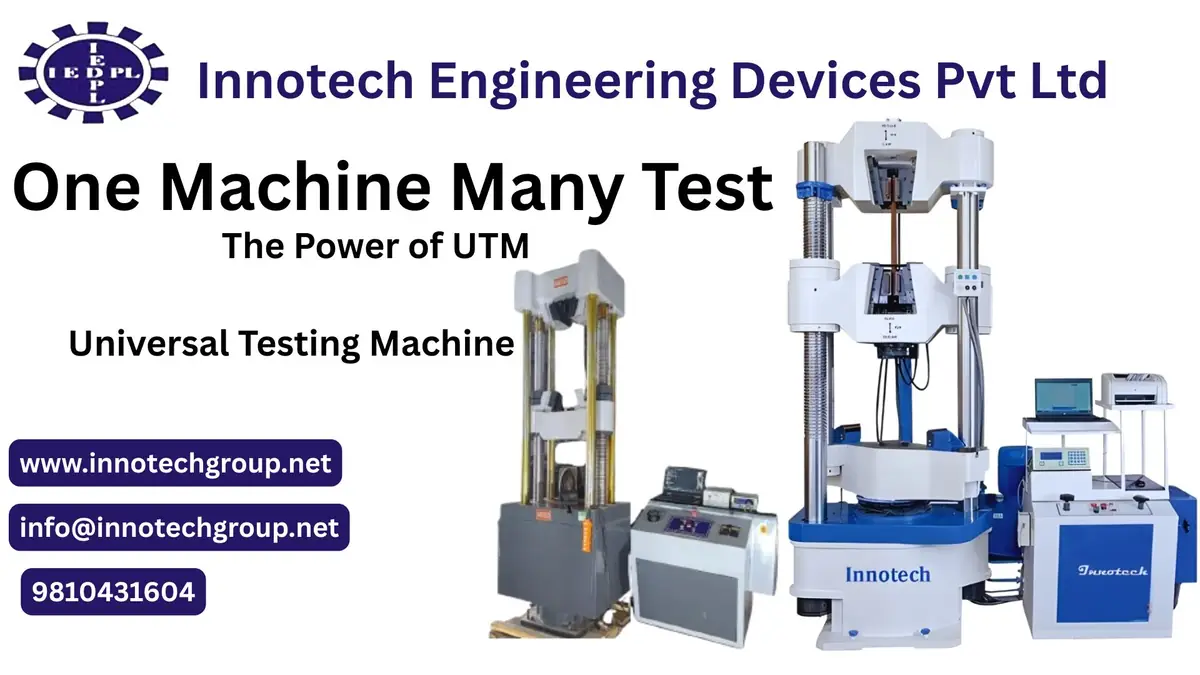
One Machine, Many Tests: Understanding the Testing Power of a Universal Testing Machine
A Universal Testing Machine (UTM) is one of the most versatile machines used in mechanical and material testing.
Unlike a single-purpose testing machine designed for one specific test, a UTM can be configured for different types of mechanical testing by using suitable grips, fixtures, load cells, extensometers and test controls.
Depending on the configuration, a UTM can be used for tensile, compression, bending, flexural and other application-specific tests.
This flexibility is one of the main reasons UTMs are widely used in manufacturing, quality-control laboratories, research facilities and material-testing laboratories.
What Makes a Universal Testing Machine "Universal"?
The word universal refers to the ability of the testing system to perform different tests using appropriate accessories and configurations.
The basic machine provides controlled force and movement. Different fixtures and measurement systems can then be used for different applications.
For example:
Tensile testing → Tensile grips
Compression testing → Compression platens
Flexural testing → Bending fixture
Special component testing → Application-specific fixture
The machine therefore becomes a testing platform that can be adapted to different requirements.
1. Tensile Testing
Tensile testing is one of the most common applications of a UTM.
In a tensile test, a specimen is held between suitable grips and subjected to a controlled pulling force.
Depending on the test setup, the machine can measure parameters such as:
* Maximum force
* Tensile strength
* Elongation
* Extension
* Yield behaviour
* Stress-strain response
Suitable grips and measurement equipment are selected according to the material and testing procedure.
2. Compression Testing
Compression testing evaluates how a material or component behaves when subjected to compressive force.
The specimen is positioned between suitable compression platens and loaded under controlled conditions.
Compression testing can be relevant to materials and products such as:
* Plastics
* Rubber
* Foam
* Construction materials
* Metals
* Composite materials
* Components
The appropriate compression fixture and loading arrangement depend on the specimen and test method.
3. Flexural and Bend Testing
A UTM can also perform flexural or bending tests when fitted with the appropriate fixture.
Common configurations include three-point and four-point bending arrangements.
During the test, the specimen is supported at defined positions while force is applied through the loading fixture.
The resulting force and displacement can be used to evaluate the material's response to bending.
4. Shear and Other Tests
With appropriate fixtures, a UTM may also be configured for certain shear, peel, tear, puncture, loading or component tests.
However, the fact that a machine is called a UTM does not automatically mean that every possible test can be performed.
The load capacity, machine travel, fixture design, load cell, control system and measurement arrangement must be suitable for the particular test.
The Fixture Can Change the Test
The testing frame is only one part of the complete testing system.
Fixtures connect the machine to the specimen.
For example:
| Test |
typical Fixture Arrangement |
| Tensile | Tensile grips |
| compression | Compression Platens |
| three pointed bend | Bending fixture |
| Four point bend | Four point bending fixture |
| Shear | Application specifix shear fixture |
| peel | peel fixture |
| component testing | customized fixture |
This means that choosing a UTM should involve more than simply selecting the maximum force capacity.
Load Cell Selection Matters
The load cell measures the force applied during the test.
A machine may be capable of a particular maximum load, but the appropriate load-measuring range should also be considered for the intended test.
For example, a laboratory may perform both relatively low-force material tests and higher-force component tests. Different load-cell configurations may therefore be considered depending on the testing program.
The right load measurement range should be discussed with the machine manufacturer based on the actual test requirements.
Extensometers and Strain Measurement
Some tensile and material tests require more than force measurement.
An extensometer or other strain-measurement system can be used to measure specimen deformation over a defined gauge length.
Depending on the application, strain measurement can help determine properties such as elongation and modulus.
The type of extensometer should be selected according to the material, specimen geometry and applicable test method.
What Can a UTM Actually Tell You?
A UTM does not simply provide a single "strength" number.
Depending on the test and instrumentation, it can provide information about:
* Applied force
* Displacement
* Extension
* Deformation
* Tensile strength
* Compressive behaviour
* Flexural response
* Elongation
* Yield behaviour
* Load at failure
* Stress-strain behaviour
The exact result depends on the test method, specimen dimensions, instrumentation and calculation procedure.
One Machine Can Serve Different Departments
A UTM can be useful when a company or laboratory performs different mechanical tests.
For example, a material-testing laboratory may use the same basic machine for tensile testing in one application and compression or bending testing in another, provided the machine and accessories are suitable.
This can reduce the need for separate dedicated equipment for every mechanical test.
Industries Using Universal Testing Machines
UTMs can be found in many industries and laboratories, including:
Automotive
Testing automotive materials, components and assemblies using suitable fixtures.
Plastics and Polymers
Evaluating tensile, compression and flexural behaviour of suitable plastic and polymer specimens.
Metals
Testing metallic specimens and components for mechanical properties.
Construction Materials
Testing suitable construction materials and components using appropriate fixtures and capacities.
Rubber and Elastomers
Performing suitable tensile and other mechanical tests on rubber materials.
Packaging
Testing suitable films, packaging materials and components with application-specific fixtures.
Research and Development
Comparing new materials, formulations, manufacturing processes and product designs.
How to Choose the Right UTM
Before purchasing a Universal Testing Machine, consider more than the maximum load capacity.
Important factors include:
1. Required testing force
2. Material being tested
3. Test types required
4. Specimen dimensions
5. Test speed
6. Crosshead travel
7. Load-cell range
8. Required grips and fixtures
9. Strain measurement requirements
10. Control method
11. Data acquisition requirements
12. Applicable test method
13. Safety requirements
14. Future testing requirements
A properly specified machine should match the complete testing program.
Can One UTM Replace Every Testing Machine?
Not necessarily.
A UTM is highly versatile, but each test requires suitable hardware and configuration.
For example, a tensile test may require a specific grip, while a flexural test requires a bending fixture. High-temperature testing may require an environmental chamber or furnace, while specialized component testing may require custom fixtures.
Therefore, the better question is not "How many tests can a UTM perform?"
The better question is:
"Which tests can this particular UTM configuration perform reliably?"
Innotech Universal Testing Machine Solutions
Innotech Engineering Devices Private Limited provides Universal Testing Machine solutions for industrial and laboratory applications in India.
The machine configuration can be discussed according to:
* Required testing capacity
* Tensile testing requirements
* Compression testing requirements
* Bending or flexural testing
* Specimen dimensions
* Grips and fixtures
* Extensometer requirements
* Control system
* Data acquisition
* Application-specific testing requirements
This approach allows the UTM to be configured around the customer's actual testing program rather than selecting a machine based only on its maximum capacity.
Conclusion
A Universal Testing Machine can be much more than a tensile testing machine.
With the right combination of load cell, grips, fixtures, measurement systems and control software, a suitable UTM can support multiple mechanical testing applications from one testing platform.
For laboratories and manufacturers performing different types of mechanical testing, this flexibility can make the UTM an important part of their testing setup.
Before selecting a machine, however, the complete test requirement should be evaluated so that the machine capacity and accessories match the intended applications.
Innotech Engineering Devices Private Limited manufactures and supplies testing equipment and application-specific testing solutions in India.
Website: www.innotechgroup.net
Email: info@innotechgroup.net
Phone: 9810431604
Category: Universal Testing Machine
Tags: universal testing machine, UTM machine, universal testing machine India, UTM testing machine, tensile testing machine, compression testing machine, flexural testing machine, bending test machine, material testing machine, mechanical testing machine, tensi
Last Updated: 06 October 2026