
Muffle Furnace: Working Principle, Uses, Temperature, Specifications & Industry Standards
Jay Pal Singh
23 November 2026
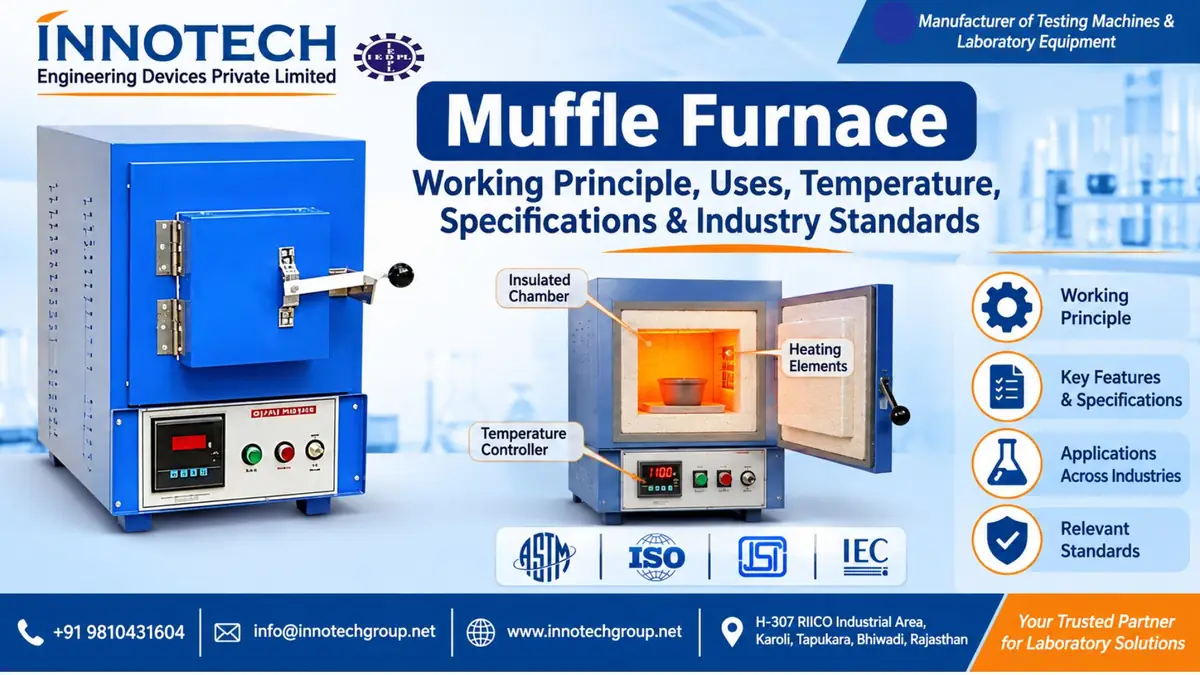
Muffle Furnace: Working Principle, Uses, Temperature, Specifications & Industry Standards
A Muffle Furnace is a high-temperature laboratory heating instrument used for ash content determination, loss on ignition, heat treatment, calcination, and material testing. It provides controlled heating inside an insulated chamber, making it useful for laboratories, research institutions, quality control departments, and manufacturing industries.
Understanding the muffle furnace working principle, temperature range, specifications, and applications helps laboratory professionals select suitable equipment and achieve repeatable testing results.
What Is a Muffle Furnace?
A muffle furnace is an electrically heated laboratory furnace designed to expose samples to high temperatures without direct contact with heating elements or fuel combustion gases.
The sample is placed inside a heat-resistant chamber surrounded by thermal insulation. Electrical resistance heating elements generate heat, while a temperature controller regulates the process using feedback from a thermocouple.
Unlike ordinary laboratory ovens, muffle furnaces are designed for high-temperature processes such as ignition, ashing, calcination, and heat treatment.
Most general-purpose electric muffle furnaces operate in air. They do not automatically provide an oxygen-free or inert atmosphere.
Muffle Furnace Working Principle
The working principle of a muffle furnace is based on electrical resistance heating, heat transfer, thermal insulation, and automatic temperature control.
When electrical current passes through the heating elements, electrical energy is converted into thermal energy. Heat is transferred to the chamber and samples through radiation, convection, and conduction.
Step-by-Step Working Process
1. Sample loading: The laboratory sample is placed in a suitable ceramic, quartz, or other method-compatible crucible.
2. Temperature setting: The operator selects the required temperature and, where supported, heating rate and holding time.
3. Electrical heating: Resistance heating elements convert electrical energy into heat.
4. Heat transfer: Thermal energy heats the furnace chamber and sample.
5. Temperature monitoring: A thermocouple measures temperature and sends feedback to the controller.
6. Automatic regulation: The controller adjusts heater power to maintain the programmed temperature.
7. Holding period: The sample remains at the required temperature for the specified duration.
8. Cooling and removal: After the cycle, the sample is cooled and handled according to the applicable laboratory procedure.
The actual sample temperature may differ from the controller reading during heating. Proper loading, furnace uniformity, and temperature verification are important for accurate results.
Main Components of a Muffle Furnace
A typical laboratory muffle furnace consists of the following components.
| Component |
Function |
| Furnace chamber | Holds samples during heating |
| Heating elements | Generate heat through electrical resistance |
| Thermal insulation | Reduces heat loss and improves thermal efficiency |
| Thermocouple | Measures furnace temperature |
| Digital temperature controller | Regulates heating and temeperature |
| Furnace door | Provides access to the chamber |
| Outer enclosure | Supports and protects the furnace assembly |
| Electrical control system | Controls heater power and elctrical protection |
| Exhaust or vent | Hepls remove gases where the design requires it |
| Over-temperature protection | Helps prevent uncontrolled overheating |
Muffle Furnace Diagram
A labelled muffle furnace diagram should show the insulated heating chamber at the centre, heating elements around the chamber, a thermocouple, temperature controller, electrical supply, door, insulation, and optional exhaust outlet.
The diagram should distinguish between the heating-element location and the sample chamber. Their physical arrangement varies by furnace design.
Muffle Furnace Temperature Range
The maximum temperature of a muffle furnace depends on its heating elements, insulation, chamber construction, and electrical design.
| Furnace Class |
Typical Rated Maximum Temperature |
Common Applications |
| General laboratory furnace | 1000–1100°C |
Ash testing, ignition, routine heating |
| High-temperature laboratory furnace | 1200°C |
Calcination, laboratory heat treatment, material testing |
| Advanced laboratory furnace | 1400°C |
Ceramics, specialized heat treatement |
| Specialized high-temperature furnace | 1600–1800°C |
Advanced ceramics, sintering, research |
These are broad equipment categories, not guaranteed operating capabilities for any particular model.
Important: Maximum rated temperature and recommended continuous operating temperature are not necessarily identical. Users should check the manufacturer's operating limits before selecting a furnace for prolonged heating cycles.
Muffle Furnace Temperature for Ash Content
One of the most important muffle furnace uses is ash content determination.
Ash content testing measures the residue remaining after a sample undergoes controlled heating and oxidation. The result is commonly expressed as a percentage of the original sample mass on the basis required by the test method.
The correct furnace temperature depends on the material and applicable standard.
| Material / Test |
Reference Standard |
Specified Temperature or Requirement |
| Solid biofuels | ISO 18122:2022 | 550 ± 10°C standard final temperature |
| Biomass | ASTM E1755-24 | 575 ± 25°C |
| Coal and coke | ASTM D3174 | Controlled ashing procedure, use the temperature profile prescribed by the method |
| Solid material fuels | ISO 1171:2024 | Ash determines under the prescribed method conditions |
| Hydraulic cement | ASTM C114-24 | Loss on ignition and other chemical analyses, follow the applicable procedure |
A temperature used for one material should not automatically be applied to another. Heating rate, sample mass, crucible type, atmosphere, holding time, and weighing procedure can affect the measured result.
How Is Ash Content Calculated?
For a basic gravimetric ash determination:
Ash Content (%) = (Mass of Ash ÷ Initial Sample Mass) × 100
The initial sample mass must use the correct dry, air-dried, or other specified basis.
For example, if a sample has a relevant initial mass of 5.00 g and leaves 0.25 g of ash:
Ash Content = (0.25 ÷ 5.00) × 100 = 5%
This example illustrates the calculation only. Actual laboratory testing must follow the applicable standard.
Muffle Furnace Uses and Applications
Muffle furnaces support numerous laboratory and industrial processes.
1. Ash Content Determination
Used to measure inorganic residue remaining after controlled oxidation of suitable materials.
2. Loss on Ignition (LOI)
Used to determine mass loss during heating, which may result from moisture, volatile substances, decomposition, and other reactions. LOI is not always equivalent to organic content.
3. Heat Treatment of Metals
Suitable furnace configurations can be used for annealing, tempering, and other controlled thermal processes involving small metal components.
4. Calcination
Used to heat minerals, chemicals, and powders to promote thermal decomposition or other intended transformations.
5. Ceramic and Material Research
High-temperature models can support ceramic processing, firing, and sintering experiments where their atmosphere and temperature capabilities are suitable.
6. Quality Control Testing
Laboratories use furnaces to perform standardized heating and residue determination procedures.
Applications Across Different Industries
| Industry |
Application |
Purpose |
| Coal and mining | Ash determination | Evaluate mineral residue |
| Cement | Loss on ignition | Support chemical quality control |
| Biomass and biofuels | Ash content testing | Assess inorganic residue |
| Steel and metallurgy | Heat treatment | Study or modify material properties |
| Ceramics | Firing and calcination | Process ceramic materials |
| Chemicals | Thermal processing | Support controlled decomposition |
| Universities | Laboratory experiments | Teaching and research |
| Material testing laboratories | High-temperature sample preparation | Support analytical procedures |
| Manufacturing | Process and QC testing | Verify material characteristics |
Types of Muffle Furnaces
Different muffle furnace configurations are available for different applications.
Standard electric muffle furnace: Suitable for routine laboratory heating, ignition, and general testing.
Digital muffle furnace: Uses an electronic temperature controller with digital indication.
Programmable muffle furnace: Supports programmed heating ramps and holding periods, depending on controller capabilities.
Ashing furnace: Designed for ash determination, with ventilation or exhaust arrangements appropriate to the process.
High-temperature muffle furnace: Uses suitable heating elements and refractory materials for higher-temperature applications.
Customized muffle furnace: Designed around specified chamber dimensions, operating temperature, sample loading, electrical supply, and process requirements.
Important Muffle Furnace Specifications
When comparing laboratory furnaces, review the following technical parameters.
| Parameter |
What It Means |
Why It Matters |
| Maximum temperature | Highest rated operating temperature | Determines process suitability |
| Continuous operating temperature | Permitted sustained operating condition | Important for long heating cycles |
| Chamber dimensions | Internal usable width, depth, and height | Determines sample capacity |
| Heating elements | Type and temperature capability | Affects heating performance |
| Temperature controller | Digital or programmable control | Supports process repeatability |
| Thermocouple | Temperature-sensing device | Provides control feedback |
| Temperature stability | Variation overtime at a defined point | Important for controlled heating |
| Temeprature uniformity | Temperature variation across the working space | Affects sample consistency |
| Heating rate | Temperature rise per unit time | Important for test methods |
| Power supply | Electrical voltage, phase, and load | Determines installation requirements |
| Insulation | Thermal protection around chamber | Reduces heat loss |
| Safety system | Protective controls and interlocks | Supports safer operation |
Buyers should request measured performance figures and their test conditions rather than relying only on general claims of accuracy or uniformity.
Relevant Muffle Furnace Industry Standards
A muffle furnace may be used as equipment within a standardized test procedure. This does not mean the furnace itself is certified to that standard.
| Standard |
Material / Test |
Purpose |
Furnace Application |
| ASTM D3174 | Coal and coke | Ash determination | Controlled ignition and residue measurement |
| ASTM E1755-24 | Biomass | Ash content determination | Dry oxidation at 575 ± 25°C |
| ISO 18122:2022 | Soid biofuels | Ash determination | Controlled heating, normally to 550 ± 10°C |
| ISO 1171:2024 | Solid mineral fuels | Ash determination | Controlled heating according to the method |
| ASTM C114-24 | Hydraulic cement | Chemical analysis, including LOI | Ignition and residue-related procedures |
Laboratories should consult the complete current standard for exact temperature programs, tolerances, sample preparation, holding periods, and reporting requirements.
Muffle Furnace vs Laboratory Hot Air Oven
| Feature |
Muffle Furnace |
Hot Air Oven |
| Main purpose | High-temperature heating and ignition | Drying and lower-temperature heating |
| Temperature capability | Typically 1000*C or higher in common models | Generally much lower |
| Common applications | Ashing, calcination,heat treatment | Drying, conditioning, moisture removal |
| Chamber design | High-temperature refractory insulation | Insulated chamber designed for lower temperatures |
| Heating process | High-temperature resistance heating | Controlled heated air and thermal transfer |
A hot air oven should not be substituted for a muffle furnace when the test method requires high-temperature ignition.
How to Select the Right Muffle Furnace
Before choosing a furnace, consider:
- Material and test method: Identify the sample and applicable standard.
- Operating temperature: Determine the highest required process temperature.
- Chamber dimensions: Check sample and crucible sizes, including clearance.
- Temperature performance: Review stability, uniformity, and verification requirements.
- Controller: Decide whether simple setpoint control or programmable heating cycles are necessary.
- Electrical supply: Confirm available voltage, phase, and electrical capacity.
- Ventilation: Consider gases, smoke, and exhaust requirements.
- Safety: Review over-temperature protection, installation clearances, and handling procedures.
- Calibration: Determine the temperature verification requirements for your laboratory.
- Maintenance: Confirm service support and availability of replacement heating elements.
Muffle Furnace Maintenance and Safety
Inspect heating elements, chamber insulation, electrical connections, and temperature sensors according to the manufacturer's maintenance instructions.
Avoid overloading the chamber or allowing samples to contact heating elements. Use temperature-rated crucibles, tongs, gloves, and other protective equipment.
Do not heat sealed containers, unknown reactive materials, or substances that may release hazardous gases without an approved procedure and suitable safety controls.
Frequently Asked Questions
What is a muffle furnace used for?
A muffle furnace is used for ash determination, loss on ignition, calcination, heat treatment, sample preparation, and high-temperature laboratory research.
What is the working principle of a muffle furnace?
It uses electrical resistance heating to generate heat inside an insulated chamber. A thermocouple and controller regulate the temperature.
What temperature is used for ash content testing?
It depends on the sample and test standard. ISO 18122:2022 specifies a standard final temperature of 550 ± 10°C for solid biofuels, while ASTM E1755-24 specifies 575 ± 25°C for biomass.
What is the maximum temperature of a muffle furnace?
Common laboratory models are rated around 1000–1200°C, while specialized models may reach 1400–1800°C.
What are the main components of a muffle furnace?
The main components include the chamber, heating elements, insulation, thermocouple, temperature controller, door, electrical controls, and safety devices.
What is the difference between a muffle furnace and an oven?
A muffle furnace is designed for high-temperature processes such as ignition and calcination. A laboratory oven is generally intended for drying and lower-temperature heating.
Which industries use muffle furnaces?
Coal, cement, chemicals, metallurgy, ceramics, research institutions, universities, and material testing laboratories use muffle furnaces.
What specifications should be checked before purchasing?
Check maximum and continuous operating temperature, chamber size, heating elements, controller, uniformity, stability, electrical supply, ventilation, safety, and calibration requirements.
Conclusion
A muffle furnace is essential for many controlled high-temperature laboratory and industrial testing processes. Selecting the correct furnace requires an understanding of the sample material, test method, temperature requirements, chamber capacity, heating performance, and applicable industry standards.
Innotech Engineering Devices Private Limited, an manufacturer of testing machines and laboratory equipment based in Bhiwadi, Rajasthan, India, provides laboratory equipment solutions for industrial and research applications.
For muffle furnace technical specifications, application guidance, and customized requirements, contact our team.
Email: info@innotechgroup.net
Phone: +91 9810431604
Category: Furnaces
Tags: muffle furnace working principle, muffle furnace, what is a muffle furnace, muffle furnace uses, muffle furnace temperature, muffle furnace diagram, muffle furnace specifications, muffle furnace for ash content, laboratory muffle furnace, electric muffle
Last Updated: 23 November 2026