
Laboratory Muffle Furnace Specifications: What to Check Before Buying
Jay Pal Singh
03 October 2026
Laboratory Muffle Furnace Specifications: What to Check Before Buying
Choosing a laboratory muffle furnace involves more than checking its maximum temperature. The chamber must accommodate your samples, the temperature range must suit your procedure, and the control system must support your laboratory's operating requirements.
A furnace selected without considering these factors may not be suitable for the intended application, even if its advertised temperature appears sufficient.
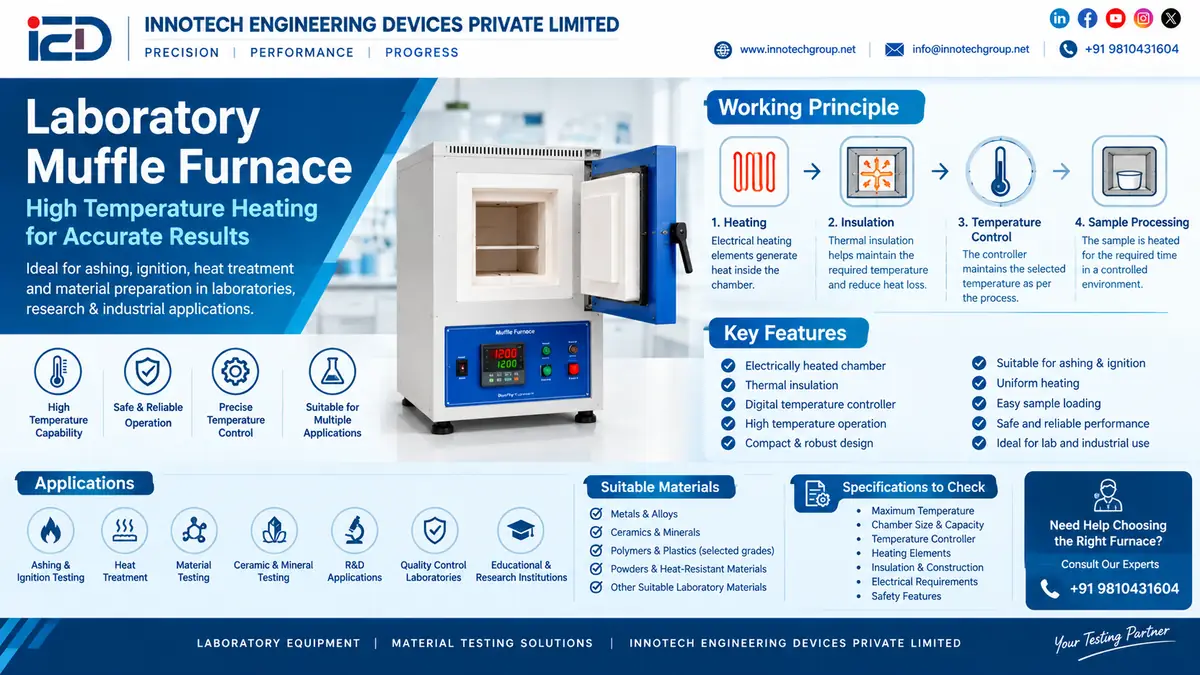
A Laboratory Muffle Furnace is an electrically heated laboratory instrument used for controlled high-temperature heating, ashing, ignition, sample preparation and other suitable thermal processes. It is used in material testing laboratories, research facilities, educational institutions and quality-control departments.
This guide explains the important laboratory muffle furnace specifications to review before purchasing equipment and how to match the furnace to your application.
What Is a Laboratory Muffle Furnace?
A laboratory muffle furnace is an electrically heated furnace with an insulated chamber designed to heat samples under specified temperature conditions.
Heating elements generate heat around or within the chamber, while the insulation helps retain heat and reduce heat loss. The sample is placed inside the chamber using a suitable heat-resistant container, such as an appropriate crucible, when required by the test procedure.
Depending on the furnace model and laboratory procedure, applications may include:
- AShing and ignition
- loss-on-ignition procedures
- Sample preparation
- Thermal treatment of suitable materials
- Ceramic and mineral testing
- Research and development
- Quality-control testing
- Educational laboratory experiments
The appropriate furnace depends on the material, required temperature, sample quantity and applicable test method.
Important Laboratory Muffle Furnace Specifications
Before purchasing a furnace, review the following specifications and confirm them with the manufacturer.
1. Maximum Operating Temperature
Maximum operating temperature is one of the first specifications laboratories consider.
The furnace must support the temperature required by the intended procedure. However, the maximum temperature alone does not determine whether the furnace is suitable.
Consider:
- Required operating temperature
- Duration of each heating cycle
- Frequency of use
- Temperature stability requiremens
- Whether the furnance will operate continuously or intermittently
- The manufactuer's recommended by the manufacturer.
Select a model that supports the actual test procedure, with an appropriate operating margin where recommended by the manufacturer.
Important: Do not assume that every muffle furnace reaches the same temperature. Confirm the maximum rated temperature and recommended operating conditions for the specific model.
2. Chamber Dimensions and Capacity
Chamber size determines how much space is available for samples and suitable sample containers.
Before selecting a furnace, measure the dimensions of the items that must fit inside the chamber.
Check:
- Internal chamber width
- Internal chamber height
- Internal chamber depth
- Number and size of samples per cycle
- Crucible or container dimensions
- Required clearance around samples
- Loading and unloading access
A larger chamber is not automatically necessary. Select the capacity according to the number of samples normally processed and the available laboratory space.
3. Temperature Controller and Display
The temperature controller allows the operator to set and monitor the furnace temperature.
Depending on the model, the control system may offer different functions, such as digital temperature indication, programmed heating stages or automatic temperature regulation.
Before purchasing, confirm:
- Controller type
- Temperature setting range
- Display readability
- Set-temperature and actual-temperature indication
- Programmable operation, if required
- Timer or process-hold functions, if required
- Alarm functions, if provided
Do not assume that every furnace includes programmable ramps, timers or data logging. These functions should be confirmed against the supplied configuration.
4. Temperature Uniformity and Measurement Accuracy
Temperature uniformity describes how consistently temperature is distributed within the usable chamber. Temperature measurement accuracy concerns how closely the indicated temperature corresponds to the measured temperature under the specified conditions.
These are different characteristics.
They can matter when a procedure requires consistent heating across several samples or a defined temperature tolerance.
Ask the manufacturer for the available temperature uniformity and measurement specifications. If the application has strict requirements, determine whether temperature mapping or additional verification is needed.
5. Heating Elements
Heating elements generate the heat needed for furnace operation.
The type, placement and rated operating conditions of the heating elements vary by model. They influence the furnace's temperature capability, heating behaviour and maintenance requirements.
Before purchasing, confirm:
- Heating-element type
- Rated temperature suitability
- Availability of replacement elements
- Maintenance requirements
- Recommended operating conditions
The appropriate heating-element arrangement depends on the furnace design and the intended thermal process.
6. Insulation and Chamber Construction
Insulation helps reduce heat loss and supports the furnace's ability to maintain the required operating temperature.
The chamber construction and insulation materials should be suitable for the rated temperature and intended usage.
Consider the following:
- Insulation materials
- Chamber lining
- External surface temperature considerations
- Structural durability
- Maintenance access
- Manufacturer-recommanded handling procedures
Do not compare furnaces on insulation material alone. Review the complete design and operating specifications.
7. Electrical Requirements
A laboratory muffle furnace requires an electrical supply compatible with the machine's rated requirements.
Before installation, confirm:
- Rated voltage
- Phase requirements
- Frequency
- Power consumption or rated input
- Current requirement
- Electrical protection requirements
- Earthing and installation requirements
Do not assume that all laboratory furnaces use the same electrical supply. Arrange installation according to the manufacturer's instructions and applicable electrical safety requirements.
Laboratory Muffle Furnace Specification Checklist
Use this table when comparing suitable furnace models.
| Specification |
What to confirm |
| Maximum operating temperature | Required temperature and rated furnance limit |
| Chamber dimensions | Internal width, height and depth |
| Chamber capacity | Sample quantity and container size |
| Temperature controller | Controller type and available functions |
| Temperature uniformity | Manufaturer's specified performance |
| Temperature measurement | Accuracy and verification requirements |
| Heating elements | Type, rated conditions and replacement availability |
| Insulation | construction and temperature suitablility |
| Electrical supply | Voltage, phase, fequency and rated input |
| Safety features | Confirm the features supplied with the model |
| Installation | Space, ventilation, and electrical requirements |
| Maintenance | Recommended inspection and servicing |
| Documentation | Operating manual and available technical documents |
The exact specifications should be obtained from the official technical datasheet for the model being considered.
Applications of Laboratory Muffle Furnaces
Laboratory muffle furnaces are used in different fields where a suitable high-temperature heating process is required.
Material Testing Laboratories
They can support sample preparation and thermal procedures associated with material evaluation, depending on the applicable test method.
Chemical and Analytical Laboratories
Suitable furnaces may be used for ashing, ignition and other defined analytical procedures.
Ceramic and Mineral Testing
Laboratories can use appropriate furnaces for heating suitable mineral, ceramic and related samples.
Educational Institutions
Engineering, science and technical institutions may use muffle furnaces for laboratory demonstrations and experiments.
Research and Quality Control
Research teams and quality-control departments can use furnaces for controlled thermal processing when the sample and procedure are compatible with the equipment.
The required furnace temperature, chamber size and operating conditions vary with the application.
How to Choose the Right Laboratory Muffle Furnace
Follow this practical selection process before requesting a quotation.
Step 1: Define the application. Identify whether the furnace will be used for ashing, ignition, sample preparation or another specified process.
Step 2: Determine the required temperature. Establish the temperature and heating duration required by the procedure.
Step 3: Calculate chamber requirements. Check the dimensions and quantity of samples and containers.
Step 4: Identify control requirements. Decide whether basic temperature control is sufficient or additional programming and monitoring functions are needed.
Step 5: Check electrical compatibility. Confirm the rated electrical supply and installation requirements.
Step 6: Review safety and maintenance. Check the supplied safety provisions, operating instructions, inspection needs and replacement-part availability.
Step 7: Confirm the specifications. Obtain the technical datasheet and confirm that the model is appropriate for the intended application.
Common Mistakes to Avoid When Buying a Muffle Furnace
Selecting Only by Maximum Temperature
A high temperature rating does not guarantee that a furnace meets the requirements for chamber size, temperature uniformity or control.
Ignoring Sample Dimensions
Samples and their containers must fit within the usable chamber with the required clearance.
Assuming Advanced Controls Are Included
Programmable heating, timers, alarms and data logging may vary by model.
Overlooking Electrical Requirements
Confirm the supply and installation requirements before placing the order.
Not Checking the Test Procedure
The selected furnace must be compatible with the required sample, temperature and applicable testing procedure.
Laboratory Muffle Furnace Manufacturer in India
Innotech Engineering Devices Private Limited manufactures and supplies laboratory and material testing equipment for industrial, educational, research and quality-control applications.
If you are looking for a Laboratory Muffle Furnace, discuss your intended application, required operating temperature, chamber dimensions and controller requirements with the Innotech team.
Request the model-specific technical specifications before purchase so that the selected furnace can be matched to your laboratory's requirements.
Frequently Asked Questions
What specifications should I check before buying a laboratory muffle furnace?
Check the maximum operating temperature, chamber dimensions, capacity, temperature controller, temperature uniformity, heating elements, insulation, electrical supply and safety provisions.
How do I choose the correct muffle furnace temperature?
Determine the temperature required by your test method or thermal process, then confirm that the selected furnace supports the required operating conditions.
Why are chamber dimensions important?
The chamber must accommodate the required samples and containers. Suitable clearance and loading space are also important.
Do all muffle furnaces have programmable temperature control?
No. Controller functions vary by model. Confirm whether the required programming, timer, alarm or data-recording functions are included.
What is temperature uniformity in a muffle furnace?
Temperature uniformity describes how consistently temperature is distributed across the specified usable chamber under defined conditions.
What is a muffle furnace used for?
Depending on the model and procedure, it can be used for ashing, ignition, sample preparation, thermal treatment and other suitable high-temperature laboratory applications.
Where can I get laboratory muffle furnace specifications in India?
Request the technical datasheet from the equipment manufacturer or supplier and confirm the specifications against your laboratory's requirements.
Conclusion
Selecting a laboratory muffle furnace requires more than comparing temperature ratings. Chamber dimensions, controller functions, temperature uniformity, heating elements, insulation, electrical compatibility and the intended test procedure all matter.
A clear specification checklist helps laboratories compare equipment systematically and choose a furnace that suits their actual application.
Innotech Engineering Devices Private Limited supplies laboratory and material testing equipment for industrial and laboratory applications. Contact the team to discuss your requirements and request the specifications of a suitable Laboratory Muffle Furnace.
Call: 9810431604
Email: info@innotechgroup.net
Website: www.innotechgroup.net
Category: Laboratory Equipment & Furnaces
Tags: Laboratory Muffle Furnace, Muffle Furnace Specifications, Laboratory Furnace, Electric Muffle Furnace, High Temperature Furnace, Laboratory Heating Equipment, Furnace Buying Guide, Furnace Selection Guide, Muffle Furnace Temperature, Chamber Dimensions, C
Last Updated: 03 October 2026