
Glow Wire Test: Procedure, Temperature, Standards and Applications Copy title
Jay Pal Singh
10 October 2026
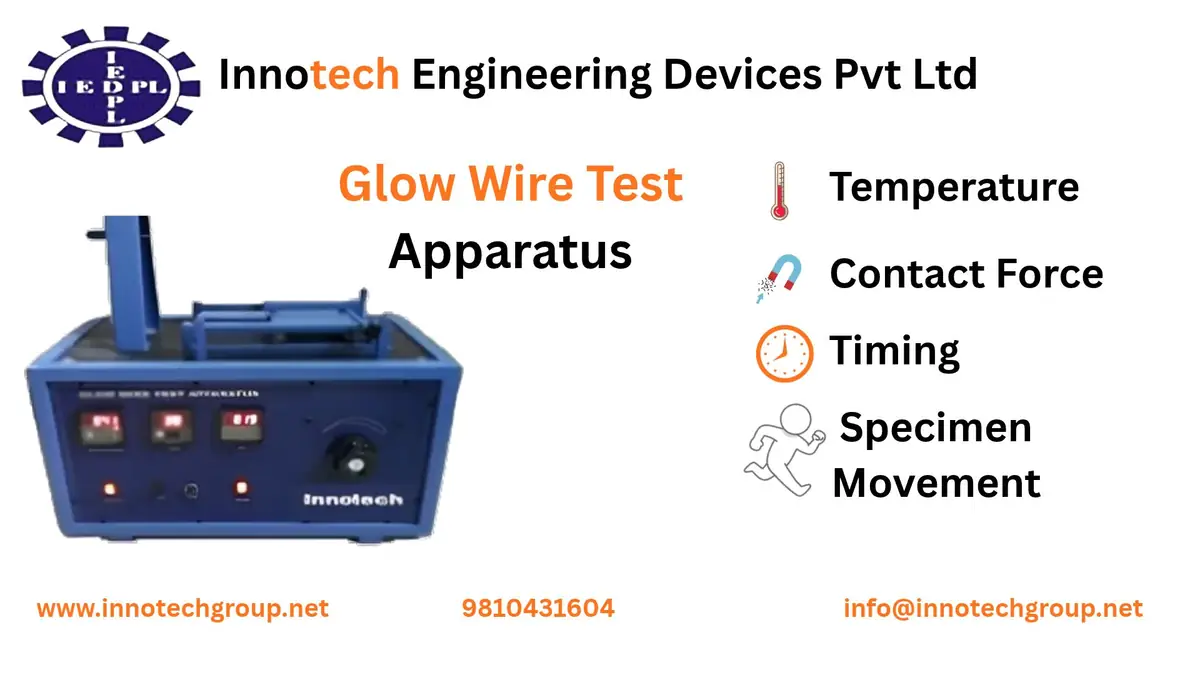
Glow Wire Test: Procedure, Temperature, Standards and Applications
Electrical and electronic products contain components made from plastics and other insulating materials. These materials must be evaluated for their behaviour when exposed to heat from sources such as glowing components or overloaded electrical resistors.
The glow wire test is a laboratory test used to evaluate ignition and flammability-related behaviour under specified test conditions. It uses an electrically heated wire to simulate a localised heat source that could occur in certain electrical equipment.
A glow wire test apparatus helps laboratories perform this test under controlled conditions and observe how a specimen responds to the heated wire.
In this guide, we explain what a glow wire test is, how the apparatus works, which standards are relevant, how test temperatures are selected, and what buyers should consider when choosing glow wire testing equipment.
What Is a Glow Wire Test?
A glow wire test is a fire hazard assessment method in which a heated wire is brought into contact with a specimen under defined conditions. The test helps evaluate whether the specimen ignites, how it behaves during exposure and, where required by the method, whether flaming or glowing continues after the wire is removed.
The method is used for relevant electrical products, components and solid insulating or combustible materials, depending on the applicable test standard.
The purpose is not to reproduce every possible real-world fire situation. Instead, the test provides a controlled way to assess a particular heat-related ignition or flammability characteristic.
Test results must be interpreted according to the specific standard and product requirements.
What Is a Glow Wire Test Apparatus?
A glow wire test apparatus is a laboratory testing system designed to apply a heated wire to a test specimen under controlled conditions.
Depending on its configuration and the applicable standard, the system may include:
- An electrically heated glow wire.
- A temperature measurement and control arrangement.
- A specimen mounting and positioning system.
- A mechanism to apply the wire to the specimen with the required force and duration.
- A timer or means of monitoring test intervals.
- A support arrangement for observing the specimen and any flaming or dripping behaviour.
- Associated controls and safety provisions.
The exact features, temperature range, measurement method and accessories should be checked against the required test procedure and the equipment manufacturer's specifications.
How Does a Glow Wire Test Apparatus Work?
The general procedure involves preparing the specimen, heating the glow wire, applying it to the specimen and observing the material's response. The exact sequence and acceptance criteria vary according to the selected test method.
Step 1: Prepare the test specimen
Prepare the specimen in accordance with the relevant standard. Its dimensions, conditioning and mounting arrangements must be suitable for the test being performed.
Step 2: Set the required test conditions
Select the required glow wire temperature, application time, force and other conditions according to the applicable standard and product specification.
The selected conditions should not be assumed to be identical for every material or finished product.
Step 3: Heat and verify the glow wire
Heat the wire and verify its temperature using the measurement method specified by the applicable standard. Correct temperature measurement is important for reliable and repeatable testing.
Step 4: Apply the glow wire
Bring the heated wire into contact with the specimen using the prescribed arrangement and conditions. The specimen is exposed for the specified duration.
Step 5: Observe the material's response
Record relevant observations, such as ignition, flaming behaviour, extinguishing time or dripping, where these are required by the selected test method.
Step 6: Evaluate and record the result
Compare the observations with the criteria defined in the applicable standard or product specification. Document the test conditions and results for review.
Important: Follow the complete test procedure and safety instructions. A general description cannot replace the requirements of the relevant standard.
Glow Wire Test Temperature
Glow wire test temperature is the temperature to which the wire is heated before it is applied to the specimen.
The appropriate temperature depends on the product, material, test method and applicable product standard. Commonly encountered set points in glow wire testing include 550°C, 650°C, 750°C, 850°C and 960°C, but this is not a universal list of requirements for every application.
The correct temperature must be selected from the relevant test specification. Do not choose a test temperature solely because it is commonly used in another application.
Temperature measurement and verification must also follow the prescribed method. Confirm the apparatus's available temperature range and measurement arrangement before purchasing it.
Important IEC Standards for Glow Wire Testing
The IEC 60695-2 series includes several related glow wire test methods. Each has a distinct purpose.
IEC 60695-2-10: Glow Wire Apparatus and Common Test Procedure
IEC 60695-2-10 specifies the glow wire apparatus and common procedure used to simulate thermal stress from sources such as glowing elements or overloaded resistors. The IEC published its 2026 edition on 8 May 2026, replacing the 2021 edition.
IEC 60695-2-11: Glow Wire Test for End Products
IEC 60695-2-11 addresses the glow wire flammability test method for end products. It evaluates behaviour under defined test conditions, including limited ignition or flame propagation behaviour.
IEC 60695-2-12: Glow Wire Flammability Index (GWFI)
IEC 60695-2-12 covers the GWFI test method for solid electrical insulating materials and other solid materials. The result relates to the material's response to the heated wire under the defined procedure.
IEC 60695-2-13: Glow Wire Ignition Temperature (GWIT)
IEC 60695-2-13 covers the GWIT test method for materials. It evaluates ignition-related behaviour according to the standard's defined procedure.
These methods are related but are not interchangeable. Before selecting a glow wire testing machine, identify the exact standard and test method required for your product or material.
What Is the Difference Between GWFI, GWIT and GWEPT?
These terms describe different glow wire testing methods or outcomes.
| Term |
Meaning |
Main Purpose |
| GWFI | Glow Wire Flammability Index | Evaluates the flammibility-related bhaviour of a material under a defined test procedure |
| GWIT | Glow Wire Ignition Temperature | Evaluated ignition-related behaviour of a meterial under a defined test procedure |
| GWEPT | Glow Wire End-Product Test | Evaluates a finished product under the applicable glow wire flammability test method |
GWFI and GWIT are material test methods, while GWEPT is associated with end-product testing. Results from one method should not automatically be treated as proof of compliance with another.
Applications of Glow Wire Testing
Glow wire testing may be used in the evaluation of relevant materials and components for electrical and electronic applications.
Common application areas include:
- Electrical switches and control components
- Plugs, sockets and connector components.
- Electrical enclosures and insulating parts.
- Households electrical appliances.
- Plastic parts used in electrical assemblies.
- Solid electrical insulating materials.
- Components used in electronic equipment.
- Produt development and material coimparison.
- Quality Control and testing laboratories.
- Research and development facilities.
The applicable test method depends on whether the specimen is a material sample or part of a finished product and on the relevant product requirements.
Benefits of Glow Wire Testing
When performed according to the applicable procedure, glow wire testing can help organisations:
- Evaluate ignition-related behaviour under controlled conditions.
- Compare selected materials using a defined test method.
- Support product development and material method.
- Assess relevant electrical insuliting components.
- Document test observations for quality control purposes.
- Support evaluation against specified product requirements.
A glow wire test alone does not guarantee that a product is fireproof or safe under every real-world condition. Its results must be considered within the wider product safety assessment.
How to Choose a Glow Wire Test Apparatus
Before purchasing a glow wire test apparatus, review the following factors.
1. Applicable test standard
Confirm whether your application requires testing of an end product, a material sample or another specified specimen type.
2. Required temperature range
Check the temperature range and measurement arrangement against your required test conditions. Confirm that the equipment can support the specified procedure.
3. Temperature measurement
Ask how wire temperature is measured and verified and whether the arrangement meets the requirements of your selected standard.
4. Specimen mounting and positioning
Check the specimen support, adjustment arrangement and contact mechanism for compatibility with the specimen and test method.
5. Test timing and observation
Review the available timing, observation and recording arrangements needed for the required procedure.
6. Safety provisions
Consider heat protection, ventilation, safe specimen handling and other laboratory safety requirements. Follow the equipment instructions and applicable workplace safety procedures.
7. Documentation and support
Ask for the technical specifications, operating instructions, applicable test method information and any available calibration or verification documentation relevant to your requirements.
Glow Wire Test Apparatus Price in India
The price of a glow wire test apparatus depends on its configuration, temperature requirements, control and measurement arrangements, specimen positioning mechanism, accessories and documentation requirements.
A meaningful price comparison should consider whether the equipment meets the same test method and technical requirements. Two machines with similar names may differ in their measurement arrangements or intended applications.
Before requesting a quotation, prepare the following information:
- Required IEC standard and test method.
- Specimen or product type.
- Required temperature range
- Measurement and control requirements.
- Required accessories and specimens fixtures.
- Any specific documentation or laboratory requirements.
This information helps the supplier understand the application and provide a more relevant quotation.
Glow Wire Test Apparatus Manufacturer and Supplier in Bhiwadi, Rajasthan
Innotech Engineering Devices Private Limited supplies testing equipment for industrial and laboratory applications. Based in Bhiwadi, Rajasthan, India, the company works with customers to understand their testing requirements.
If you are looking for a glow wire test apparatus, share the applicable standard, specimen type, required temperature and other technical requirements with our team. These details help clarify the required configuration before an order is finalised.
Please confirm the actual equipment specifications, available features and compliance requirements before purchase. Do not assume that every configuration automatically satisfies every IEC test method.
Contact Innotech Engineering Devices Private Limited
- Location: Bhiwadi, Rajasthan, India
- Phone: +91 9810431604
- Email: info@innotechgroup.net
- Website: https://www.innotechgroup.net
Consult to Expert for your testing equipment requirements.
Frequently Asked Questions About Glow Wire Testing
1. What is the purpose of a glow wire test?
It evaluates ignition or flammability-related behaviour when a specimen is exposed to an electrically heated wire under defined conditions.
2. What temperature is used in a glow wire test?
The required temperature depends on the test method and product specification. Common set points include 550°C, 650°C, 750°C, 850°C and 960°C, but the correct value must be confirmed from the applicable standard.
3. Which standard is used for glow wire testing?
The relevant IEC 60695-2 standards include IEC 60695-2-10 for the apparatus and common procedure, IEC 60695-2-11 for end-product testing, IEC 60695-2-12 for GWFI and IEC 60695-2-13 for GWIT.
4. What is the difference between GWFI and GWIT?
GWFI evaluates flammability-related behaviour of a material, while GWIT evaluates ignition-related behaviour. They use separate test methods and produce different results.
5. Can a glow wire test be used for plastic materials?
Yes, applicable glow wire methods can be used to evaluate suitable solid insulating and other solid materials. The specimen preparation and test method must match the intended evaluation.
6. Is glow wire testing only for electrical products?
No. The methods may also apply to relevant solid materials, depending on the test method. However, the selected standard determines whether a material specimen or end product is being evaluated.
7. Does passing a glow wire test mean a product is fireproof?
No. A passing result applies to the specified test conditions and acceptance criteria. It does not prove that a product is fireproof under all possible conditions.
8. What should I check before buying a glow wire test apparatus?
Check the required test standard, specimen type, temperature range, temperature measurement method, specimen positioning, timing arrangements, safety provisions and documentation.
9. What affects the price of a glow wire test apparatus in India?
The price depends on the machine configuration, temperature and measurement requirements, controls, accessories and documentation needed for the application.
10. Where can I enquire about a glow wire test apparatus in India?
You can contact Innotech Engineering Devices Private Limited in Bhiwadi, Rajasthan, at +91 9810431604 or info@innotechgroup.net to discuss your application and equipment requirements.
Conclusion
Glow wire testing is an important method for evaluating ignition and flammability-related behaviour in relevant electrical products and solid materials. Understanding the test procedure, temperature requirements, IEC standards and differences between GWFI, GWIT and end-product testing helps laboratories and manufacturers select appropriate equipment.
Before purchasing a glow wire test apparatus, confirm the applicable test method and technical requirements. For assistance with testing equipment enquiries, contact Innotech Engineering Devices Private Limited in Bhiwadi, Rajasthan.
Consult to Expert to discuss your testing requirements.
Category: Special Purpose Testing Machines
Tags: Glow Wire Test, Glow Wire Test Apparatus, IEC 60695, Electrical Safety Testing, Plastic Flammability Testing, Fire Hazard Testing, Glow Wire Test Procedure, GWFI Test, GWIT Test, Material Testing Equipment, Laboratory Testing, Innotech Engineering Devices
Last Updated: 10 October 2026