
Glow Wire Test Apparatus: Working Principle, Components, Standards and Applications
Jay Pal Singh
11 November 2026
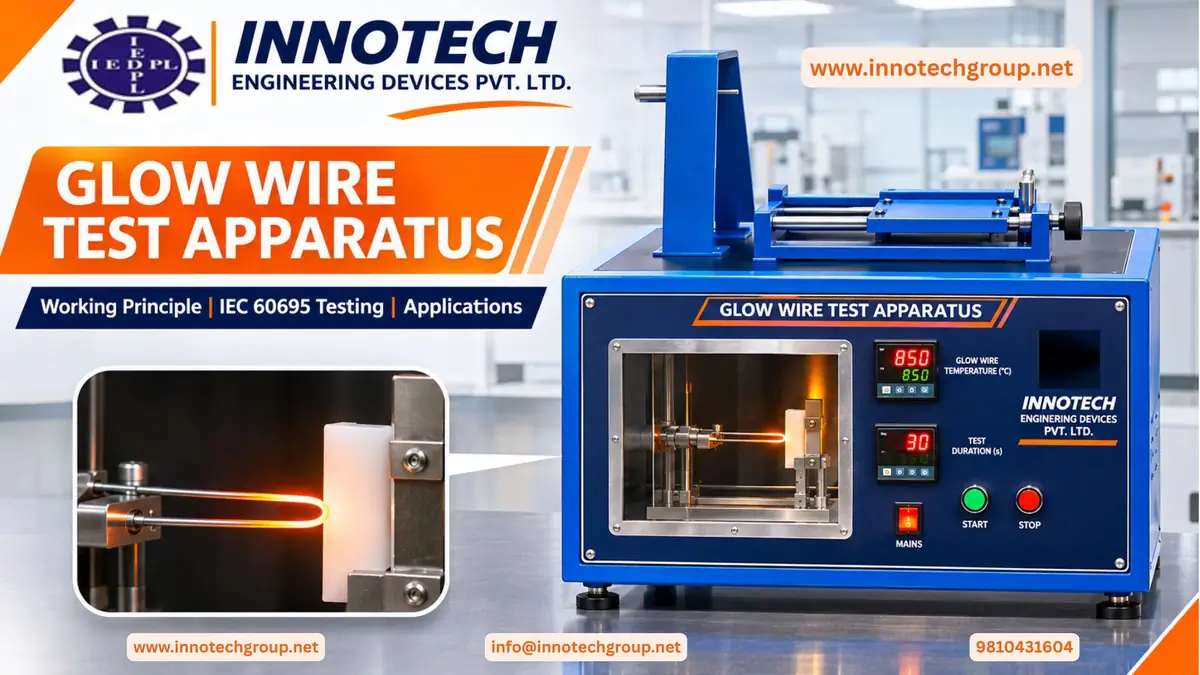
Glow Wire Test Apparatus: Working Principle, Components, Standards and Applications
Electrical and electronic products contain plastic parts, insulating materials, connectors and components that may come into contact with heat during normal operation or under fault conditions. An overheated connection, glowing element or overloaded electrical resistor can become a potential ignition source. For this reason, manufacturers and testing laboratories evaluate how materials and finished products behave when exposed to a controlled source of heat.
A Glow Wire Test Apparatus is laboratory testing equipment used to assess the ignition and fire-related behaviour of electrical insulating materials and end products under specified thermal conditions. It uses an electrically heated wire to simulate the thermal stress that may occur near a hot electrical component.
The apparatus is used in electrical product testing laboratories, plastic manufacturing units, appliance industries, component manufacturers and quality-control departments. Selecting the correct glow wire testing equipment is important because the test setup, temperature measurement, specimen arrangement and applicable test standard all influence the reliability of the results.
This guide explains the glow wire test apparatus, its working principle, important components, testing methods, IEC standards, applications and points to consider before selecting equipment.
What Is a Glow Wire Test Apparatus?
A glow wire test apparatus is a fire hazard testing system that exposes a test specimen to a heated wire under controlled conditions. The heated wire is brought into contact with the specimen for a specified period, following the applicable test method.
During testing, the laboratory observes whether the specimen ignites, how long any flame continues after the wire is removed, whether the material produces flaming or glowing particles, and whether the specimen is consumed.
The test helps evaluate the behaviour of insulating materials and electrical components when exposed to a localised heat source. It is particularly relevant to products in which plastic or insulating parts are located near electrical connections, heating elements or other components that may become hot.
A glow wire tester generally consists of a heated wire assembly, temperature-measuring arrangement, specimen holder, controlled movement mechanism and a test chamber. The exact configuration depends on the intended test method and applicable standard.
How Does a Glow Wire Test Apparatus Work?
The working principle is based on controlled thermal contact between an electrically heated wire and a prepared test specimen.
The glow wire is heated electrically until it reaches the temperature required by the selected test procedure. The specimen is mounted on a holder and positioned in relation to the heated wire. The apparatus then brings the wire and specimen into contact using the prescribed arrangement.
The test is performed for the specified contact duration and under controlled conditions. After the contact period, the operator observes the specimen and records the required results.
Step-by-step working process
1. Specimen preparation: Prepare the material or product sample according to the applicable test standard. Its dimensions, thickness and conditioning requirements depend on the test method.
2. Wire temperature setting: Set the required glow-wire temperature using the temperature control and measurement system.
3. Temperature verification: Verify that the temperature-measuring arrangement is suitable for the selected procedure and is correctly positioned.
4. Specimen mounting: Secure the specimen in the holder so that it remains correctly positioned during the test.
5. Contact and timing: Bring the heated wire into contact with the specimen using the specified force, position and contact duration.
6. Observation: Observe ignition, flame behaviour, glowing, melting and any particles falling from the specimen.
7. Result recording: Record the test conditions and observations for evaluation according to the relevant standard.
The test temperature, specimen arrangement, contact time and acceptance criteria must be selected from the applicable test method or product standard. A single temperature setting should not be treated as suitable for every material or finished product.
Main Components of Glow Wire Testing Equipment
The performance of a glow wire test apparatus depends on the correct design and operation of its major components.
| Component |
Function |
| Glwo wire assembly | Provides the electrically heated contact source |
| Heating circuit | Supplies the electrical current required to heat the wire |
| Temperature sensor | Measures the glow-wire temperature |
| Temperature controller and display | Allows the operator to set and monitor test temperature |
| Specimen holder | Holds the test material or product in position |
| Movement mechanism | Controls the movement of the wire or specimen during contact |
| Contact force arrangement | Helps maintain the force specified by the test procedure |
| Penetration control | Limits the movement or penetration of the wire into the specimen |
| Test chamber | Provides a controlled test environment and helps contain the test area |
| Observation window | Allows the operator to observe the specimen during testing |
| Exhaust arrangement | Supports removal of smoke and fumes when properly installed |
1. Glow Wire Assembly
The glow wire is the central component of the apparatus. It acts as the heated source that comes into contact with the test specimen. The wire material, dimensions and arrangement must meet the requirements of the applicable standard.
2. Temperature Measurement and Control
Accurate temperature measurement is essential for repeatable testing. The apparatus uses a suitable temperature sensor and display or control arrangement to monitor the heated wire.
The measurement system should be verified as required by the selected test method. The latest IEC 60695-2-10:2026 edition also includes a normative annex addressing the use of a pyrometer for glow-wire testing.
3. Specimen Holder and Movement Mechanism
The specimen holder keeps the sample stable during testing. The movement mechanism brings the specimen and glow wire together in a controlled manner.
Depending on the apparatus design, the specimen may move towards a stationary glow wire, or the glow wire may move towards a stationary specimen.
4. Test Chamber and Observation Area
The test chamber provides space for mounting and observing the specimen. The testing environment must meet the requirements of the applicable method, including ventilation and protection against unwanted air movement.
The chamber and exhaust arrangement should be appropriate for the laboratory's safety requirements.
Important IEC Standards for Glow Wire Testing
Glow wire testing is covered by different parts of the IEC 60695 series. The correct part depends on whether the laboratory is testing a finished product or a material sample.
| Standard |
Test method |
Main purpose |
| IEC 60695-2-10:2026 | Glow-wire apparatus and common test procedure | Specific the apparatus and common procedure |
| IEC 60695-2-11:2021 | Glow-Wire Flammability Test Method for End Products (GWEPT) | Evaluates specified end products |
| IEC 60695-2-12:2021 | Glow-Wire Flammability Index (GWFI) | Evaluates the flammability behaviour of materials |
| IEC 60695-2-13:2021 | Glow-Wire Ignition Temperature (GWIT) | Evaluates the ignition characteristics of materials |
IEC 60695-2-10:2026 – Glow Wire Apparatus
IEC 60695-2-10 specifies the glow-wire apparatus and common test procedure. It provides the foundation for the related glow-wire test methods used for end products and materials.
The fourth edition was published on 8 May 2026 and replaces the 2021 edition. One significant change is the addition of a normative annex on the use of a pyrometer for glow-wire testing.
IEC 60695-2-11 – GWEPT
This method applies to end products. It is used to evaluate the behaviour of a finished product or specified part when exposed to a heated glow wire under the test conditions.
IEC 60695-2-12 – GWFI
GWFI stands for Glow-Wire Flammability Index. It is a material test used to evaluate the temperature at which a material meets the specified flammability criteria.
IEC 60695-2-13 – GWIT
GWIT stands for Glow-Wire Ignition Temperature. It is used to evaluate the ignition characteristics of solid electrical insulating materials and other solid materials under the specified test procedure.
Important: GWFI and GWIT are material test results. They should not automatically be treated as proof that a complete electrical product or connector meets every applicable product safety requirement. The relevant product standard determines which tests and acceptance criteria apply.
Difference Between GWFI, GWIT and GWEPT
These terms are closely related but are not interchangeable.
| Parameter |
GWFI |
GWIT |
GWEPT |
| Full form | Glow-Wire Flammability Index | Glow-Wire Ignition Temperature | Glow-Wire End-Product Test |
| Standard | IEC 60695-2-12 | IEC 60695-2-13 | IEC 60695-2-11 |
| Test subject | Material specimen | Material specimen | End product |
| Main purpose | Evaluates flammability behaviour | Evaluates ignition characteristics | Evaluates end-product behaviour |
| Application | Material selection and comparison | Material selection and comparison | Product-level assessment |
For example, a plastic material supplier may provide GWFI and GWIT information for a particular grade of polymer. An electrical appliance manufacturer may also need to evaluate the relevant finished component or product according to its applicable product standard.
Applications of Glow Wire Test Apparatus
Glow wire testing is relevant to industries that manufacture or use electrical insulating materials and components exposed to possible thermal stress.
Electrical and Electronics Industry
Electrical switches, sockets, connectors, terminal blocks, circuit protection components and insulating housings may contain plastic parts located near current-carrying components. Glow wire testing can help evaluate their behaviour under specified heat exposure.
Plastic and Polymer Manufacturing
Plastic manufacturers use glow wire test results to compare the fire-related behaviour of different polymer grades and material formulations. Testing may be relevant to engineering plastics, insulating plastics and flame-retardant material development.
Household Appliances
Appliances such as washing machines, refrigerators, electric irons, heaters and kitchen equipment contain electrical and insulating components. The relevant product standards may specify glow-wire testing for particular parts.
Cable and Electrical Accessories
Electrical accessories and selected insulating components used in cable-related applications may require fire hazard assessment. The exact test method depends on the product specification and applicable standard.
Automotive Electrical Components
Connectors, housings and other electrical insulating components used in automotive applications may be evaluated against the relevant customer or product requirements. Glow wire testing should not be assumed to replace other automotive fire or material tests.
Research and Quality-Control Laboratories
R&D centres, third-party testing laboratories and industrial quality-control departments use glow wire testing to compare materials, evaluate product designs and maintain documented test records.
Glow Wire Test for Plastics and Electrical Connectors
Plastic materials are widely used in electrical connectors, switches, sockets and appliance housings because they provide electrical insulation and allow manufacturers to produce complex component shapes.
However, the behaviour of a plastic material under heat depends on its formulation, thickness, additives, processing and test conditions. Glow wire testing provides a controlled method for evaluating specified material or product behaviour.
For plastic material evaluation, GWFI and GWIT tests may be relevant. For a finished electrical connector or other end product, the applicable product standard may require an end-product glow wire test.
When selecting a glow wire test apparatus for connector testing, consider:
- Whether the intended test is for a material specimen or a finished connector.
- Whether the specimen holder can accommodate the required sample geometry.
- Whether the test arrangement can maintain the required contact conditions.
- Whether temperature measurement and verification meet the applicable method.
- Whether the laboratory can document the required observations and results.
A GWFI or GWIT value for a raw plastic material should not be used as a substitute for an end-product test where the relevant standard requires one.
How to Select the Right Glow Wire Test Apparatus
Before purchasing glow wire testing equipment, identify the test methods, product types and laboratory requirements. A machine should be selected according to the work it needs to perform, rather than only its maximum temperature or advertised features.
| Selection factor |
What to check |
| Applicable standard | Identify the relevant IEC 60695 test method and product standard |
| Test temperature | Confirm that the required temperature range is supported |
| Temperature measurement | Check the sensor, display and verification procedure |
| Glow wire assembly | Confirm that the wire design and dimensions suit the test method |
| Specimen holder | Check the sample size, shape and mounting arrangement |
| Contact mechanism | Confirm controlled movement and the required contact conditions |
| Force and penetration | Check how th apparatus contols and verifies these parameters |
| Test chamber | Review chamber size, observation and ventilation arrangement |
| Safety | Check electrical protection, hot-surface protection and exhaust provisions |
Questions to Ask Before Ordering
1. Which IEC 60695 test methods can the apparatus be configured for?
2. Is the equipment intended for material testing, end-product testing or both?
3. What specimen dimensions and shapes can be accommodated?
4. How is glow-wire temperature measured and verified?
5. What accessories and specimen fixtures are included?
6. What installation, training and after-sales support are available?
7. Can the supplier provide technical documentation for the proposed configuration?
The answers help buyers compare equipment based on actual testing requirements rather than relying on a generic product description.
Glow Wire Test Apparatus Manufacturer in Bhiwadi, Delhi and India
When purchasing laboratory testing equipment, buyers should consider the manufacturer's technical understanding, equipment configuration, documentation, delivery support and after-sales service.
Innotech Engineering Devices Pvt. Ltd. is an industrial testing machine and laboratory equipment manufacturer serving customers across India. With manufacturing operations associated with Delhi and Bhiwadi, Rajasthan, the company supports industrial and laboratory buyers looking for testing equipment for quality-control, product development and material evaluation.
Customers searching for a **Glow Wire Test Apparatus Manufacturer in Bhiwadi**, a **Glow Wire Tester Manufacturer in Delhi**, or a glow wire testing equipment supplier in India can contact Innotech to discuss their testing requirements.
The company can also connect with buyers and laboratories in Mumbai, Chennai, Kolkata and other industrial locations across India. Before finalising an order, customers should share the applicable test standard, specimen details and required configuration so that the proposed equipment can be evaluated against their application.
For a technical discussion or quotation, contact the Innotech team with your test requirements.
Frequently Asked Questions About Glow Wire Test Apparatus
1. What is a glow wire test apparatus used for?
A glow wire test apparatus is used to evaluate the ignition and flammability behaviour of specified electrical insulating materials and end products when exposed to a heated wire under controlled test conditions.
2. Which standard is used for glow wire testing?
The IEC 60695 series covers glow wire testing. IEC 60695-2-10 specifies the apparatus and common procedure, IEC 60695-2-11 covers end-product testing, IEC 60695-2-12 covers GWFI and IEC 60695-2-13 covers GWIT.
3. What is the difference between a glow wire tester and a glow wire test apparatus?
Both terms commonly refer to equipment used for glow wire testing. The important consideration is whether the particular machine configuration meets the requirements of the intended test method.
4. Can a glow wire test apparatus test plastic materials?
Yes, suitable configurations can be used for material testing under the relevant method, including GWFI and GWIT testing. The specimen preparation and test conditions must follow the applicable standard.
5. Can the same apparatus be used for connector testing?
A suitable apparatus may be configured for the required connector or end-product test. The specimen holder, test arrangement and applicable product standard should be checked before selecting the equipment.
6. What is the difference between GWFI and GWIT?
GWFI evaluates the flammability behaviour of a material, while GWIT evaluates its ignition characteristics. Both are material test methods, but they use different evaluation criteria.
7. What information should a glow wire test report contain?
A test report generally records the specimen identification, material or product details, applicable standard and edition, test temperature, test conditions, observations, results and relevant equipment or measurement information required by the method.
8. Where can I buy a glow wire test apparatus in India?
You can contact Innotech Engineering Devices Pvt. Ltd. to discuss glow wire testing equipment requirements. Share your intended IEC test method, specimen details and laboratory requirements to help identify a suitable configuration.
Contact Innotech for Glow Wire Testing Equipment
Choosing the correct glow wire test apparatus starts with understanding the material or product being tested and the applicable IEC test method. A suitable setup helps laboratories conduct controlled testing, record observations and evaluate specimens against the required criteria.
If you are looking for a **Glow Wire Test Apparatus Manufacturer in Bhiwadi, Delhi or India**, contact Innotech Engineering Devices Pvt. Ltd. to discuss your application and equipment requirements.
Company: Innotech Engineering Devices Pvt. Ltd.
Email: info@innotechgroup.net
Phone: +91 9810431604
Manufacturing locations: Delhi and Bhiwadi, Rajasthan
Service coverage: All over India
Contact the team for product details, technical discussion and a quotation for glow wire testing equipment.
Category: Electrical Safety Testing Equipment
Tags: glow wire test apparatus, glow wire testing apparatus, Manufacturer in Bhiwadi, Glow Wire Test Apparatus Manufacturer & Supplier in Bhiwadi Rajasthan India
Last Updated: 11 November 2026