
Flexural Testing Machine: Working Principle, Test Procedure, Applications and Price in India
Jay Pal Singh
03 November 2026
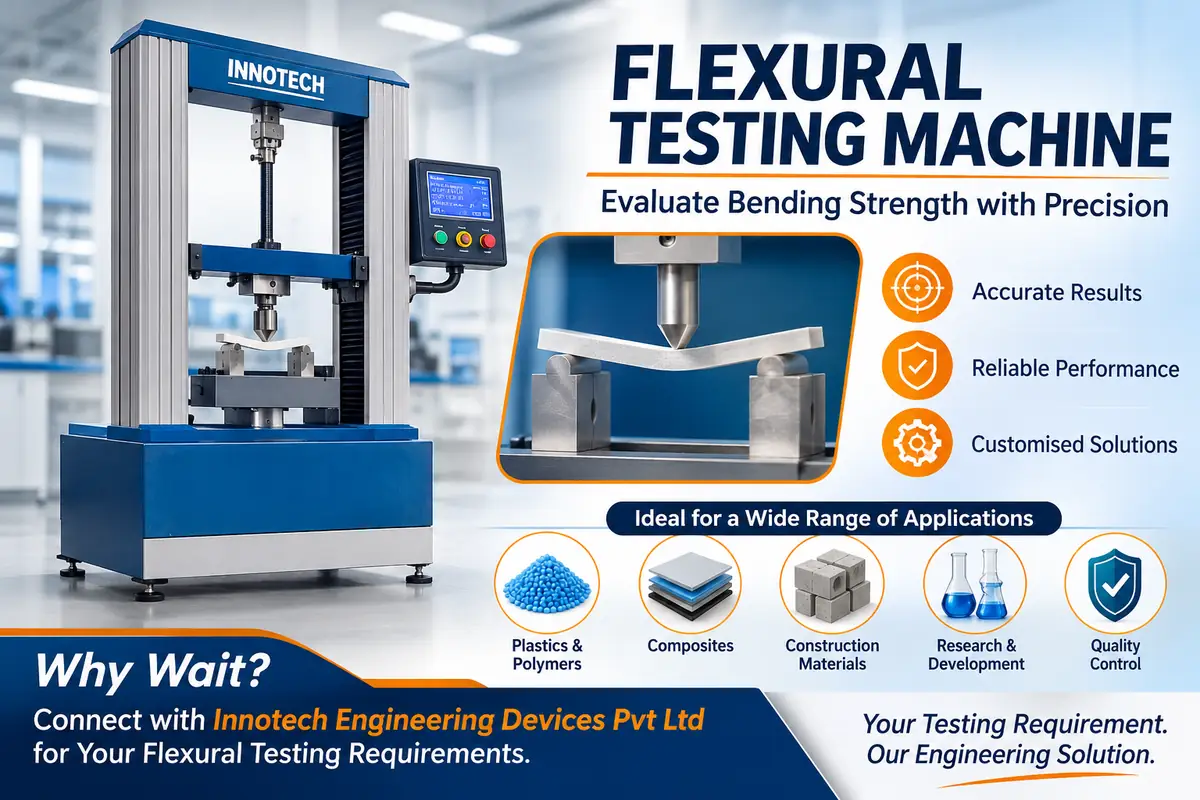
Flexural Testing Machine: Working Principle, Test Procedure, Applications and Price in India
A flexural testing machine is used to evaluate how a material behaves when subjected to bending forces. It helps manufacturers and testing laboratories determine important properties such as flexural strength, flexural modulus and deformation under an applied load. These measurements are useful when selecting materials for products and components that must withstand bending during their service life.
Flexural testing is commonly used for plastics, polymers, composites and construction materials. The machine and testing arrangement depend on the material being evaluated, required test force, specimen dimensions and applicable testing standard.
If you are searching for a flexural test apparatus, flexural testing machine or flexural test machine in India, understanding the working principle, testing procedure and machine configuration can help you select suitable equipment for your laboratory or manufacturing facility.
Innotech Engineering Devices Private Limited, based in Bhiwadi, Rajasthan, provides testing machine solutions for industrial and laboratory applications. Contact our team to discuss flexural testing requirements and suitable machine configurations.
What Is a Flexural Testing Machine?
A flexural testing machine is a material testing system designed to measure the resistance of a specimen to bending or flexural deformation.
During a flexural test, a specimen is placed on supporting points and subjected to a controlled load. The machine measures the applied force and the specimen's response as it bends. Depending on the material and test method, the results can be used to calculate flexural strength, flexural modulus and other relevant properties.
Flexural testing helps answer important questions:
- How much load can a material withstand before bending or failure?
- How stiff is the material when subejcted to bending?
- How does the material deform under an applied force?
- Does the material meet the required quality or performance criteria?
The machine may be designed specifically for a particular material or configured using a suitable testing frame and flexural fixture.
Working Principle of a Flexural Testing Machine
The working principle of a flexural testing machine is based on applying a controlled force to a supported specimen and measuring its response.
In a common three-point bending arrangement, the specimen rests on two supports while a loading nose applies force at the centre. As the load increases, the specimen bends. The machine records the applied force and the corresponding deflection.
The recorded measurements are used to evaluate the flexural behaviour of the material.
Three-Point Bending Test
Three-point bending is a widely used arrangement for flexural testing of rigid and semi-rigid plastic specimens.
The setup generally consists of:
1. Two lower supports that hold the specimen.
2. One upper loading nose positioned between the supports.
3. A load measurement system to record the applied force.
4. A displacement or deflection measurement arrangement.
5. A control system to operate the test according to selected parameters.
As the loading nose moves downward, the specimen experiences bending. The machine records the load and deflection throughout the test.
Four-Point Bending Test
In four-point bending, the specimen is supported at two points and loaded at two positions through an upper loading arrangement.
This creates a bending region between the loading points. Four-point bending is used for specific material and composite testing applications where the applicable test method requires this arrangement.
The choice between three-point and four-point bending depends on the material, specimen geometry and relevant testing standard.
Flexural Testing Procedure: Step-by-Step
A proper testing procedure is important for obtaining meaningful and repeatable results. The exact procedure must follow the applicable material standard.
Step 1: Prepare the Test Specimen
Prepare the specimen according to the selected test method. Its dimensions, shape, surface condition and conditioning requirements should be checked before testing.
Step 2: Select the Correct Fixture
Choose a suitable three-point or four-point bending fixture according to the material and test requirement.
Step 3: Set the Support Span
Position the lower supports at the required distance. The support span is selected according to the specimen dimensions and applicable standard.
Step 4: Place the Specimen
Position the specimen carefully on the supports. Ensure that it is properly aligned with the loading arrangement.
Step 5: Configure the Test Parameters
Set the required test speed, loading conditions, measurement settings and stopping criteria according to the relevant method.
Step 6: Apply the Load
The machine applies force through the loading nose or specified fixture. The specimen begins to bend under the applied load.
Step 7: Record Load and Deflection
The measurement system records the applied force and corresponding deflection or displacement.
Step 8: Analyse the Results
The recorded data is used to determine the required flexural properties. Depending on the method and material behaviour, results may include flexural strength, flexural modulus and load-deflection or stress-strain curves.
What Properties Are Measured During Flexural Testing?
Flexural testing provides information about the bending behaviour of a material.
1. Flexural Strength
Flexural strength represents the maximum flexural stress sustained by a specimen under the specified test conditions. It helps evaluate the material's resistance to bending-related failure.
2. Flexural Modulus
Flexural modulus indicates the stiffness of a material when subjected to bending. A higher value generally indicates greater resistance to flexural deformation under comparable test conditions.
3. Flexural Stress
Flexural stress represents the stress developed within the specimen during bending. It is calculated using the applied force and relevant specimen and fixture dimensions.
4. Flexural Strain
Flexural strain describes the deformation experienced by the specimen during bending.
5. Deflection
Deflection refers to the displacement of the specimen during the test. It helps evaluate how much the specimen bends under the applied load.
The exact reported properties depend on the test standard, specimen behaviour and measurement arrangement.
Applications of Flexural Testing Machines
Flexural testing is important in industries where materials and components experience bending loads during manufacturing, handling or service.
Plastic and Polymer Industry
Plastic manufacturers use flexural testing to evaluate the bending behaviour and stiffness of rigid and semi-rigid plastic materials. The results can support material selection, product development and quality control.
Composite Material Industry
Composite materials are tested to evaluate their flexural performance under specified loading conditions. The test can help assess the behaviour of reinforced materials and composite structures.
Construction Material Testing
Construction materials may require dedicated flexural strength testing to evaluate their resistance to bending. Depending on the material, a specialised hydraulic flexural strength testing machine may be required.
Electrical Insulation Industry
Suitable electrical insulating materials can be evaluated for flexural properties to understand their mechanical behaviour under bending loads.
Research and Development Laboratories
Research laboratories use flexural testing to compare materials, study mechanical properties and support product development.
Quality Control Departments
Manufacturers can use flexural testing as part of defined inspection procedures to check whether selected materials meet specified performance requirements.
Flexural Testing Standards: ASTM D790 and ISO 178
Testing standards define the procedures and conditions required for evaluating material properties. Two important standards used for flexural testing of plastics are ASTM D790 and ISO 178.
| Standard |
Scope |
| ASTM D790 | Flexural properties of unreinforced and reinforced plastics and electrial insulating materials |
| ISO 170 | Determination of flexural properties of rigid and semi-regid plastics |
Both standards include three-point loading arrangements, but their technical requirements and procedures are not identical.
The correct standard should be selected according to the material specification and testing requirement. Specimen dimensions, support span, testing speed, conditioning and deflection measurement can influence the results.
Important: A machine's ability to perform a flexural test does not automatically establish compliance with a particular standard. The correct fixture, measurement arrangement, machine verification, software settings and test procedure must be confirmed.
Always check the current applicable edition before conducting standardised testing.
Flexural Testing Machine vs Flexural Test Apparatus
The terms flexural testing machine and flexural test apparatus are often used when searching for bending-test equipment. However, they may refer to different parts of a testing setup.
| Comparison |
Flexural Testing Machine |
Flexural Test Apparatus |
| Meaning | Complete testing system or configured testing machine | Fixture or arrangement used for the flexural test |
| Main function | Applies and measures the testing load | Supports and positions the specimen |
| Components | Frame, loading system, measurement and control | Support, loading nose and realted fixture parts |
| Configuration | Depends on capacity and application | Depends on specimen dimensions and test method |
| Selection | Based on material, force and test requirements | Based on the applicable test arrangement |
A flexural fixture can be used with a compatible Universal Testing Machine or a dedicated testing machine. The selected equipment must provide the required force range, measurement capability and test space.
Types of Flexural Testing Machines
Different materials and testing applications require different machine arrangements.
1. Universal Testing Machine with Flexural Fixture
A Universal Testing Machine can be configured for flexural testing using a compatible three-point or four-point bending fixture.
This arrangement is useful for laboratories that perform multiple types of mechanical tests, such as tensile, compression and flexural testing, on suitable materials.
2. Dedicated Flexural Testing Machine
A dedicated flexural testing machine is designed around a specific bending-test application. Its configuration depends on the material, required load capacity, specimen dimensions and test procedure.
3. Hydraulic Flexural Strength Testing Machine
Hydraulic flexural strength testing machines are used for suitable higher-force and construction-material testing applications. The machine capacity, loading arrangement and specimen supports must match the material and test method.
4. Customised Flexural Testing System
Some applications require special fixtures, specimen supports, loading arrangements or control systems. In such cases, an application-specific testing system may be considered after reviewing the technical requirements.
How to Choose the Right Flexural Testing Machine
Selecting a suitable flexural test machine requires more than checking its maximum load capacity. Consider the following factors before purchasing.
1. Material type: Identify whether you will test plastic, polymer, composite or construction material.
2. Required test method: Confirm whether three-point or four-point bending is required.
3. Load capacity: Select a suitable force range based on the expected specimen behaviour.
4. Specimen dimensions: Share the length, width and thickness of the test specimen.
5. Support span: Confirm the required support spacing according to the test method.
6. Testing speed: Check the required loading or crosshead speed.
7. Deflection measurement: Determine whether crosshead displacement or a separate deflection measurement device is required.
8. Control system: Consider manual, digital or computerised operation according to laboratory requirements.
9. Applicable standards: Confirm the required ASTM, ISO or other relevant material test method.
10. Calibration and service: Consider the measurement verification, maintenance and technical support requirements.
Sharing these details with the manufacturer helps identify a suitable machine and fixture configuration.
Flexural Testing Machine Price in India
The flexural testing machine price in India depends on the machine design, load capacity, testing arrangement, control system and accessories.
Some important factors that influence the quotation include:
- Required maximum testing force
- Dedicated machine or UTM configuration
- Three-ppoint or four-pillar bending fixtures
- Specimen dimensions and support span
- Load measurement and deflection measurement arrangements
- Manual, digital or computerised control system
- Software and reporting requirements
- Calibration and verification requirements
- Installation, commissioning and training
- Customised fixtures and application-specific features
When comparing flexural testing machine prices, review the complete technical configuration instead of comparing only the quoted machine capacity.
For an accurate quotation, share your material type, specimen dimensions, required test method and applicable standard with the supplier.
Why Choose Innotech Engineering Devices for Flexural Testing Equipment?
Innotech Engineering Devices Private Limited is an Indian manufacturer and supplier of testing machines and laboratory equipment based in Bhiwadi, Rajasthan.
Our flexural testing equipment solutions can be discussed according to the customer's material, specimen dimensions, required test method and load capacity.
What we offer:
- Testing equipment solutions for industrial and laboratory applications
- Flexural testing machine configurations based on application requirements
- Suitable testing fixture and arrangement discussions
- Customised testing machine development, subject to engineering feasibility
- Technical consultation for machine selection
- Installation and commissioning support according to the confirmed order scope
- Maintenance, repair and machine upgradation support
- Supply of testing machines to customers across india
We also provide Universal Testing Machine solutions that can be configured for flexural testing with suitable fixtures, depending on the machine's technical capability.
Frequently Asked Questions About Flexural Testing Machines
1. What is a flexural testing machine used for?
A flexural testing machine is used to evaluate the bending behaviour of materials under an applied load. It helps determine properties such as flexural strength, flexural modulus and deformation.
2. What is a flexural test apparatus?
A flexural test apparatus is the fixture arrangement used to support and load a specimen during bending tests. It may include lower supports and an upper loading nose for three-point bending.
3. What is the difference between three-point and four-point bending?
In three-point bending, one loading point applies force between two supports. In four-point bending, two loading points apply force to the specimen between two supports. The appropriate method depends on the material and testing standard.
4. Which materials can be tested using a flexural testing machine?
Depending on the machine and fixture configuration, flexural testing can be performed on suitable plastics, polymers, composites, electrical insulating materials and construction materials.
5. What is ASTM D790?
ASTM D790 is a standard test method used to determine the flexural properties of unreinforced and reinforced plastics and electrical insulating materials.
6. What is ISO 178?
ISO 178 specifies a method for determining the flexural properties of rigid and semi-rigid plastics under defined test conditions.
7. What is flexural strength?
Flexural strength is the maximum flexural stress sustained by a specimen during a bending test under the specified test conditions.
8. What is flexural modulus?
Flexural modulus is a measure of a material's stiffness when subjected to bending. It indicates how strongly the material resists flexural deformation.
9. Can a Universal Testing Machine perform flexural testing?
Yes. A compatible Universal Testing Machine can perform flexural testing when fitted with a suitable bending fixture and configured according to the material's test requirements.
10. What determines the price of a flexural testing machine?
The price depends on load capacity, machine type, fixture arrangement, control system, measurement requirements, software, accessories and installation scope.
11. Can a flexural testing machine be customised?
Application-specific configurations can be discussed based on material type, specimen dimensions, required load, test method and fixture requirements, subject to engineering feasibility.
12. Where can I buy a flexural testing machine in India?
You can contact Innotech Engineering Devices Private Limited, Bhiwadi, Rajasthan, to discuss flexural testing equipment, machine configurations and quotations for your laboratory or industrial application.
Contact Innotech for Flexural Testing Machine Requirements
Looking for a flexural testing machine manufacturer in India for your material testing laboratory, manufacturing unit or quality-control department?
Connect with Innotech Engineering Devices Private Limited to discuss your flexural testing requirements, machine configuration, fixture selection and quotation.
Share your material type, specimen dimensions, required load capacity and applicable test method so our team can understand your application.
Innotech Engineering Devices Private Limited
OEM Manufacturer of Testing Machines & Laboratory Equipment
H-307 RIICO Industrial Area Karoli, Tapukara, Bhiwadi, Rajasthan, India
Email: info@innotechgroup.net
Phone: +91 9810431604 / +91 8929666430
Your Testing Requirement. Our Engineering Solution.
Category: Flexural Testing Machine
Tags: Flexural Testing Machine, Flexural Testing Machine Manufacturer in India, Flexural Testing Machine Supplier in India, Flexural Test Machine, Flexural Test Machines, Flexural Testing Equipment, Flexural Strength Testing Machine, Flexural Test Apparatus, Fl
Last Updated: 03 November 2026