
Endurance Testing Machine: What It Does, Why It Matters, and How to Choose the Right Supplier in India
Jay Pal Singh
09 October 2026
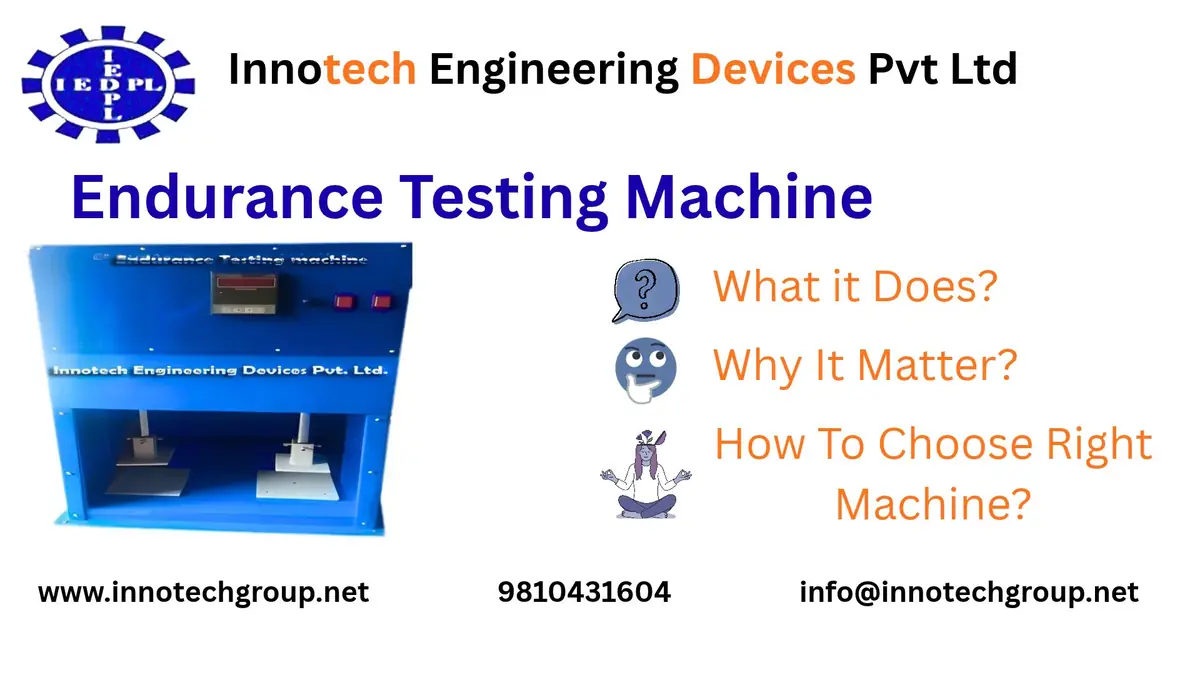
Endurance Testing Machine: A Practical Guide for Manufacturers and Testing Laboratories
Have you ever wondered how manufacturers know whether a component will continue working after thousands or even millions of operations?
A product may work perfectly when it is new. But after months of use, some parts may become loose, wear out, crack, or stop working properly. This is why manufacturers test their products before putting them into regular use.
An Endurance Testing Machine helps manufacturers check how a component performs under repeated operating conditions. Depending on the application, the machine can repeat a particular movement, apply a load, or operate a mechanism for a specified number of cycles.
For example, an automotive component may need to operate repeatedly during the vehicle's service life. A switch may need to turn on and off many times. A hinge may need to open and close repeatedly without losing its function. Endurance testing helps manufacturers study how such components perform over time.
In this article, we will explain what an endurance testing machine does, what it does not do, why manufacturers use it, how to prepare for a test, what to check before and after testing, and how to choose a suitable supplier or manufacturer in India.
What Is an Endurance Testing Machine?
An endurance testing machine is equipment used to evaluate the durability and performance of a component or product under repeated operating cycles or prolonged test conditions.
The machine is configured according to the part being tested. It may repeat a movement, apply a specified load, operate a mechanism, or follow a defined testing sequence.
During testing, the operator observes whether the component continues to work as expected. Depending on the test setup, the process may also record the number of completed cycles, operating time, load, displacement, or other relevant parameters.
The main purpose is simple: to understand how a product behaves during repeated use and identify possible weaknesses before the product is released or approved.
What Does an Endurance Testing Machine Do?
An endurance testing machine can help manufacturers:
- Check whether a component continues working after repeated operation.
- Find wear, looseness, deformation, or mechanical damage.
- Evaluate how a product performs during long-duration testing.
- Compare different component designs or materials.
- Check whether a design improvement has improved durability.
- Support product development and quality control.
- identify failure points under defined test conditions.
- Record the numner of cycles completed before a specified failure, when the test setup supports this.
The exact results depend on the component, test method, machine configuration, and failure criteria.
What Does an Endurance Testing Machine Not Do?
It is equally important to understand the limitations of this equipment.
An endurance testing machine does not automatically tell you the complete service life of every product. A test result represents the conditions used during that particular test. Actual service life can also depend on temperature, moisture, vibration, maintenance, handling, and real-world operating conditions.
The machine also does not replace every other type of testing.
For example:
• A hardness tester measures resistance to indentation using its specified test method.
• A tensile testing machine evaluates material behaviour under tensile loading.
• An impact tester evaluates a material's response to a specified impact test.
• An endurance testing machine evaluates repeated operation or other defined durability conditions.
Some products may need more than one type of test before their performance can be properly evaluated.
Why Is Endurance Testing Important?
Imagine a company manufacturing a mechanical lever. The lever works correctly during the first few operations, but after repeated use, its movement becomes difficult or a connecting part begins to loosen.
If the problem is discovered only after the product reaches customers, it may lead to complaints, repairs, warranty costs, or product recalls.
Endurance testing gives manufacturers an opportunity to investigate such problems under controlled conditions.
1. To Check Product Durability
Manufacturers can observe whether a component continues to perform its intended function after repeated operation.
2. To Find Weak Points
Testing may reveal cracks, excessive wear, loose connections, deformation, or loss of function, depending on the product and test method.
3. To Improve Product Design
When a component fails earlier than expected, engineers can study the result and make changes to the design, material, or manufacturing process.
4. To Compare Different Designs
Two versions of a component can be tested under the same defined conditions to help engineers compare their performance.
5. To Support Quality Control
A defined endurance test can be used as part of a quality-control plan when suitable acceptance criteria and sampling procedures have been established.
Where Is an Endurance Testing Machine Used?
Endurance testing is useful in industries where products or components are expected to operate repeatedly.
| Industry |
Example of Suitable Test Applications |
| Automotive | Switches, levers, pedals, hinges, and selected mechanical mechanisms |
| Industrial Manufacturing | Actuators, moving assemblies, and operating mechanisms |
| Electrical and Electronics | Switches, controls, and selected electromechanical components |
| Consumer Products | Hinges, closures, and repetitive-use mechanisms |
| Research and Development | Prototype evaluation and comparison of component designs |
| Quality control Laboratories | Durability check according to defined test procedures |
Not every endurance testing machine can test all these products. The fixtures, loading system, movement, controls, and measurement arrangements must match the intended application.
How Does an Endurance Testing Machine Work?
The working principle depends on the component and the required test. A typical test may follow these steps:
1. Mount the component: Place the test specimen in the correct fixture and secure it properly.
2. Set the test conditions: Define the required movement, load, speed, number of cycles, and test duration, as applicable.
3. Check the setup: Confirm alignment, connections, guarding, and measurement systems.
4. Start the test: Operate the machine according to the approved procedure.
5. Repeat the cycle: The machine repeats the required operation or movement.
6. Monitor the component: Check for abnormal noise, wear, deformation, malfunction, or other defined warning signs.
7. Stop at the required point: End the test after the specified cycles or duration, or when a predefined failure condition is reached.
8. Inspect and record: Examine the component and document the test results.
The test should follow a defined procedure rather than relying only on an operator's general observation.
What Should You Do Before Using an Endurance Testing Machine?
Good preparation can make testing more consistent and help prevent incorrect results.
Before starting, check the following:
• Understand the test objective: Know exactly what you want to evaluate.
• Identify the component: Record its type, dimensions, material, and relevant product details.
• Confirm the test procedure: Check the applicable standard, customer specification, or internal test method.
• Inspect the machine: Check the frame, fixtures, moving parts, controls, and safety arrangements.
• Check the mounting arrangement: Ensure the component is installed securely and correctly aligned.
• Confirm the test settings: Verify the required load, movement, speed, cycles, and duration, where applicable.
• Check the monitoring system: Confirm that the cycle counter and any required sensors or recording systems work correctly.
• Define failure criteria: Decide what will count as failure before the test begins.
• Record initial condition: Photograph or document the specimen and note any existing damage.
If the test uses a specific standard, follow its requirements for specimen preparation, conditioning, operating conditions, and evaluation.
How to Use an Endurance Testing Machine Safely
The following is a general operating sequence. Always follow the manufacturer's operating manual and the approved test procedure for your particular machine.
1. Switch on and inspect the machine according to the operating instructions.
2. Install the correct fixture for the component.
3. Mount the specimen securely.
4. Enter or set the required test parameters.
5. Verify safety guards, emergency-stop arrangements, and any required interlocks.
6. Run a preliminary check, where appropriate, to confirm correct movement and alignment.
7. Start the test and observe the initial cycles.
8. Monitor the machine and component according to the test plan.
9. Stop the machine if an unsafe condition or unexpected malfunction occurs.
10. At the end of the test, stop the equipment and make the system safe before removing the specimen.
Do not reach into moving parts or adjust a fixture while the machine is operating. Maintenance, jam removal, and other interventions should follow the manufacturer's safety and isolation procedures.
What Should You Check After Endurance Testing?
Finishing the required cycles is not the only part of the test. The component must also be evaluated.
After testing:
• Record the total cycles completed and the test duration.
• Note whether the component completed the test or failed earlier.
• Inspect for cracks, wear, deformation, looseness, or other relevant damage.
• Check whether the component still performs its intended function.
• Review available load, displacement, or other recorded data.
• Compare the results with the specified acceptance criteria.
• Take photographs of important findings.
• Prepare a test report and retain the records for future comparison.
If the component fails, record the failure point and observed condition. Further investigation may be required to understand the cause.
Important: Completing a certain number of cycles does not, by itself, prove that a product will last for the same number of operations in real-world service. Conclusions must consider the test conditions and the intended application.
Important Parameters to Consider
| Parameter |
Why It Matters |
| Test Cycles | Defines the required number of repeated operations |
| Test Duration | Establishes how long the test should run |
| Operating Speed or Frequency | Determines how quickly the cycle is repeated |
| Load or Force | Represents the required mechanical loadingm where applicable |
| Movement or Stroke | Defines the motions required by the component |
| Fixture Arrangement | Keeps the components in the correct position |
| Failure Criteria | Establishes when the test should be considered failed |
| Monitoring and Recording | Helps document test progess and results |
These are parameters to specify, not universal values. The actual ranges must be selected for the component and test procedure.
How to Choose the Best Endurance Testing Machine Manufacturer in India
Choosing a supplier is not only about comparing prices. The machine must be suitable for the component, the required test, and the conditions in which it will be used.
Here are some points to consider before placing an order.
1. Check the Manufacturer's Technical Understanding
Explain what you want to test and ask how the proposed machine will perform that test. A suitable manufacturer should be able to discuss the fixture, movement, loading requirements, controls, and test procedure.
2. Share Your Component Details
Provide a drawing, photograph, sample, or relevant dimensions. These details help the manufacturer understand how the component needs to be mounted and operated.
3. Confirm the Test Parameters
Discuss the required cycles, operating speed, load, movement, duration, and failure conditions. Do not assume every machine can achieve every combination of parameters.
4. Ask About Controls and Data Recording
Depending on your needs, you may require a cycle counter, programmable controls, sensors, automatic stopping, or a data-recording system. Confirm which features are included in the quoted configuration.
5. Discuss Applicable Standards
If your customer or industry requires a particular testing standard, share the exact standard and edition. Ask the manufacturer to confirm whether the proposed machine can meet the required test method.
6. Review Safety and Maintenance Requirements
Ask about guarding, emergency stops, routine maintenance, spare parts, operator training, and technical support.
7. Request a Clear Quotation
A useful quotation should identify the machine configuration, included fixtures, control system, accessories, installation or commissioning arrangements, warranty terms, delivery schedule, and exclusions.
8. Compare the Complete Solution
Compare quotations based on technical suitability, build quality, included features, service support, and total cost—not price alone.
Why Discuss Your Requirement with Innotech Engineering Devices Private Limited?
Innotech Engineering Devices Private Limited supplies testing equipment and develops customized testing solutions for industrial and laboratory applications.
For endurance testing, the correct configuration depends on the component and the test procedure. Discussing the application before ordering helps establish the required operating movement, test cycles, fixtures, controls, and monitoring arrangements.
When contacting Innotech, it is helpful to share:
• The component name and its intended use.
• A drawing, photograph, or sample, if available.
• The required movement and loading conditions.
• The target number of cycles and test duration.
• The applicable testing standard or customer procedure.
• Any requirements for automation, sensors, or test reports.
These details help the supplier understand your application and discuss a suitable machine configuration.
For customers looking for an Endurance Testing Machine manufacturer or supplier in India, Innotech can discuss application-specific requirements from its location in Bhiwadi, Rajasthan.
Contact the team to discuss your requirements:
• Company: Innotech Engineering Devices Private Limited
• Phone: +91 9810431604
• Email: info@innotechgroup.net
• Website: www.innotechgroup.net
• Location: Bhiwadi, Rajasthan, India
Frequently Asked Questions
What is the main purpose of an endurance testing machine?
Its main purpose is to evaluate how a component performs under repeated operation or prolonged test conditions.
Is endurance testing the same as fatigue testing?
Not always. Endurance testing is a broad term for repeated-operation or durability testing. Fatigue testing specifically studies damage caused by repeated or fluctuating stresses. The appropriate test depends on the component and the failure mechanism being investigated.
How many cycles should an endurance test run?
The required cycle count depends on the product, intended service conditions, test procedure, and acceptance criteria. There is no single cycle count suitable for every component.
Can an endurance testing machine run automatically?
Some configurations support programmable or automated operation. Confirm the available control functions and safety features for the specific machine.
Does passing an endurance test guarantee a product's service life?
No. It shows how the product performed under the specified test conditions. Real-world service life can differ because actual operating conditions may also include temperature changes, contamination, vibration, maintenance, and other factors.
What information should I provide when requesting a quotation?
Share the component details, required movement, loading conditions, target cycles, test duration, applicable test procedure, and any requirements for automation or data recording.
How do I choose an endurance testing machine supplier in India?
Look for a supplier who understands your application, clearly defines the proposed machine configuration, discusses applicable standards and safety, and provides transparent commercial terms and after-sales support.
Conclusion
An endurance testing machine helps manufacturers understand how components perform after repeated operation. It can support durability evaluation, product development, design improvement, and quality control when the test is properly planned and the results are evaluated against clear criteria.
Before choosing a machine, define what you need to test, how the component operates, how many cycles are required, and what counts as failure. Then discuss these details with a manufacturer who can recommend a suitable configuration.
If you are planning to purchase an endurance testing machine for your laboratory or production facility, contact Innotech Engineering Devices Private Limited to discuss your testing requirements.
Consult to Expert: +91 9810431604
Website: www.innotechgroup.net
Email: info@innotechgroup.net
Call: 9810431604
Category: Material Testing Laboratory
Tags: Endurance Testing Machine, Endurance Testing Equipment, Durability Testing, Cycle Testing Machine, Component Testing, Automotive Testing Equipment, Product Reliability Testing, Quality Control, Mechanical Testing, Industrial Testing Equipment, Testing Mac
Last Updated: 09 October 2026