
Different Types of Fatigue Endurance Testing Systems
Jay Pal Singh
24 October 2026
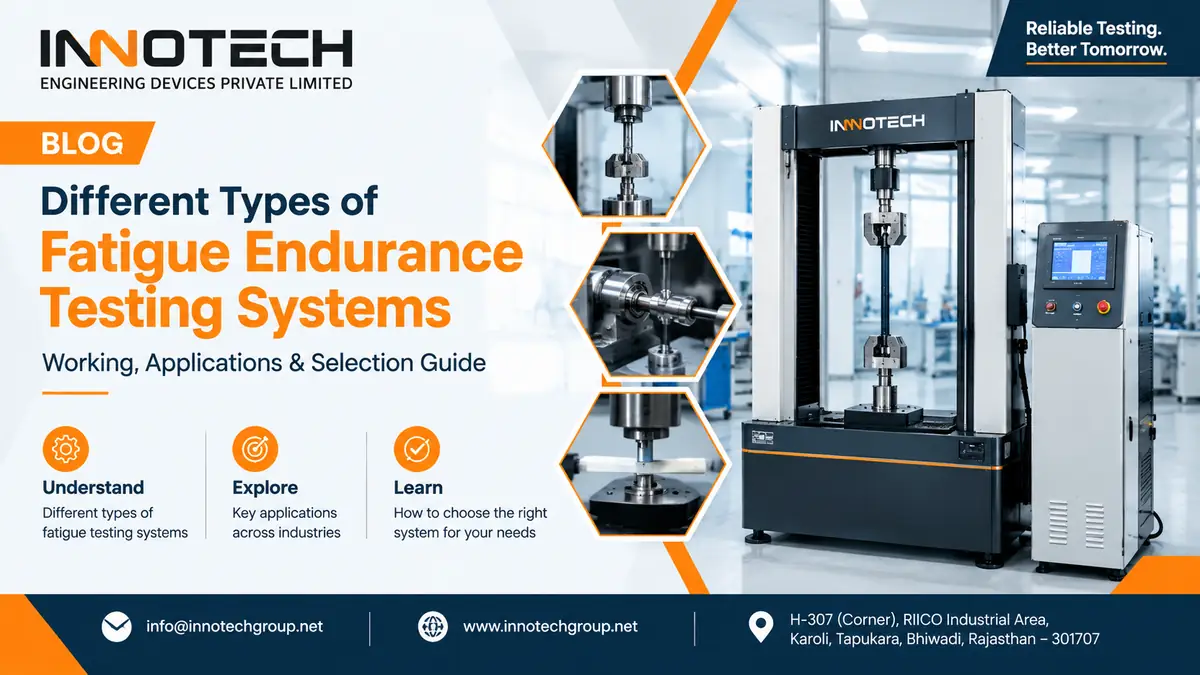
Different Types of Fatigue Endurance Testing Systems: Working, Applications & Selection Guide
Fatigue endurance testing systems are used to evaluate how long a material, component, or product can withstand repeated loading, movement, vibration, or stress before failure. Manufacturers use these systems to assess product durability, identify weak points, and improve product reliability before products reach the market.
Innotech Engineering Devices Private Limited, based in Bhiwadi, Rajasthan, offers testing machine solutions for industrial and laboratory applications. The right fatigue endurance testing system depends on the component being tested, the type of load, the required test cycles, and the applicable testing procedure.
What Are Fatigue Endurance Testing Systems?
A fatigue endurance testing system repeatedly applies a specified load, stress, movement, or operating condition to a test specimen or component. The test helps determine its resistance to repeated use and identifies cracking, deformation, wear, or other signs of failure.
These systems are useful in industries where products experience repeated forces during normal operation, including automotive, engineering, manufacturing, electrical equipment, and materials research.
Different Types of Fatigue Endurance Testing Systems
1. Cyclic Load Testing Systems
Cyclic load testing systems apply repeated loads to a specimen or component. Depending on the machine design, the load may be tensile, compressive, or a combination of loading conditions.
Applications:
- Testing mechanical components exposed to repeated forces
- Evaluating material durability
- Assessing the performance of engineering parts
- Research and product development
The required load capacity, frequency, cycle count, and specimen dimensions should be considered when selecting a system.
2. Tension-Compression Fatigue Testing Systems
These systems evaluate how materials or components respond to repeated tensile and compressive forces. They are useful for studying fatigue behaviour under alternating or repeated loading conditions.
Applications:
- Metal and engineering material testing
- Mechanical component development
- Material research and quality evaluation
- Testing parts exposed to repeated pulling and pushing forces
The machine configuration should match the required force range, loading pattern, and test method.
3. Rotating Bending Fatigue Testing Systems
Rotating bending fatigue testing systems assess the fatigue resistance of specimens subjected to bending stress while rotating. They are commonly used to study the durability of metal specimens and components under repeated bending conditions.
Applications:
- Metal fatigue research
- Shaft and rod material evaluation
- Engineering laboratories
- Product development and material comparison
The specimen geometry, rotational speed, bending load, and test procedure are important selection factors.
4. Flexural Fatigue Testing Systems
Flexural fatigue testing systems subject a specimen to repeated bending. They help assess how materials and components perform when exposed to repeated flexing during use.
Applications:
- Polymer and plastic component testing
- Rubber and flexible material evaluation
- Composite material research
- Repeated-bending durability studies
The appropriate fixture, specimen dimensions, loading method, and number of cycles depend on the material and test requirements.
5. Component Endurance Testing Systems
Component endurance testing systems are designed to evaluate the durability of complete components or assemblies under repeated operating conditions. The test may reproduce a specific movement, load, or operating cycle.
Applications:
- Automotive and mechanical components
- Industrial product development
- Moving parts and mechanical assemblies
- Quality assurance and durability evaluation
These systems can be application-specific. The required fixtures, motion, operating sequence, sensors, and control system should be defined before finalizing the design.
6. Customized Fatigue Endurance Testing Systems
Some products require a specific test arrangement that may not be covered by a standard machine. Customized fatigue endurance testing systems can be developed around the component, loading pattern, cycle requirements, and intended test procedure.
Customization may involve test fixtures, loading mechanisms, control systems, cycle counters, data recording, and safety features, subject to technical feasibility.
How to Choose the Right Fatigue Endurance Testing System
Before purchasing a fatigue endurance testing machine, consider the following factors:
- Test specimen: Identify the material, component shape, dimensions, and weight.
- Loading type: Determine whether the test requires tension, compression, bending, rotation, or a specific movement.
- Load capacity: Select a system that covers the required testing forces.
- Test frequency: Establish the required operating speed and cycle frequency.
- Cycle count: Define the target number of cycles and the criteria for test completion.
- Control and data recording: Identify the need for cycle counting, force measurement, displacement monitoring, and test reports.
- Standards and procedure: Confirm the applicable test method and acceptance criteria before ordering.
Fatigue Endurance Testing System Price in India
The price of a fatigue endurance testing system in India depends on its load capacity, test frequency, machine configuration, fixtures, automation, sensors, software, and customization requirements. A system designed for a small material specimen may differ significantly in cost from a machine intended for complete component endurance testing.
For an accurate quotation, share the component details, test method, required load, cycle frequency, and applicable standard with the manufacturer.
Frequently Asked Questions
1. What is a fatigue endurance testing system used for?
It is used to evaluate how a material or component performs under repeated loading or operating cycles and to identify fatigue-related failure.
2. What are the main types of fatigue testing systems?
Common types include cyclic load, tension-compression fatigue, rotating bending fatigue, flexural fatigue, and component endurance testing systems.
3. Can fatigue endurance testing machines be customized?
Customization may be possible based on the application, loading conditions, fixtures, control requirements, and technical feasibility.
4. What affects the price of a fatigue endurance testing machine?
Important factors include load capacity, test frequency, fixtures, automation, measurement systems, software, and the required test procedure.
Contact Innotech for Fatigue Endurance Testing Solutions
Looking for a fatigue endurance testing system for your laboratory or industrial application? Contact **Innotech Engineering Devices Private Limited** to discuss your testing requirements and suitable machine configurations.
Email: info@innotechgroup.net
Phone: +91 9810431604
Address: H-307 (Corner), RIICO Industrial Area, Karoli, Tapukara, Bhiwadi, Rajasthan – 301707
Share your application and test requirements to discuss a suitable solution.
Category: Furnace
Tags: fatigue endurance testing systems, fatigue testing machine manufacturer India, cyclic load testing system, tension compression fatigue testing machine, rotating bending fatigue tester, flexural fatigue testing system, component endurance testing machine,
Last Updated: 24 October 2026