
Cold Crushing Strength Testing Machine: Working Principle, Standards, Applications & Buying Guide
Jay Pal Singh
07 November 2026
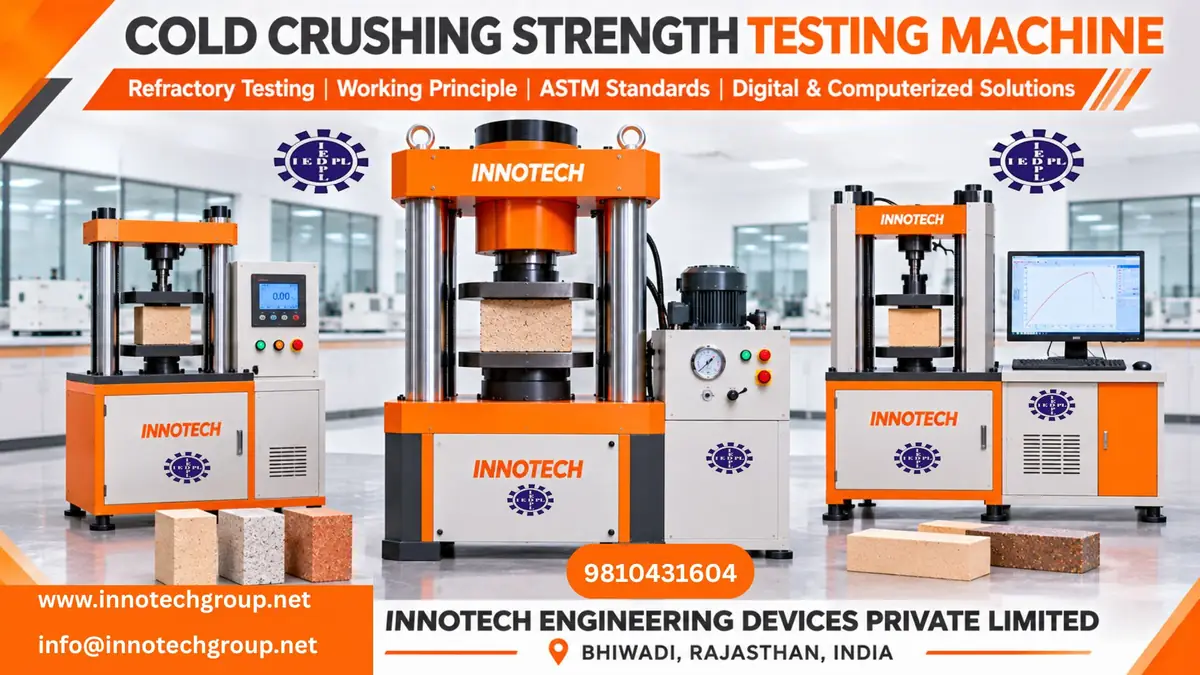
Cold Crushing Strength Testing Machine: Working Principle, Standards, Applications & Buying Guide
Introduction
Refractory materials are used in industries where equipment operates at very high temperatures. They are found in furnaces, kilns, boilers, steel plants, cement plants, glass manufacturing units and other industrial heating systems.
But how do manufacturers know whether a refractory brick or castable material has sufficient strength before it is used in an industrial furnace?
One important quality control test is the Cold Crushing Strength (CCS) Test.
A Cold Crushing Strength Testing Machine is used to determine how much compressive load a refractory specimen can withstand at room temperature before it fails. The result helps manufacturers evaluate material quality, compare production batches and maintain product specifications.
This machine is also known as a Refractory Cold Crushing Strength Testing Machine, Cold Compressive Strength Tester or Refractory CCS Testing Machine.
In this guide, we explain its working principle, applications, technical specifications, testing standards and important points to consider before purchasing the equipment.
What Is a Cold Crushing Strength Testing Machine?
A Cold Crushing Strength Testing Machine is a compression testing instrument designed to measure the maximum compressive strength of refractory materials at room temperature.
During testing, a prepared refractory specimen is placed between two compression platens. The machine gradually applies a compressive load until the specimen cracks or fails.
The maximum load recorded at failure is divided by the loaded cross-sectional area to calculate the cold crushing strength.
The result is generally expressed in MPa (N/mm²) or kgf/cm².
This machine is commonly used for testing:
- Fire bricks and refractory bricks
- high alumina bricks
- Silica bricks
- Magnesia and basic refactory products
- Dense shaped refactory materials
- Refractory castables and suitable prepared specimens
- Other refractory prodcuts according to their applicable test methods
What Is Cold Crushing Strength (CCS)?
Cold Crushing Strength is the maximum compressive stress a refractory specimen can withstand under specified conditions at room temperature before failure.
It indicates the resistance of a refractory material to compressive loading under a particular test procedure.
The basic formula is:
Cold Crushing Strength = Maximum Breaking Load / Loaded Cross-sectional Area
For example, suppose a specimen has a loaded cross-sectional area of 2,500 mm² and fails under a maximum load of 500,000 N.
CCS = 500,000 / 2,500
CCS = 200 N/mm² or 200 MPa.
This result represents the strength measured under the specified testing conditions.
An important point: CCS is not the same as hot strength. A refractory material may have good cold crushing strength but behave differently when exposed to high temperatures. Therefore, CCS should be considered alongside other refractory properties such as refractoriness under load, modulus of rupture and thermal shock resistance.
Working Principle of Cold Crushing Strength Testing Machine
The machine works on the principle of uniaxial compression testing. A steadily increasing compressive load is applied to a specimen until it can no longer support the load.
A typical machine consists of a heavy-duty loading frame, hydraulic or mechanical loading system, compression platens, load measurement system and digital or computerized controller.
How Does the Machine Work?
1. Specimen Preparation
A refractory brick or material sample is prepared according to the dimensions, surface condition and preparation requirements of the selected testing standard.
2. Specimen Placement
The specimen is placed centrally between the upper and lower compression platens. Correct alignment is important for uniform load distribution.
3. Setting Test Parameters
The operator selects the required loading conditions and test settings according to the applicable standard.
4. Application of Compressive Load
The hydraulic or mechanical system gradually applies pressure to the specimen through the compression platens.
5. Load Measurement
The load cell or calibrated force-measuring system continuously measures the applied force.
6. Specimen Failure
As the load increases, cracks develop in the specimen. Eventually, the specimen fails, and the maximum load is recorded.
7. CCS Calculation and Reporting
The maximum load is divided by the loaded cross-sectional area. A digital or computerized system can display the result and store test data, depending on its configuration.
This process helps laboratories determine whether refractory materials meet their required strength specifications.
Main Components of a Refractory CCS Testing Machine
A properly designed machine generally includes:
- Loading Frame: Provides the structural supppport required during compression testing.
- Hydraulic Power Pack: Genreates and controls the compressive force in hydraulic models.
- Compression Platens: Appply the load uniformly to the specimen.
- Spherical Seating: Helps accommodate small angular variations and improve platen alignment where required by the test method.
- Load Cell / Force Measuring System: Measures the applied compressive load.
- Digital Controller: Displays load readings and test parameters.
- Computerized Software: Can provides live monitoring, data storage and test reports.
- Safety Protection: Protects the operator from unexpected specimen failure and equipment overload.
The compression platens are particularly important because their hardness, surface finish, flatness and dimensions can affect test results.
Technical Specifications of Cold Crushing Strength Testing Machine
The required machine capacity depends on the expected breaking load, specimen dimensions and applicable testing standard.
The following are important configuration parameters to consider:
| Parameter |
Configuration |
| Machine Type |
Cold Crushing Strength Testing Machine |
| Application | Refactory Material Compression Testing |
| Loading System | Hydraulic / Mechanical |
| Load Capacity | Selected according to maximum expected test load |
| Force Measurement | Calibrated load cell or force measuring system |
| Display | Digital |
| Operation | Manual / Digital / Computerized |
| Compression Platens | Hardened are precision-finished |
| Loading Control | Controlled compressive loading |
| Result Display | kN, N, MPa or kgf/cm² |
| Data Recording | Digital / Computerized, as configured |
| Test Reports | Available with suitable software |
| Safety | Overload and operator protection |
Final capacity, platen dimensions, loading rate, accuracy, specimen accommodation, power supply and software features should be finalized according to the selected standard and customer requirements.
Industry Standards for Cold Crushing Strength Testing
Different countries and industries may follow different testing standards. Before purchasing a machine, it is important to identify the exact standard required by your laboratory or customer.
Some important standards include:
1. IS 1528 (Part 4):2012 – India
This Indian Standard specifies the method for determining the cold crushing strength of dense shaped refractory products. It is particularly relevant for Indian refractory manufacturers and testing laboratories.
2. ASTM C133-24 – USA and International Buyers
ASTM C133 covers test methods for determining the cold crushing strength and modulus of rupture of refractory materials. It is used for dried or fired refractory shapes.
3. ISO 10059-1:2025 – International Standard
This standard specifies the referee test without packing for determining the cold compressive strength of dense shaped refractory products, including standard refractory bricks, special shapes and precast products.
4. EN ISO 10059-1:2025 – European Market
This European adoption follows ISO 10059-1:2025 and supersedes EN 993-5:2018.
5. IS 1528 (Part 17) / ISO 8895 – Insulating Refractories
These are relevant references for cold crushing strength testing of shaped insulating refractory products.
The machine should be configured according to the exact test method, not simply advertised as suitable for every standard. For example, platen design, specimen preparation, loading rate and force measurement requirements can differ.
Applications of Cold Crushing Strength Testing Machine
Cold crushing strength testing is important for quality control and product development in several industries.
Refractory Brick Manufacturing: Checks the compressive strength of fire bricks, high alumina bricks and other shaped refractory products.
Steel and Iron Industry: Supports quality evaluation of refractory materials used in furnaces, ladles and other high-temperature equipment.
Cement Industry: Helps evaluate refractory materials used in rotary kilns and industrial heating systems.
Glass Manufacturing: Used for quality testing of refractory products used in glass melting furnaces.
Ceramic Industry: Supports mechanical strength evaluation of suitable refractory and ceramic products.
Foundry Industry: Helps manufacturers assess refractory materials used in melting and casting operations.
Refractory Research Laboratories: Supports material development, comparison and quality documentation.
Cold Crushing Strength Testing Machine Buying Guide
Choosing the right refractory compression testing machine is not only about selecting the highest load capacity. The machine must match your specimen, testing standard and laboratory requirements.
Consider these points before purchasing:
1. Identify the Material: Confirm whether you will test dense refractory bricks, insulating bricks, castables or special refractory shapes.
2. Select the Correct Load Capacity: Estimate the maximum breaking load using the specimen's cross-sectional area and expected CCS. Select a machine with a suitable measurement range and sufficient capacity.
3. Check the Applicable Standard: Identify whether your requirement is IS 1528 Part 4, ASTM C133, ISO 10059-1 or another method.
4. Check Compression Platens: Confirm platen dimensions, hardness, surface finish, flatness and seating arrangements.
5. Choose the Loading System: Hydraulic systems are commonly used for high-force compression testing. The loading control must meet the required test method.
6. Check Measurement Accuracy: Verify the force-measuring system and calibration requirements. ISO 10059-1:2025 specifies ISO 7500-1 Grade 2 accuracy or better for the test machine.
7. Digital or Computerized Operation: Choose digital operation for direct readings or computerized operation if you need data storage, graphs and automatic reporting.
8. Discuss Customization: If your laboratory tests different specimen sizes or follows different international standards, discuss suitable platens, fixtures, loading control and software before ordering.
Cold Crushing Strength Testing Machine Manufacturer in India – Innotech
Innotech Engineering Devices Private Limited is an OEM manufacturer of testing machines and laboratory equipment based in Bhiwadi, Rajasthan, India.
We provide customized testing machine solutions according to industrial and laboratory requirements. Our approach is to understand the material being tested, the required load range, specimen dimensions and applicable testing standard before suggesting a machine configuration.
We welcome enquiries from refractory manufacturers, steel plants, cement industries, research laboratories and quality control departments across India and international markets.
Why Discuss Your Requirement with Innotech?
- Customized machine configurations
- Hydraulic and digital control options.
- Computerized testing and reporting options
- Application-specific compression platens
- Configuration based on Indian and international test standards
- Technical consultation to identify a suitable machine
- Manufacturing base in Bhiwadi, Rajasthan, India
- Enquiries welcomed from customers across India and oversears
Whether you are searching for a cold crushing strength testing machine in India, a refractory CCS tester in Delhi, Chennai or Maharashtra, or a customized refractory compression testing machine for an international laboratory, our team welcomes your enquiry.
Frequently Asked Questions
1. What is a cold crushing strength testing machine?
It is a compression testing machine used to determine the maximum compressive stress a refractory specimen can withstand at room temperature before failure.
2. Is a cold crushing strength tester the same as a refractory compression testing machine?
For refractory CCS applications, these terms are commonly used for the same type of equipment. However, the actual machine configuration must match the required test method.
3. What is the difference between cold crushing strength and hot crushing strength?
Cold crushing strength measures compressive strength at room temperature. It does not directly measure the material's strength under high-temperature operating conditions.
4. Which standards are used for refractory CCS testing?
Important standards include IS 1528 Part 4, ASTM C133-24 and ISO 10059-1:2025. Insulating refractory products have separate testing requirements.
5. Can one machine perform tests according to ASTM, ISO and IS standards?
A suitably configured machine may support multiple test methods, provided its capacity, accuracy, platens, loading control and specimen arrangements meet each applicable standard.
6. Is a computerized cold crushing strength testing machine available?
Computerized configurations can include digital load monitoring, test data storage and automatic report generation, depending on the software and machine configuration.
7. Can I order a customized cold crushing strength testing machine from India?
Yes. Innotech welcomes domestic and international enquiries for customized refractory testing equipment. Share your testing standard, specimen dimensions and expected load so that a suitable configuration can be discussed.
Contact Innotech for Refractory Testing Equipment
Looking for a reliable Cold Crushing Strength Testing Machine Manufacturer in India?
Contact Innotech Engineering Devices Private Limited to discuss your laboratory requirements and customized machine configuration.
Innotech Engineering Devices Private Limited
Address: H-307, RIICO Industrial Area Karoli, Tapukara, Bhiwadi, Rajasthan, India
Email: info@innotechgroup.net
Phone: +91 9810431604 / +91 8929666430
Share your material type, specimen dimensions, required testing standard and expected load. Our team will help you identify a suitable testing solution.
Category: Refractory Testing Equipment
Tags: Cold Crushing Strength Testing Machine, Cold Crushing strength testing machine, Refractory cold crushing strength testing machine, Cold crushing strength tester
Last Updated: 07 November 2026