
What Is the Cobb Test for Paper? Formula, Procedure, Cobb 60 & Acceptance Criteria
Jay Pal Singh
28 November 2026
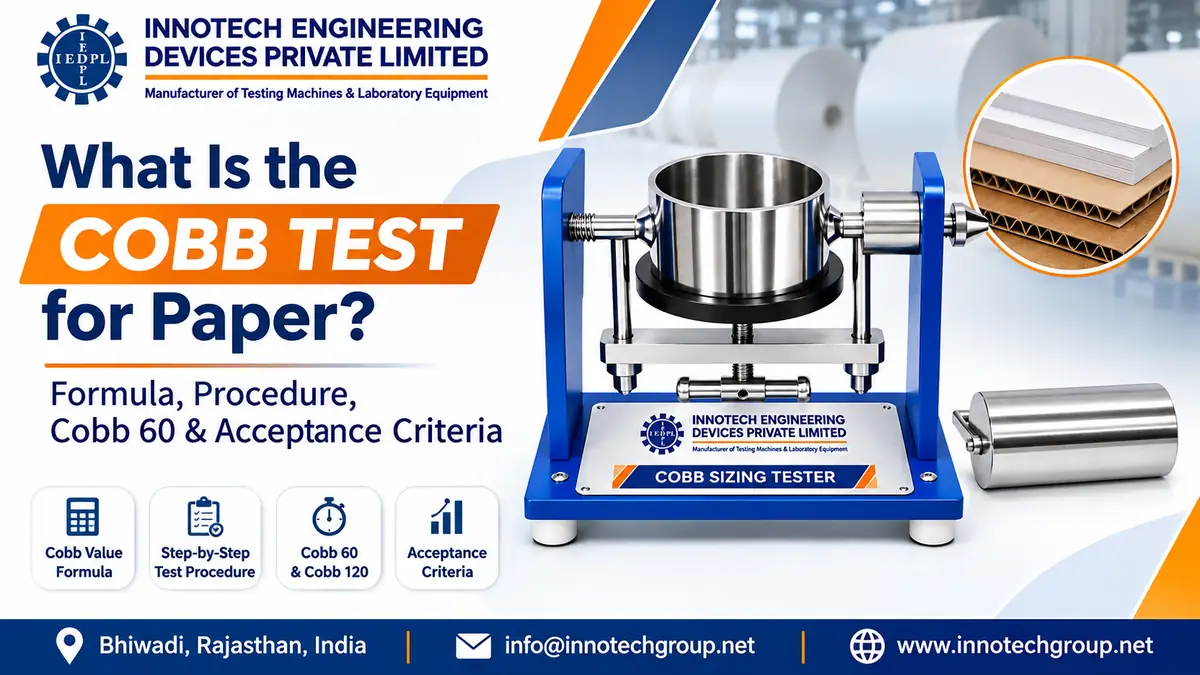
What Is the Cobb Test for Paper? Formula, Procedure, Cobb 60 & Acceptance Criteria
Why do two corrugated boxes manufactured from paper of similar thickness and grammage perform differently when exposed to moisture? Why do some paper products absorb excessive water, develop surface defects or lose packaging performance during storage and transportation?
One important factor is the water absorptiveness of paper and board, which can be evaluated using a Cobb Sizing Tester.
The Cobb Test for Paper is a widely used laboratory method for determining the quantity of water absorbed by paper, paperboard and corrugated fibreboard during a specified period. It helps paper manufacturers, packaging industries and quality control laboratories monitor material consistency and surface-sizing performance.
Innotech Engineering Devices Pvt. Ltd., a Cobb Sizing Tester manufacturer in Bhiwadi, Rajasthan, India, manufactures standard and customised paper testing instruments according to customer-specific technical requirements.
What Is the Cobb Test for Paper?
The Cobb test determines the water absorbed by a defined surface area of paper or board under specified testing conditions.
The result, known as the Cobb value, is expressed in grams per square metre (g/m²).
The test is particularly useful for evaluating suitable grades of kraft paper, paperboard, linerboard, corrugated fibreboard and packaging materials.
A lower Cobb value generally indicates lower water absorption under comparable testing conditions.
The Cobb Sizing Tester is also known as:
- Cobb Tester.
- Cobb Water Absorption Tester.
- Cobb Test Apparatus.
- Paper Water Absorption Testing Machine.
Industrial laboratories can explore Innotech's Cobb Sizing Tester for Paper and Corrugated Board for application-specific equipment requirements.
Why Is Cobb Testing Important in the Paper and Packaging Industry?
Excessive water absorption can influence the performance of paper-based products during converting, storage, transportation and use.
Cobb sizing testing helps manufacturers:
- Monitor surface-sizing consistency.
- Evaluate incoming paper and board quality.
- Compare different paper suppliers.
- Investigate moisture-related packaging problems.
- Verify customer-specific material requirements.
- Evaluate changes in sizing and coating processes.
- Identify variations between production batches.
Cobb testing measures water absorptiveness, not waterproofness, wet tensile strength or complete packaging performance. Additional testing may be necessary depending on the application.
Industry Standards for Cobb Sizing Testing
| Testing Standard |
Application |
| ISO 535:2023 | Determination of water absorptiveness of paper and board |
| TAPPI T 441 | Water absorptiveness of sized paper, paperboard and corrugated fibreboard |
| IS 1060 (Part 1) | Testing requirements for paper and allied products, wehre applicable |
| FEFCO Test Method No. 7 | Water absorptiveness of corrugated fibreboard |
| GB/T 1540 | Water aborptiveness testing of paper and board |
Laboratories should follow the applicable standard and edition specified by their customers. Testing durations and procedural requirements may differ between standards.
Equipment Required for a Cobb Water Absorption Test
A conventional Cobb testing setup includes:
- Cobb Test Apparatus with a defined test area.
- Water reservoir or test cylinder.
- Specimen clamping and sealing arrangement.
- Nominal 10 kg couch roller.
- Suitable precision weighing balance.
- Graduated measuring cylinder.
- Stopwatch or digital timer.
- Suitable blotting paper.
- Specimen cutting template.
- Water of the quality specified by the testing standard.
The commonly used exposed test area is 100 cm², corresponding to an internal cylinder diameter of approximately 112.8 mm.
Cobb Test Procedure: Step-by-Step Guide
Step 1: Prepare and Condition the Specimen
Select representative paper or board specimens. Condition them according to the applicable standard and avoid damaged, contaminated or visibly defective areas unless the investigation specifically requires them.
Step 2: Record the Initial Weight
Weigh the prepared specimen using a suitable precision balance and record its initial mass.
Step 3: Mount the Specimen
Place the specimen in the Cobb Sizing Tester with the required testing surface exposed. Secure the clamping arrangement to prevent leakage.
Step 4: Introduce the Test Water
For a conventional 100 cm² test area, a commonly specified quantity is 100 mL of water.
Start timing as the water contacts the specimen.
Step 5: Maintain the Specified Exposure
Follow the timing sequence defined by the selected standard. The nominal test duration includes prescribed water removal and blotting operations.
Step 6: Remove Excess Water
Remove the remaining water at the specified time and transfer the specimen to suitable blotting paper.
Step 7: Blot the Specimen
Use the standard weighted couch roller and prescribed blotting procedure to remove excess surface water consistently.
Step 8: Record the Final Weight
Promptly weigh the specimen and record its final mass.
Calculate the Cobb value using the difference between initial and final specimen weights.
Reject invalid measurements, including leakage or other conditions identified by the applicable test method.
Cobb 60 vs Cobb 120: Understanding Test Duration
ISO 535 specifies different nominal test durations and corresponding water removal and blotting times.
| Test designation |
Water removal time |
Norminal blotting time |
| Cobb 30 | 20 sec | 30 sec |
| Cobb 60 | 45 sec | 60 sec |
| Cobb 120 | 105 sec | 120 sec |
The table shows nominal timings. Follow the applicable standard for permitted tolerances and the complete procedure.
A Cobb 60 test does not mean leaving the water in contact with the paper for the entire 60 seconds.
Cobb 60 and Cobb 120 results cannot be converted into one another using simple multiplication because the relationship between absorption and exposure time is not necessarily linear.
Cobb Test Formula and Value Calculation
The Cobb value of paper is calculated using the following formula:
Cobb Value (g/m²) = [(W₂ − W₁) × 10,000] ÷ A
Where:
- W₁ = Initial specimen mass in grams.
- W₂ = Final specimen mass in grams.
- A = Exposed test area in cm².
For a standard test area of 100 cm²:
Cobb Value = (W₂ − W₁) × 100
Practical Calculation Example
| Parameter |
Recorded value |
| Initial specimen weight | 3.25g |
| Final specimen weight | 3.61g |
| Water absorbed | 0.36g |
| Test area | 100 cm² |
Cobb value = (3.61 − 3.25) × 100
Result: 36 g/m²
If this measurement was obtained using the Cobb 60 procedure, the result would be reported as Cobb 60 = 36 g/m².
What Is a Good Cobb Value for Paper?
There is no universal acceptable Cobb value for every paper grade.
The appropriate value depends on material type, surface treatment, intended application, testing duration and customer requirements.
Packaging intended to resist moisture may require lower water absorptiveness, while certain converting or bonding applications may require different absorption characteristics.
ISO 535 and TAPPI T 441 establish testing methods rather than one universal acceptance limit for all paper products.
Practical Quality Control Case: Comparing Three Paper Suppliers
Consider a hypothetical corrugated box manufacturer purchasing kraft paper from three suppliers.
The agreed purchase specification requires a maximum Cobb 60 value of 35 g/m² for the evaluated surface.
| Suppplier |
Test 1 |
Test 2 |
Test 3 |
Average |
| A | 28 | 30 | 29 | 29 |
| B | 38 | 42 | 40 | 40 |
| C | 25 | 45 | 35 | 35 |
All values are expressed in g/m².
Supplier A demonstrates consistent results within the illustrative limit. Supplier B exceeds it. Supplier C achieves an acceptable average but exhibits considerable variation.
If the specification requires every individual result to remain below or equal to 35 g/m², Supplier C would not qualify.
This demonstrates why laboratories should assess individual measurements, average values and sample variability before accepting a material batch.
Seven Common Cobb Testing Errors and Their Solutions
| Testing error |
Corrective action |
| Water leaking around the cylinder | Inspect the sealing pad and clamping arrangement |
| Incorrect specimen conditioning | Follow the prescribed conditioning procedure |
| Incorrect water removal timing | Use a reliable stop watch or timer |
| Delayed final weighing | Weight promptly to minimise evalporation effects |
| Incorrect exposed test area | Verify the test cylinder dimensions |
Small weighing errors can influence the reported Cobb value.
For a 100 cm² test area, a mass difference error of 0.01 g changes the calculated result by 1 g/m².
Appropriate balance resolution, controlled handling and consistent test procedures are therefore essential.
What Should a Cobb Test Report Include?
A useful laboratory report should record:
- Material grade, supplier and batch identification.
- Tested specimen surface.
- Applicable standard and edition.
- Nominal test duration.
- Exposed test area.
- Initial and final specimen weights.
- Individual Cobb values and required statistical results.
- Acceptance criteria and test deviations.
This information helps customers reproduce and evaluate reported results.
How to Choose the Right Cobb Sizing Tester
Before purchasing a Cobb Tester for paper or corrugated board, confirm the specimen thickness range, exposed test area, clamping arrangement, roller specification, weighing balance requirements and applicable industry standard.
Customers comparing Cobb Sizing Tester manufacturers and suppliers in India should also evaluate the supplied accessories, technical documentation and availability of suitable customisation.
Cobb Sizing Tester Manufacturer in Bhiwadi, Rajasthan, India
Innotech Engineering Devices Pvt. Ltd. manufactures industrial testing machines according to customer requirements.
Our Cobb Sizing Testers can be configured for suitable paper, packaging and corrugated board applications, subject to the applicable testing method.
We welcome enquiries from paper mills, packaging manufacturers and laboratories in Bhiwadi, Tapukara, Khushkhera, Neemrana, Alwar, Jaipur, Delhi NCR and throughout India.
International buyers can also request customised equipment configurations and export quotations.
The Cobb Tester price depends on the selected construction, fixture configuration, accessories and scope of supply.
Frequently Asked Questions
What is the full form of Cobb Tester?
Cobb is not an acronym. It refers to the Cobb water absorptiveness test method.
What is the unit of Cobb value?
Grams per square metre (g/m²).
Is a lower Cobb value always better?
No. The required water absorption characteristics depend on the intended application and material specification.
Can a Cobb Tester measure wet tensile strength?
No. Wet tensile strength and water absorptiveness are different material properties requiring different testing methods.
Where can I buy a Cobb Sizing Tester in India?
Innotech manufactures standard and customised Cobb Sizing Testers in Bhiwadi, Rajasthan, India.
Request Cobb Sizing Tester Price and Specifications
Looking for a reliable Cobb Water Absorption Tester for your paper mill, packaging industry or quality control laboratory?
Share your applicable industry standard, specimen dimensions and technical requirements with Innotech.
Explore our Cobb Sizing Tester and request a customised quotation https://innotechgroup.net/products/cobb-sizing-tester
Innotech Engineering Devices Pvt. Ltd.
Manufacturer of Industrial Testing Machines
Bhiwadi, Rajasthan, India
Phone: +91 9810431604
Email: info@innotechgroup.net
Category: Paper Testing Equipment
Tags: Cobb Test for Paper, Cobb Sizing Tester, Cobb Sizing Test, Cobb Test Procedure, Cobb Test Formula, Cobb Value of Paper, Cobb Value Calculation, Cobb 60 Test, Cobb 120 Test, Cobb Tester Full Form, Cobb Water Absorption Test, Cobb Water Absorption Tester, C
Last Updated: 28 November 2026