
Bursting Strength Test for Paper & Corrugated Boxes: Procedure, Formula & Applications
Jay Pal Singh
05 October 2026
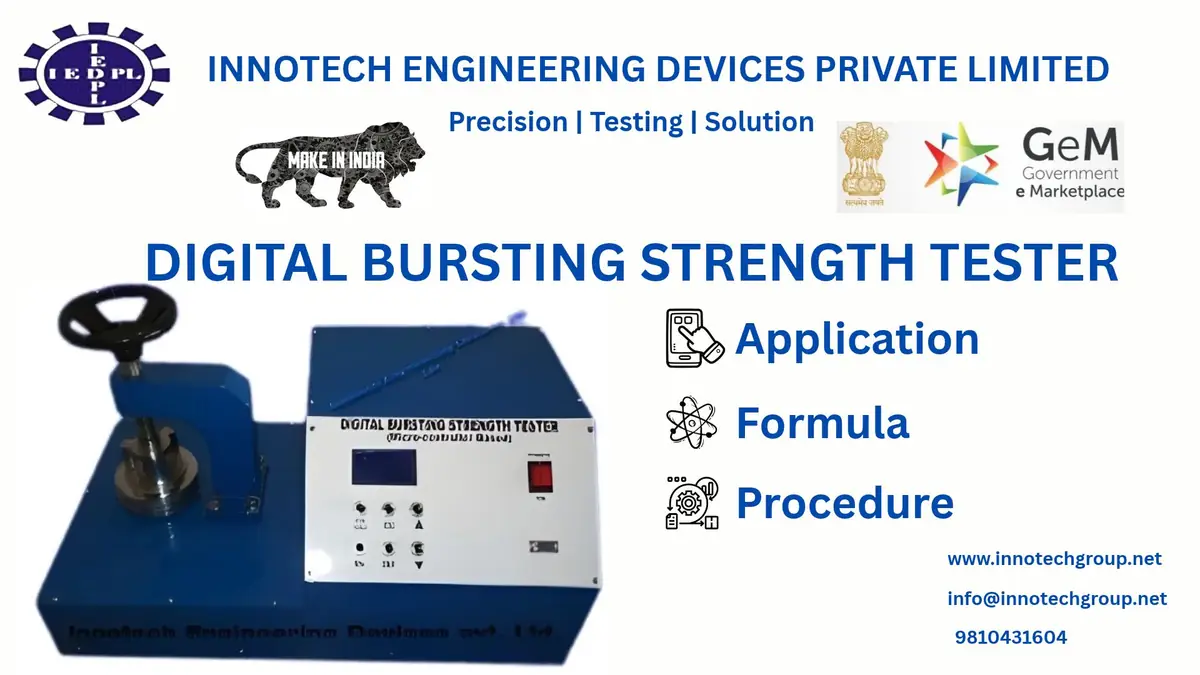
Bursting Strength Test for Paper & Corrugated Boxes: Procedure, Formula & Applications
Paper and corrugated boxes are widely used for packaging, transportation and storage. During handling and distribution, packaging materials may experience pressure, impact, stacking loads and other mechanical stresses. Their ability to resist these forces is important for protecting the packed products.
The bursting strength test is a commonly used quality-control test to measure the resistance of paper, paperboard and corrugated board to rupture under increasing pressure. A bursting strength tester applies controlled hydraulic pressure to a clamped test specimen until the material bursts. The maximum pressure at failure is recorded as its bursting strength.
For packaging manufacturers, paper mills, corrugated box manufacturers and testing laboratories, this test helps evaluate material quality and maintain consistent packaging performance.
Innotech Engineering Devices Pvt. Ltd. manufactures and supplies testing machines and laboratory equipment from Bhiwadi, Rajasthan, India. Contact our team for information about bursting strength testing equipment and machine requirements.
What Is Bursting Strength?
Bursting strength is the maximum hydraulic pressure that a paper or board specimen can withstand before it ruptures under the specified test conditions.
During the test, a flat specimen is held firmly between circular clamping plates. An expandable diaphragm applies pressure against the specimen. Pressure increases until the material bursts, and the maximum pressure reached is recorded.
Bursting strength is generally expressed in:
- kPa (kilopascals)
- kgf/cm² (kilogram-force per square centimetre)
- psi (pounds per square inch)
A higher bursting strength value generally indicates greater resistance to this particular type of pressure-induced rupture. However, it does not automatically mean that a carton will have better stacking strength or overall packaging performance.
What Is a Bursting Strength Test for Paper and Corrugated Boxes?
The bursting strength test is used to evaluate the resistance of packaging materials to rupture when pressure is applied through a flexible diaphragm.
The test is relevant to different materials, but the appropriate testing method depends on the specimen.
- Paper bursting strength test: Used to measure the resistance of paper sheets to bursting pressure.
- Corrugated board bursting strength test: Used to evaluate the bursting resistance of corrugated fibreboard, including suitable single-wall and double-wall board specimens.
- Carton bursting strength test: The test is generally performed on a representative corrugated board specimen taken from the carton material. It evaluates the board's resistance to bursting, not the complete carton's stacking performance.
This distinction is important because paper, linerboard and corrugated board may require different test methods and equipment configurations.
How Does a Bursting Strength Tester Work?
A bursting strength tester generally works on the hydraulic pressure principle.
The instrument has a clamping arrangement, a flexible rubber diaphragm, a pressure-generating system and a pressure-measuring arrangement.
During operation:
1. A prepared specimen is placed over the diaphragm.
2. The specimen is secured between the clamping plates.
3. Hydraulic pressure is applied through the diaphragm.
4. The diaphragm expands and places increasing pressure on the specimen.
5. The pressure continues to increase until the specimen ruptures.
6. The maximum pressure indicated by the instrument is recorded.
The recorded value represents the bursting strength under the selected test method and test conditions.
Bursting Strength Test Procedure: Step-by-Step
A proper bursting strength test procedure is important for obtaining consistent and repeatable results.
Step 1: Prepare the Test Specimen
Cut representative samples from the paper or corrugated board according to the applicable test method. Avoid damaged, folded, creased or visibly defective areas unless those areas are specifically being investigated.
Step 2: Condition the Samples
Condition the specimens in the atmosphere specified by the relevant testing standard or customer specification. Moisture content and temperature can influence paper and board properties.
Step 3: Check the Testing Instrument
Ensure that the bursting strength tester is clean, correctly assembled and suitable for the material being tested. Check the diaphragm, clamping surfaces, pressure system and measuring arrangement.
Step 4: Position the Specimen
Place the specimen centrally over the diaphragm and within the clamping area. Ensure that the material is positioned correctly and is not wrinkled.
Step 5: Clamp the Specimen
Secure the specimen using the instrument's clamping arrangement. The specimen must remain firmly held during the test without slipping.
Step 6: Apply Hydraulic Pressure
Start the test. The instrument applies increasing hydraulic pressure through the expanding diaphragm until the specimen bursts.
Step 7: Record the Maximum Pressure
Record the maximum pressure reached immediately before specimen failure. Use the measurement unit specified by the test method.
Step 8: Repeat and Evaluate
Perform the required number of tests on representative specimens. Calculate the average where required and compare the results with the material specification or customer acceptance criteria.
Important: The specimen preparation, conditioning, clamping, test rate and number of measurements should follow the applicable standard. Do not compare results obtained using different methods or incompatible instrument configurations without checking their requirements.
Bursting Strength Formula
The bursting strength formula depends on the type of result being calculated.
Two commonly used terms are bursting strength and bursting factor.
1. Bursting Strength
Bursting strength is the maximum pressure recorded when the test specimen ruptures.
For example:
If a paper specimen bursts at a maximum pressure of 3.5 kgf/cm², its measured bursting strength is 3.5 kgf/cm² under that test condition.
2. Bursting Factor Formula
The commonly used bursting factor formula is:
Bursting Factor (BF) = Bursting Strength × 1000 / Grammage (GSM)
Where:
- Bursting strength is expressed in kgf/cm².
- Grammage is expressed in g/m².
- BF is the bursting factor calculated using this conventional unit combination.
Bursting Factor Formula with Example
Suppose a paper sample has:
- Bursting strength = 14 kgf/cm²
- Grammage = 120 GSM
Applying the formula:
Bursting Factor = (14 × 1000) / 120
Bursting Factor = 14000 / 120
Bursting Factor = 116.67
Therefore, the calculated bursting factor is approximately 116.67.
This is an illustrative calculation. Actual results depend on the measured bursting strength and grammage of the sample.
3. Burst Index Formula
Burst index is another way of expressing bursting performance, particularly in paper testing.
Burst Index = Bursting Strength (kPa) / Grammage (g/m²)
The result is commonly expressed in kPa·m²/g.
Do not mix the burst index formula with the conventional bursting factor formula. They use different units and conventions.
Difference Between Bursting Strength and Bursting Factor
| Parameter |
Bursting Strength |
Bursting Factor |
| Meaning | Maximum pressure before rupture | Bursting strength relative to grammage |
| Calculation | Measured by the tester | Calculated using bursting strength and GSM |
| Common units | kPa, kgf/cm², psi |
Conventional BG Value |
| Main use | Meaures resistance to bursting pressure | Compares bursting performance relative to paper grammage |
Bursting strength is the measured test result, while bursting factor is a calculated value. Both are useful for evaluating paper and packaging material quality.
Bursting Strength of Paper vs Corrugated Board
Paper and corrugated board are different materials and should not automatically be tested using the same procedure.
| Comparison |
Paper |
Corrugated Board |
| Material | Single or laminated paper sheets | Combined structure of liners and fluting |
| Test Objective | Measure resistance to bursting pressure | Measure bursting resistance of board |
| Typical application | Paper mills and paper quality laboratories | Corrugated box and packaging manufacturers |
| Relevant ISO standard | ISO 2758 | ISO 2759 |
| Relevant TAPPI method |
TAPPI T 403 | TAPPI T 810 |
The test method must be selected according to the actual material, its construction and the applicable customer or product specification.
Standards for Bursting Strength Testing
Selecting the correct test standard is important for reliable and comparable test results.
ISO 2758 – Paper Bursting Strength
ISO 2758:2014 specifies a method for measuring the bursting strength of paper subjected to increasing hydraulic pressure. Its stated application range is 70 kPa to 1,400 kPa.
It is intended for paper and is not the preferred method for components such as fluting medium or linerboard in combined board.
ISO 2759 – Board Bursting Strength
ISO 2759:2014 specifies a method for determining the bursting strength of board, including corrugated and solid fibreboard. Its stated application range is 350 kPa to 5,500 kPa.
TAPPI T 403 – Bursting Strength of Paper
TAPPI T 403 is the test method for measuring the bursting strength of paper. It should not be treated as the corrugated board test method.
TAPPI T 810 – Bursting Strength of Corrugated Board
TAPPI T 810 describes a procedure for measuring the bursting strength of single-wall and double-wall corrugated board using a diaphragm-based instrument. The published method scope specifies a range of 690 kPa to 4,825 kPa and does not cover triple-wall corrugated board.
Always confirm the latest applicable edition and the customer's required method before selecting a testing instrument.
Bursting Strength Test vs Box Compression Test
Bursting strength and box compression strength are different packaging properties.
A bursting strength test measures the resistance of a paper or board specimen to pressure-induced rupture.
A box compression test measures the ability of a complete box or carton to withstand compressive loading, such as stacking pressure during storage and transportation.
| Parameter |
Bursting Strength Test |
Box Compression Test |
| Test specimen | Paper or board sample | Complete box or carton |
| Main measurement | Pressure at rupture | Compressive load at deformation or failure |
| Main purpose | Evaluate bursting resisitance | Evaluate stacking and compression performance |
| Typical equipement | Bursting strength tester | Box compression testing machine |
| Result | kPa, kgf/cm² or psi |
N, kN or kgf |
If you are searching for a corrugated box compressive strength calculation, note that it is not the same as the bursting strength formula. Box compression calculations may use factors such as edge crush strength, board thickness and box dimensions. Actual box compression performance should be evaluated using the applicable compression test method.
Applications of Bursting Strength Testing
Bursting strength testing is used in packaging and paper-related industries to evaluate material quality.
1. Corrugated Box Manufacturing
Corrugated box manufacturers use bursting strength tests to check the resistance of board material to bursting pressure and maintain consistency between production batches.
2. Paper Mills
Paper manufacturers evaluate the bursting strength of paper to monitor product quality and compare material performance against specifications.
3. Packaging Material Manufacturing
Packaging material manufacturers use the test to assess paperboard and suitable packaging substrates used in protective packaging.
4. Quality Control Laboratories
Testing laboratories perform bursting strength measurements for incoming material inspection, production quality checks and customer testing requirements.
5. Printing and Paper Converting Industries
Paper converting and printing businesses may evaluate the strength characteristics of paper and board before selecting materials for specific packaging applications.
6. Research and Development
R&D teams use test results to compare material grades, evaluate changes in paper composition and study the influence of manufacturing processes on bursting performance.
Factors Affecting Bursting Strength of Paper and Corrugated Board
Several material and testing factors can influence the measured bursting strength.
- Grammage: The mass of paper per unit area can influence its strength characteristics.
- Moisture content: Changes in moisture can affect the mechanical properties of paper and board.
- Fibre quality: Fibre composition and bonding influence the strength of paper.
- Board construction: Liner quality, fluting medium and board structure can affect corrugated board performance.
- Manufacturing quality: Variations in material formation, bonding and production processes may influence test results.
- Specimen condition: Damaged, creased or poorly prepared samples can produce misleading results.
- Testing conditions: Clamping, diaphragm condition, conditioning and test procedure can affect repeatability.
For meaningful comparisons, samples should be prepared and tested under consistent conditions.
How to Select a Bursting Strength Tester?
Selecting the correct bursting strength testing machine depends on the material, expected pressure range and applicable test standard.
Before purchasing a machine, consider the following points:
| Selection Factor |
What to Check |
| Material Type | Paper, paperboard, linerboard or corrugated board |
| Testing standard | ISO, TAPPI or customer-specific method |
| Pressure range | Suitable for the expected bursting strength |
| Measuring unit | kPa, kgf/cm² or psi |
| Clamping arrangement | Suitable for the specimen and test method |
| Diaphragm | Correct type and compatibility with the test method |
| Pressure system | Consistent and contrlled pressure application |
| Display | Clear measurementd and result presentation |
| Calibration | Availability of calibration and verification support |
Manual vs Digital Bursting Strength Tester
A manual instrument may be suitable for certain basic testing requirements, depending on its design and the applicable standard.
A digital bursting strength tester may provide an electronic display and easier reading of test results. Depending on the model, it may also offer additional data-recording or reporting features.
Before purchasing, verify the instrument's actual specifications, pressure range, measurement accuracy, clamping arrangement and compliance with the required test method. Do not select a machine only because it is described as digital or automatic.
Why Choose Innotech for Testing Machines?
Innotech Engineering Devices Private Limited is a manufacturer and supplier of testing machines and laboratory equipment based in Bhiwadi, Rajasthan, India.
We work with industrial buyers, manufacturers and testing laboratories looking for equipment for material evaluation and quality-control applications.
When discussing your bursting strength testing requirements with our team, share:
- Whether you need to test paper or corrugated board.
- The applicable ISO, TAPPI or customer-specific test method.
- The expected bursting strength range.
- Your required measurement units.
- Any digital display, data recording or reporting requirements.
- Your laboratory or production testing requirements.
This information helps our team understand your application and discuss a suitable machine configuration.
We serve customers across India, including Delhi NCR, Mumbai, Chennai, Kolkata, Bengaluru, Ahmedabad, Pune, Jaipur and other industrial locations. Machine suitability and configuration should be confirmed against your technical requirements.
Frequently Asked Questions About Bursting Strength Testing
1. What is a bursting strength test?
A bursting strength test measures the maximum pressure that paper or board can withstand before rupturing under a specified test procedure.
2. What is the bursting strength tester used for?
A bursting strength tester is used to evaluate the resistance of paper, paperboard and suitable corrugated board specimens to pressure-induced rupture.
3. What is the formula for bursting strength?
Bursting strength is the maximum pressure recorded when the specimen bursts. It is measured by the testing instrument and is generally expressed in kPa, kgf/cm² or psi.
4. What is the bursting factor formula?
The conventional formula is:
Bursting Factor = Bursting Strength (kgf/cm²) × 1000 / Grammage (GSM).
5. How is the bursting factor of paper calculated?
Measure the bursting strength of the paper, determine its grammage and apply the conventional bursting factor formula using the specified units.
6. What is the difference between bursting strength and burst index?
Bursting strength is the maximum pressure at rupture. Burst index is the bursting strength in kPa divided by the paper grammage in g/m².
7. Which standard is used for corrugated box bursting strength testing?
ISO 2759 and TAPPI T 810 are relevant methods for corrugated and other board testing, subject to their respective scopes and specimen requirements.
8. Which standard is used for paper bursting strength testing?
ISO 2758 and TAPPI T 403 are commonly referenced methods for paper bursting strength testing.
9. Is bursting strength the same as box compression strength?
No. Bursting strength evaluates the pressure required to rupture a board specimen. Box compression strength evaluates the compressive load a complete box can withstand.
10. What is the difference between a manual and digital bursting strength tester?
A digital tester generally provides an electronic display of the measurement. Actual features vary by model, so buyers should check the instrument specifications and test-method compatibility.
11. How many samples should be tested?
The number of specimens depends on the applicable test standard, customer specification and testing objective. Follow the required method rather than using an arbitrary sample count.
12. Where can I buy a bursting strength tester in India?
You can contact Innotech Engineering Devices Pvt. Ltd., a testing machine manufacturer and supplier based in Bhiwadi, Rajasthan, for information about your paper or corrugated board testing requirements.
13. Can I get a bursting strength testing machine for corrugated boxes in Delhi, Mumbai or Chennai?
Contact Innotech Engineering Devices Pvt. Ltd. in Bhiwadi, Rajasthan, for product information and supply enquiries across India, including Delhi NCR, Mumbai, Chennai and other locations. Confirm the required test method and machine configuration before ordering.
14. What information is required before selecting a bursting strength tester?
Share the material type, expected pressure range, applicable standard, specimen requirements and desired measurement features. These details help determine a suitable testing configuration.
Contact Innotech for Bursting Strength Testing Machine Requirements
Looking for a bursting strength tester for paper or corrugated boxes?
Contact Innotech Engineering Devices Pvt. Ltd. for product information, technical discussions and quotation enquiries. Our team can discuss your testing application and machine requirements.
Innotech Engineering Devices Private Limited
OEM Manufacturer of Testing Machines & Laboratory Equipment
H-307 RIICO Industrial Area Karoli, Tapukara, Bhiwadi, Rajasthan, India
Email: info@innotechgroup.net
Phone: +91 9810431604
Contact us to discuss your paper and corrugated board testing requirements.
Category: Packaging Testing Equipment
Tags: Bursting Strength Test, Bursting Strength Tester, Bursting Strength Testing Machine, Paper Bursting Strength, Bursting Strength of Paper, Corrugated Box Bursting Strength, Box Bursting Strength Test, Carton Bursting Strength, Paper Testing Machine, Packag
Last Updated: 04 November 2026