
Bag Tensile Testing Machine: Working Principle, Applications, Specifications & Manufacturer in India
Jay Pal Singh
07 November 2026
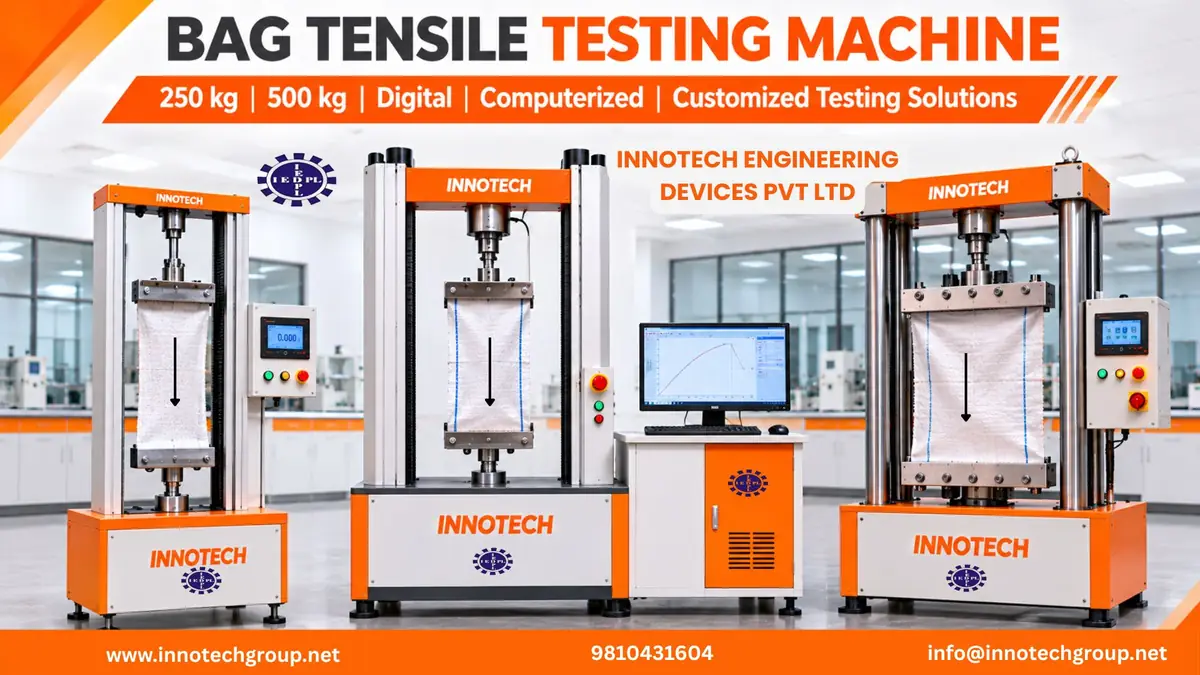
Bag Tensile Testing Machine: Working Principle, Applications, Specifications & Manufacturer in India
Introduction
Have you ever wondered how manufacturers check whether a plastic bag, cement bag or woven packaging bag can withstand the load it is designed to carry? A bag may look strong from the outside, but its actual strength depends on the quality of its material, weaving, thickness and manufacturing process.
This is where a Bag Tensile Testing Machine becomes important.
A bag tensile testing machine is a laboratory testing instrument used to measure the tensile strength, breaking force and elongation of bag materials. It helps manufacturers understand how much pulling force a material can withstand before it stretches excessively or breaks.
Industries manufacturing HDPE bags, PP woven sacks, cement bags, fertilizer bags, sugar bags and other flexible packaging materials use tensile testing to maintain product quality.
Innotech Engineering Devices Private Limited, based in Bhiwadi, Rajasthan, India, is developing customized bag tensile testing machines with different capacities, including 250 kgf and 500 kgf models, along with digital and computerized configurations to meet different industrial testing requirements.
What Is a Bag Tensile Testing Machine?
A Bag Tensile Testing Machine is designed to evaluate the strength of bag fabric and other flexible packaging materials by applying a controlled pulling force.
During testing, a prepared specimen is held between two specially designed grips. One grip remains stationary, while the other moves at a controlled speed. As the grips move apart, tension is applied to the specimen.
The machine measures the force required to stretch or break the material and can also measure elongation, depending on its configuration.
The test helps manufacturers evaluate:
- Maximum force required to break the specimen/
- Tensile strength of the tested material.
- Elongation before breaking.
- Material stretching behaviour.
- Consitency between different production batches.
The machine is particularly useful for quality control laboratories where bag manufacturers need reliable and repeatable test results.
Why Is Bag Tensile Testing Important?
Packaging bags are used to carry products during filling, handling, storage and transportation. Weak material or poor manufacturing quality can result in bag failure, product leakage and customer complaints.
For example, cement bags must withstand filling and transportation operations, while fertilizer and sugar bags need sufficient strength for storage and handling.
A bag tensile testing machine helps manufacturers:
- Check material quality: Identify whether the bag fabric has sufficient tensile strength.
- Reduce bag failure: Detect weak materials before they become finished products.
- Improce production quality: Compare samples from different production batches.
- Evaluate elongation: Understand how much the material stretches under pulling force.
- Compare raw materials: Evaluate different HDPC, PP and other flexible packaging materials.
- Maintain quality records: Store test readings and reports for future reference when computerized software is provided.
- Support product development: Help manufacturers evaluate new material combinations and manufacturing processes.
Working Principle of Bag Tensile Testing Machine
The working principle is based on the constant-rate-of-traverse method, where a test specimen is pulled between two grips at a controlled speed.
The machine generally consists of a load frame, load cell, motor, gearbox, screw mechanism, moving crosshead, grips and a digital or computerized control system.
How Does the Machine Work?
Step 1: Prepare the specimen
A test sample is cut from the bag fabric according to the dimensions and preparation procedure specified by the applicable test method.
Step 2: Fix the specimen
The prepared sample is placed between the upper and lower grips. Proper gripping is important to prevent slipping or unwanted damage near the gripping area.
Step 3: Set testing parameters
The operator selects the required test speed, measurement units and test settings according to the selected testing procedure.
Step 4: Apply tensile force
The motor-driven mechanism moves the crosshead at the selected speed, gradually pulling the specimen.
Step 5: Measure force and elongation
The load cell measures the applied force, while the machine's displacement or elongation measuring system records the extension.
Step 6: Record the result
When the specimen breaks or the test reaches its specified endpoint, the system records the relevant readings. A computerized version can display a load-versus-elongation graph and generate a test report.
This process allows manufacturers to compare the strength and stretching behaviour of different samples under controlled testing conditions.
Main Components of a Bag Tensile Testing Machine
A properly configured machine generally includes:
- Load Cell: Measures the tensile force applied to the specimen.
- Motor and Gearbox: Drive the moving crosshead.
- Ball Screw or Screw Mechanism: Provides controlled and smooth movement.
- Upper and Lowerr Grips: Hold the specimen during testing.
- Digital Controller: Displays force, elongation and test parameters.
- Computer Software: Records readings, graphs and test reports in computerized models.
- Safety System: Provides protection against overload and excessive crosshead travel.
The grip design is particularly important. Different bag materials require suitable gripping arrangements to reduce slippage and avoid premature failure at the gripping points.
Technical Specifications of Bag Tensile Testing Machine
The machine can be configured according to the material, testing load and laboratory requirements.
| Parameter |
Available / Proposed Configuration |
| Machine Type | Bag Tensile Testing Machine |
| Load Capacity | 250 kgf / 500 kgf or more |
| Higher Capacity | As per customer requirement |
| Machine Operation | Digital / Computerized |
| Load Measurement | Electronic Load Cell |
| Force Display | kgf, N or kN |
| Elongation Measurement | Digital measurement system |
| Crosshead Movement | Motorized |
| Speed | Selectable as per test method |
| Gripping System | Application-specific grips |
| Data Recording | Digital / Computer Software |
| Graph | Load vs Elongation, computerized version |
| Test Reports | Available with suitable software |
| Safety | Overload and travel protection, as configured |
Note: These are proposed configuration options, not a finalized production specification. Actual accuracy, speed range, travel, dimensions, power supply, grip design and software functions will be confirmed according to the selected model and customer requirements.
Digital vs Computerized Bag Tensile Testing Machine
Choosing the right machine depends on how frequently testing is performed and how the laboratory manages its test results.
Digital Bag Tensile Testing Machine
A digital bag tensile testing machine displays the applied load and elongation on a digital controller.
It is suitable for laboratories that need straightforward testing, direct readings and convenient operation without advanced computer-based reporting.
Main advantages:
- Easy-to-read digital display
- Simple operation
- Direct load measurement
- Suitable for routine quality checks
- Economical configuration compared with advanced computerized systems.
Computerized Bag Tensile Testing Machine
A computerized tensile testing machine connects the testing system to a computer through dedicated software.
It provides additional facilities for test monitoring, data storage and result analysis.
Main advantages:
- Live test monitoring
- Load-versus-elongation graphs
- Automatice data recording
- Test history and result storage
- Report generation and printing
- Easier comparison between multiple test samples
For laboratories performing regular testing and maintaining quality documentation, a computerized model can be a practical choice.
Difference Between Bag Tensile Testing Machine and General Tensile Testing Machine
Both machines work on the tensile testing principle, but their configurations and applications can be different.
A general tensile testing machine is designed for testing a wide range of materials, such as metals, plastics, rubber and other materials, using suitable fixtures and test methods.
A bag tensile testing machine is configured specifically for bag fabrics and flexible packaging materials.
| Comparison |
Bag Tensile Testing Machine |
General Tensile Testing Machine |
| Main Application | Bag and packaging material testing | Multiple material testing |
| Test Samples | HDPE, PP woven bag fabric and other suitable materials | Metal, plastic rubber, films and more |
| Gripping Arrangement | Designed for bag fabric specimens | Depends on the materials |
| Capacity | Selected according to bag material requirements | Available in different load ranges |
| Testing Setup | Application-specific | General-purpose or application-specific |
| Customization | Bag-specific grips and fixtures | Multiple fixture and accessories |
A general tensile testing machine can also test bag materials if it has the correct load capacity, grips, travel and testing configuration. Therefore, the main difference is not simply the machine name but its suitability for the intended test.
Applications of Bag Tensile Testing Machine
Bag tensile testing equipment is used in several packaging and manufacturing industries.
- HDPE Bag Manufacturing: Testing the tensile properties of HDPE woven fabrics used for industrial packaging.
- PP Woven Stack Manufacturing: Evaluating the strength and elongation of polypropylene woven bag materials.
- Cement Industry: Checking the mechanical properties of cement packaging materials.
- Sugar Industry: Testing woven sacks used for sugar packaging.
- Fertilizer Industry: Evaluating packaging material used for fertilizer storage and transportation.
- Agriculture Industry: Testing bags used for grains, seeds and agricultural products.
- Food Packaging Industry: Checking the mechanical properties of suitable flexible packaging materials.
- Packaging Quality Control Laboratories: Performing routine material testing and maintaining quality records.
Which Testing Standards Are Used for Bag Tensile Testing?
The applicable testing standard depends on the bag construction, material and specimen type.
Some relevant standards and references include:
- IS 14968:2015: Specification for HDPE/PP woven sacks used for packaging 25 kg and 50 kg sugar.
- IS 1969 (Part 1): Relevantg method for determining the breaking strength of woven textile fabrics.
- ASTM D882: Tensile properties of thin plastic sheeting and films.
- ASTM D638: Tensile properties of plastic materials using standard specimens.
It is important to understand that IS 14968 is a product specification for particular HDPE/PP woven sacks, not a universal tensile testing procedure. The required specimen preparation, grip arrangement, speed and reporting method must be selected according to the applicable test requirement.
How to Select the Right Bag Tensile Testing Machine?
Before purchasing a machine, consider the following points:
1. Testing Material: Confirm whether you will test HDPE, PP woven fabric, nonwoven material or another packaging material.
2. Load Capacity: Select 250 kgf, 500 kgf or another suitable capacity according to the expected breaking force.
3. Machine Type: Choose digital operation for routine testing or computerized operation for graphs and detailed reporting.
4. Grip Design: Ensure the grips are suitable for your specimen and test method.
5. Elongation Measurement: Check the required measuring range and accuracy.
6. Testing Speed: Confirm that the machine supports the speed required by your testing procedure.
7. Software Requirements: Consider data storage, graph generation, report formats and result comparison.
8. Future Requirements: If you plan to test different materials later, discuss suitable customization options.
Selecting the correct capacity is important. A machine should not be selected only because it has a higher load rating. The load cell range, expected breaking force and required measurement resolution should all be considered.
Bag Tensile Testing Machine Manufacturer in India – Innotech
Innotech Engineering Devices Private Limited is an OEM manufacturer of testing machines and laboratory equipment based in Bhiwadi, Rajasthan, India.
We are developing customized bag tensile testing machines for packaging manufacturers, industrial laboratories and quality control departments.
Our proposed range includes 250 kgf and 500 kgf configurations, with options for digital and computerized operation. Higher capacities and application-specific modifications can also be discussed according to customer requirements.
We understand that every industry does not require the same testing arrangement. A cement bag manufacturer, an HDPE woven sack manufacturer and a flexible packaging laboratory may have different testing needs.
Therefore, we focus on selecting suitable load capacity, gripping arrangements, measuring systems and software configurations according to the intended application.
Why Consider Innotech?
- Customized testing machine solutions.
- 250 kgf and 500 kgf capacity options.
- Digital and computerized configurations.
- Application-specifc gripping arrangements.
- Solutions based on customer testing requirements.
- Manufacturing and technical support from Bhiwadi, Rajasthan.
- Suppply across India.
Whether you are looking for a bag tensile testing machine, HDPE bag testing machine, PP woven sack testing equipment or a customized computerized tensile testing machine, our team can help you identify a suitable configuration.
Frequently Asked Questions (FAQs)
1. What is a bag tensile testing machine used for?
It is used to measure the tensile strength, breaking force and elongation of bag fabrics and suitable flexible packaging materials.
2. Can the machine test HDPE and PP bags?
Yes. With suitable grips and test settings, it can test specimens prepared from HDPE and PP woven bag materials.
3. What capacities are available?
Innotech is developing 250 kgf and 500 kgf configurations. Other capacities can be considered according to customer requirements.
4. What is the difference between digital and computerized models?
A digital model displays test readings on its controller, while a computerized model can additionally provide software-based monitoring, graphs, data storage and test reports.
5. Can the bag tensile testing machine be customized?
Yes. Load capacity, grips, travel, measuring system and software configuration can be selected according to the application and test requirements.
6. Does the machine test complete bags or cut fabric samples?
A conventional tensile testing configuration generally tests prepared fabric specimens held between grips. Complete bag and jumbo bag load testing require a different test arrangement and may need a dedicated test rig.
7. How do I select the correct load capacity?
The expected breaking force of the specimen, material type, test method and required measurement accuracy should be considered before selecting a 250 kgf, 500 kgf or higher-capacity model.
Contact Innotech for a Customized Bag Tensile Testing Machine
Looking for a reliable Bag Tensile Testing Machine Manufacturer in India?
Discuss your testing requirements with Innotech Engineering Devices Private Limited. We can help you select a suitable digital or computerized machine with the required capacity and testing arrangement.
Innotech Engineering Devices Private Limited
Location: H-307, RIICO Industrial Area, Karoli, Tapukara, Bhiwadi, Rajasthan, India
Email: info@innotechgroup.net
Phone: +91 9810431604 / +91 8929666430
Contact our team for machine details, customization and a quotation.
Category: Packaging Testing Equipment
Tags: Bag Tensile Testing Machine, Bag Tensile Testing Machine Manufacturer in India, Bag Tensile Testing Machine Application, Specifications
Last Updated: 07 November 2026