
1200°C Muffle Furnace Manufacturer in India: Specifications, Applications & Selection Guide
Jay Pal Singh
23 November 2026
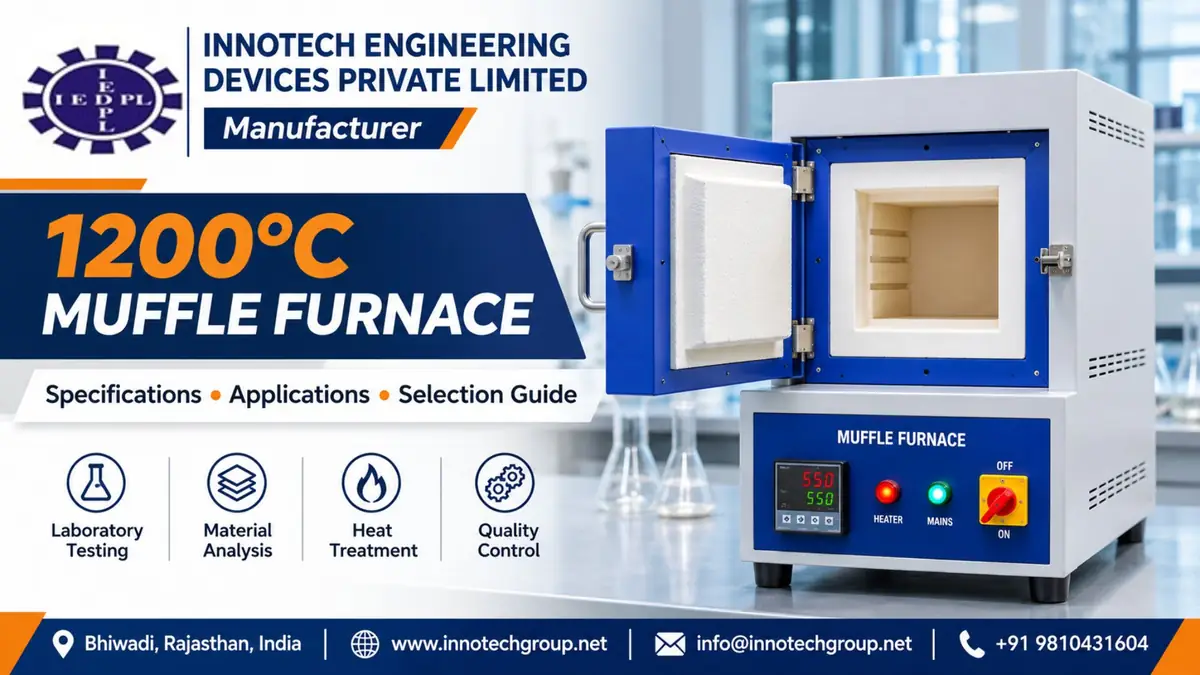
1200°C Muffle Furnace Manufacturer in India: Specifications, Applications & Selection Guide
Choosing a 1200°C muffle furnace is not simply about finding equipment that reaches a high temperature. For a testing laboratory, the important questions are whether the furnace can maintain the required temperature, accommodate the samples, follow the testing procedure, and deliver consistent results over repeated heating cycles.
A laboratory testing coal, cement, or minerals may need a furnace for ash determination or loss on ignition. A research institution may require controlled heating of ceramic powders, while a manufacturing quality control department may need a programmable furnace for material evaluation.
Innotech Engineering Devices Private Limited, based in Bhiwadi, Rajasthan, India, manufactures industrial testing machines and laboratory equipment for customers across India. This guide explains the specifications and practical considerations buyers should evaluate when selecting a laboratory muffle furnace.
What Is a 1200°C Muffle Furnace?
A 1200°C muffle furnace is an electrically heated laboratory furnace with a maximum rated temperature of 1200°C. It uses resistance heating elements, an insulated chamber, a temperature sensor, and an electronic controller to heat samples under controlled conditions.
It is commonly considered for laboratory processes such as:
- Ash content determination
- Loss on ignition (LOI)
- Calcination of suitable minerals and powders
- Heat treatment of small metal components
- Ceramic material research
- High-temperature sample preparation
- Industrial quality control and educational experiments
A 1200°C maximum rating does not necessarily mean the equipment is suitable for continuous operation at 1200°C. The permitted continuous operating temperature must be confirmed from the particular furnace design.
1200°C Muffle Furnace Specifications: What Should Buyers Check?
When requesting a quotation from a muffle furnace manufacturer in India, buyers should provide a clear technical specification rather than asking only for a furnace of a particular temperature.
| Specification |
What to Check |
Why It Matters |
| Maximum temperature |
1200°C rated maximum |
Determines upper temperature capability |
| Continuous operating temperature | Permitted temperature for prolonged use | Important for extended heating cycles |
| Internal chamber size | Width x depth x height in mm | Determines usable sample space |
| Heating elements | Material, arrangement, replacement | Affects heating performance and maintenance |
| Temperature controller | Digital PID or programmable | Determines process-control flexibility |
| Thermocouple | Type and operaing suitability | Supports temperature measurement |
| Heating rate | Specified °C/min under stated conditions |
Important for controlled thermal cycles |
| Temperature uniformity | Variation within the defined working space | Affects consistency between samples |
| Temperature stability | Variation overtime at a measurement point | Important during holding periods |
| Insulation | Refractory or suitable insulating material | Helps reduce heat loss |
| Electrical supply | Voltage, phase, frequency, power rating | Determines installation requirements |
| Safety protection | Over-temperature cut-off, electrical protection | Reduces operating risks |
| Documentation | Manual, wiring details, test-records | Supports installation and maintenance |
The final specifications should be confirmed in the manufacturer's technical offer. Not every 1200°C furnace has the same controller, chamber dimensions, heating performance, or safety features.
How to Select the Correct Muffle Furnace Chamber Size
Chamber capacity is one of the most important factors in selecting a laboratory muffle furnace.
For example, a laboratory testing a few small crucibles may not require the same chamber volume as a quality control department processing multiple samples in each cycle.
Chamber Volume Calculation
For a rectangular chamber:
Chamber Volume (Litres) = Width × Depth × Height (mm) ÷ 1,000,000
| Internal Chamber Dimensions |
Calculated Chamber Volume |
| 100 * 100 * 100 mm | 1.0L |
| 150 * 150 * 150 mm | 3.375L |
| 200 * 200 * 200 mm | 8.0L |
| 250 * 250 * 250 mm | 15.625L |
| 300 * 300 * 300 mm | 27.0L |
These are illustrative chamber dimensions, not confirmed Innotech model specifications.
Important Selection Advice
Do not select a furnace only by its chamber volume. Check the number of crucibles, sample spacing, permissible loading weight, and required clearance from chamber walls or heating elements.
An oversized furnace can also increase installation space and energy requirements. The best selection is one that provides adequate working space for the intended testing workload.
Heating Elements Used in 1200°C Muffle Furnaces
Heating elements convert electrical energy into heat. Their material and arrangement influence furnace performance and service life.
Depending on the furnace design, high-temperature resistance elements may use suitable iron-chromium-aluminium alloys or other materials rated for the intended operating conditions.
When comparing electric muffle furnace specifications, ask the manufacturer:
- What type of heating element is used?
- Are elements installed on two, three, or more sides?
- Can damaged heating elements be replaced?
- What is the recommended continuous operating temperature?
- Are spare heating elements available?
- What operating conditions can shorten element life?
Heating element selection should account for the maximum temperature, operating atmosphere, heating cycles, and sample materials.
Digital and Programmable Muffle Furnace Temperature Controllers
A digital muffle furnace uses an electronic controller to regulate temperature based on feedback from a thermocouple.
A basic digital controller maintains a selected temperature. A programmable controller can support more complex heating cycles.
For example, a programmable cycle might include:
1. Heating from room temperature to a selected intermediate temperature.
2. Holding at that temperature for a defined period.
3. Increasing temperature at a controlled rate.
4. Maintaining the final temperature.
5. Completing the program and cooling according to the process.
The availability of ramp-and-soak programming, multiple segments, alarms, and data recording depends on the selected controller.
For laboratories following defined thermal procedures, programmable control can improve process consistency and reduce manual intervention.
Maximum Temperature vs Continuous Operating Temperature
This distinction is particularly important when purchasing a 1200 degree muffle furnace.
Maximum temperature is the highest temperature for which the furnace is rated under specified conditions.
Continuous operating temperature is the temperature at which the furnace is designed to operate for extended periods.
Some commercial 1200°C laboratory furnaces recommend approximately 1100°C for prolonged operation. However, this is not a universal specification and must be verified for the actual equipment.
A laboratory requiring several hours of heating at 1150°C should confirm that the proposed furnace is suitable for that duty rather than assuming any 1200°C-rated model will be adequate.
Applications of Muffle Furnaces Across Industries
Different industries require different heating conditions, sample capacities, and testing procedures.
| Industry |
Common Application |
Selection Consideration |
| Cement | Loss on ignition and chemical testing | Method-specific temperature and holding time |
| Coal and mining | Ash determination | Controlled heating and suitable ventilation |
| Steel and metallurgy | Small-component heat treatment | Temperature uniformity and sample loading |
| Chemical laboratories | Calcination and sample preparation | Material compatibility and exhaust requirements |
| Ceramics | Firing and material research | Heating profile and operating temperature |
| Universities | Research adn practical experiments | Flexible temperature control |
| Industrial QC laboratories | Material testing | Repeatability and documentation |
| Biomass laboratories | Ash content testing | Applicable test method and sample preparation |
Muffle Furnace for Ash Content Testing
For ash determination, the furnace must satisfy the temperature and procedural requirements of the applicable test method.
For example, ISO 18122:2022 covers ash content determination for solid biofuels, while ASTM E1755-24 covers ash determination in biomass.
A furnace suitable for one ash-testing procedure is not automatically suitable for every material or standard.
Standard vs Customized Muffle Furnace
A standard laboratory furnace may be sufficient for routine testing. However, some laboratories need customized chamber dimensions, special controllers, or additional safety and monitoring features.
When Should You Consider a Customized Muffle Furnace?
Customization may be appropriate when:
- Samples are unusually large or have special shapes.
- Multiple crucibles must be processed together.
- The testing method requires a particular heating program.
- Temperature monitoring or data recording is necessary.
- The laboratory has specific electrical installation constraints.
- Additional safety or exhaust arrangements are required.
- The application requires a defined working-space temperature uniformity.
When discussing a customized muffle furnace, buyers should share the actual sample dimensions, material, operating temperature, heating duration, and intended test procedure.
The manufacturer can then evaluate technical feasibility and propose a suitable configuration.
How to Choose a Muffle Furnace Manufacturer in India
Finding a suitable muffle furnace manufacturer in India requires more than comparing product photographs or catalogue descriptions.
Laboratory and industrial buyers should evaluate the manufacturer's ability to understand the application and provide documented technical specifications.
1. Application Understanding
The supplier should ask what material will be tested, which test method applies, and how the furnace will be used.
2. Technical Documentation
Request a technical data sheet identifying the maximum temperature, chamber dimensions, controller, thermocouple, power requirements, and safety provisions.
3. Customization Capability
For non-standard applications, confirm whether the manufacturer can evaluate special chamber sizes, controller functions, and process requirements.
4. Temperature Performance
Ask how temperature stability and uniformity are measured. A controller displaying the correct temperature does not by itself establish uniform temperature throughout the chamber.
5. Installation and Electrical Requirements
Confirm the required electrical connection, installation clearances, ventilation, and safe operating conditions.
6. Warranty and Service
Check warranty coverage, replacement parts, technical support, and service arrangements before finalizing the purchase.
7. Calibration and Testing Records
If temperature verification is required, clarify whether the manufacturer can provide appropriate test documentation or arrange calibration through a suitable laboratory.
Muffle Furnace Manufacturer in Bhiwadi, Rajasthan
Bhiwadi is an established industrial location in Rajasthan with access to Delhi NCR and surrounding manufacturing regions.
Innotech Engineering Devices Private Limited, located in Bhiwadi, manufactures testing machines and laboratory equipment for industrial, educational, and research applications.
Customers looking for a muffle furnace in Rajasthan, a muffle furnace manufacturer in Bhiwadi, or laboratory equipment suppliers serving in India can contact Innotech to discuss their requirements.
For muffle furnace enquiries, buyers should provide the intended application, operating temperature, chamber dimensions, controller requirements, and quantity. These details help the technical team assess the proposed equipment configuration.
Muffle Furnace Buying Checklist for Laboratories
Before issuing a purchase order, verify the following:
- Material to be heated or tested
- Applicable ASTM, ISO, BIS, or internal test procedure
- Required operating and maximum temperature
- Duration of each heating cycle
- Internal chamber dimensions
- Number and size of samples or crucibles
- Heating rate and holding time
- Temperature stability and uniformity requirements
- Digital or programmable controller
- Thermocouple and temperature verification
- Electrical power availability
- Exhaust and ventilation requirements
- Over-temperature protection
- Installation and operating documentation
- Warranty, maintenance, and spare-part support
A properly prepared technical requirement helps buyers compare quotations on a like-for-like basis.
Frequently Asked Questions
What is a 1200°C muffle furnace used for?
It is used for controlled high-temperature processes such as ash determination, calcination, loss on ignition, sample preparation, and suitable laboratory heat-treatment applications.
Is a 1200°C muffle furnace suitable for continuous operation at 1200°C?
Not necessarily. The maximum rated temperature may be higher than the recommended continuous operating temperature. Check the manufacturer's specified duty limits.
Which muffle furnace is suitable for ash content testing?
Select a furnace that meets the temperature, heating-cycle, chamber, and ventilation requirements of the relevant ash determination standard.
What chamber size should I select?
The required size depends on the number of samples, crucible dimensions, loading arrangement, and clearance needed for heating.
What is the difference between a digital and programmable muffle furnace?
A basic digital furnace maintains a selected temperature. A programmable model can execute defined heating ramps and holding periods, subject to controller capability.
Can a muffle furnace be customized?
Yes, customized furnace designs are possible, subject to technical feasibility. Buyers should discuss chamber size, heating requirements, electrical supply, and control functions with the manufacturer.
Where can I buy a muffle furnace in India?
Buyers can approach laboratory furnace manufacturers and suppliers offering documented specifications, application support, warranty, and service arrangements. Innotech Engineering Devices Private Limited in Bhiwadi, Rajasthan, can be contacted for technical enquiries.
What is the difference between laboratory and industrial muffle furnaces?
Laboratory furnaces generally handle smaller samples and controlled experimental processes. Industrial furnace configurations may require larger chambers, heavier loading capacities, or application-specific construction.
Which specifications are most important?
Operating temperature, chamber dimensions, heating elements, temperature control, uniformity, power requirements, safety features, and service support are among the most important parameters.
Conclusion
A 1200°C muffle furnace should be selected according to its intended testing application, not simply its maximum temperature rating.
For laboratories and industrial quality control departments, chamber size, heating performance, controller functionality, operating temperature, safety, and technical support are essential purchasing considerations.
Innotech Engineering Devices Private Limited is a manufacturer of testing machines and laboratory equipment based in Bhiwadi, Rajasthan, India.
For 1200°C muffle furnace specifications, laboratory furnace requirements, customized equipment enquiries, and technical discussions, contact Innotech.
Email: info@innotechgroup.net
Phone: +91 9810431604
Location: Bhiwadi, Rajasthan, India
Category: Furnaces
Tags: muffle furnace manufacturer in India, muffle furnace suppliers, laboratory muffle furnace, 1200 degree muffle furnace, electric muffle furnace, digital muffle furnace, programmable muffle furnace, muffle furnace specifications, high temperature muffle fur
Last Updated: 23 November 2026