



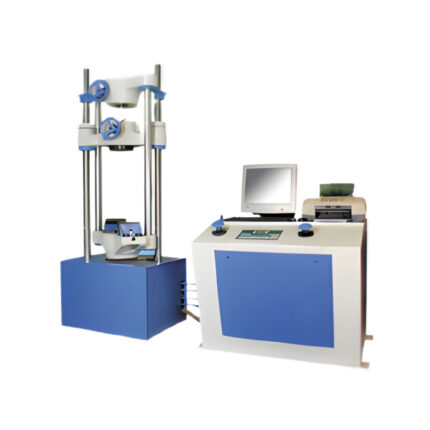
COMPUTERIZED TENSILE TESTING MACHINE
Technical Specifications (Typical)
-
Capacity Range: 1 kN to 1000 kN (or higher on request)
-
Drive System: Servo motor / AC variable frequency drive / Hydraulic (as per model)
-
Load Measurement: High-precision strain gauge load cell
-
Accuracy: ±1% or better of indicated load
-
Crosshead Speed: 0.01 to 500 mm/min (programmable)
-
Speed Accuracy: ±1%
-
Stroke Length: 800 – 1200 mm (customizable)
-
Grips: Wedge, pneumatic, hydraulic, compression platens, bending fixtures
-
Control Mode: Load, displacement, and strain control
-
Software: PC-based testing software with graph plotting, test methods, and report generation
-
Data Output: Load vs extension, stress vs strain curves
-
Safety Features: Overload protection, limit switches, emergency stop
-
Power Supply: 230V / 415V AC, 50 Hz
-
Standards Compliance: ASTM E8, ASTM A370, ISO 6892, BIS standards
A Computerized Tensile Testing Machine (CTTM) is a precision material testing system designed to determine the tensile, compressive, bending, shear, and peel strength of materials under controlled loading conditions. The machine is equipped with a servo motor or hydraulic system, high-accuracy load cell, and computerized data acquisition software for real-time monitoring, analysis, and reporting.
It is widely used in quality control, R&D laboratories, educational institutes, and production lines to evaluate mechanical properties such as ultimate tensile strength, yield strength, elongation, modulus of elasticity, and more, in accordance with ASTM, ISO, BIS, and EN standards.
Applications
-
Metals (steel, aluminum, alloys)
-
Plastics and polymers
-
Rubber and elastomers
-
Wires, cables, and fasteners
-
Textiles and fabrics
-
Composite materials
Related products

MARTINDALE ABRASION TESTER
Technical Specifications
-
Test Method: Martindale Abrasion & Pilling Method
-
Motion: Lissajous figure (multi-directional rubbing)
-
Number of Test Stations: 4 / 6 / 8 / 9 / 12 / 16 stations (optional)
-
Specimen Diameter: 38 mm or 140 mm (as per standard)
-
Abrasive Medium: Standard wool fabric / sandpaper
-
Applied Pressure:
-
9 kPa (Light fabrics)
-
12 kPa (Workwear, upholstery)
-
-
Counter Range: 0 – 99,999 cycles (digital presettable)
-
Drive System: Precision motor with gearbox
-
Control System: Microprocessor / Digital controller
-
Display: LCD / LED digital display
-
Auto Stop: Yes, at preset cycles
-
Power Supply: 220–240 V AC, 50 Hz
-
Standards Compliance:
-
ISO 12947
-
ASTM D4966
-
BS 3424
-
EN 530
-
GB/T 21196
-
Applications
-
Abrasion resistance testing of woven & knitted fabrics
-
Pilling resistance evaluation
-
Upholstery and automotive textile testing
-
Carpet and floor covering testing
-
Quality control and R&D
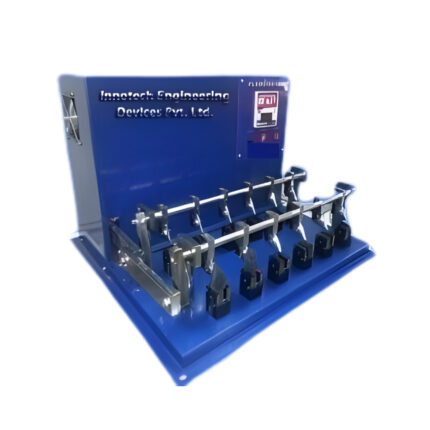
FLEXO- METER
Technical Specifications
-
Measuring Principle: Cantilever bending method
-
Test Parameter: Bending length / Stiffness
-
Specimen Width: Typically 25 mm (as per standards)
-
Specimen Length: Adjustable
-
Measurement Range: Suitable for low to high stiffness materials
-
Scale Type: Direct reading scale / Graduated scale
-
Accuracy: High precision with repeatable results
-
Operation: Manual / Semi-automatic (model dependent)
-
Construction: Rigid metal body with corrosion-resistant finish
-
Clamping System: Precision specimen holder for accurate positioning
-
Standards Compliance:
-
ISO 2493
-
TAPPI T489
-
BS 3748
-
Applications
-
Paper & Paperboard testing
-
Packaging material evaluation
-
Carton & corrugated box testing
-
Printing & publishing industry
-
Quality control & R&D laboratories
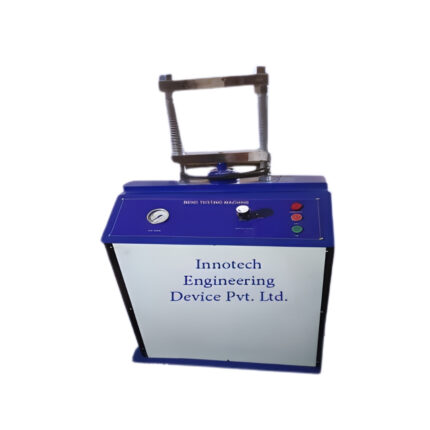
HYDRAULIC BEND TESTING MACHINE
Key Features
-
Heavy-duty hydraulic loading system
-
Rigid steel frame construction
-
Smooth and controlled bending operation
-
Hardened bending rollers and mandrels
-
Digital load indicator / PLC touch screen (optional)
-
Manual / semi-automatic operation
-
Low maintenance and long service life
-
Safety valves and overload protection
-
Compact and floor-mounted design
Applications
-
TMT bar bend and rebend testing
-
Weld joint bend testing
-
Structural steel quality verification
-
Pipe and tube bend testing
-
Research & development laboratories
-
Educational and training institutes
Standards Compliance
-
IS 1599
-
IS 1786
-
ASTM A370
-
ISO 15630
-
EN standards

MOTORIZED KNOTCH CUTTER
Key Features
-
Motorized operation for uniform and precise notch cutting
-
High-accuracy linear slide mechanism
-
Interchangeable cutters for V-notch and U-notch
-
Rigid body construction for vibration-free operation
-
Adjustable cutting depth and feed
-
Safety cover for operator protection
-
Suitable for metals, plastics, and composite specimens
Technical Specifications (Typical)
-
Notch Types: V-notch (45°), U-notch (2 mm radius)
-
Specimen Size: As per ASTM / ISO standards
-
Motor: Single phase / Three phase AC motor
-
Cutting Accuracy: ±0.01 mm
-
Standards Compliance: ASTM E23, ISO 148, IS 1757
-
Operation: Bench-mounted, motor-driven
Applications
-
Impact test specimen preparation
-
Quality control laboratories
-
Metallurgical testing labs
-
Plastic and polymer testing
-
Research & development centers

GOVERNOR TESTING MACHINE
Main Functions
-
Testing of centrifugal governors
-
Measurement of speed vs lift characteristics
-
Determination of controlling force
-
Study of stability and sensitiveness
-
Calibration of mechanical governors
Construction & Components
-
Rigid MS fabricated frame
-
Variable speed electric motor with controller
-
Vertical spindle with governor mounting arrangement
-
Precision RPM measuring system (digital tachometer / encoder)
-
Sleeve lift measurement using dial gauge / LVDT
-
Load application mechanism (weights / spring system)
-
Safety guard enclosure
-
Digital display / DAQ system (optional)
Typical Technical Specifications
-
Speed Range: 0 – 6000 RPM (customizable)
-
Speed Control: VFD / Servo drive
-
RPM Accuracy: ±0.5%
-
Lift Measurement Range: 0 – 25 mm
-
Lift Accuracy: 0.01 mm
-
Power Supply: 230V / 415V AC
-
Mounting Type: Vertical
-
Data Output: Digital display / PC interface (optional)
Types of Governors Tested
-
Watt Governor
-
Porter Governor
-
Proell Governor
-
Hartnell Governor
-
Wilson-Hartnell Governor
Applications
-
Mechanical engineering laboratories
-
Polytechnic & engineering colleges
-
R&D centers
-
Industrial training institutes
-
Governor calibration workshops

COMPUTERIZED SPRING TESTING MACHINE
Key Functions
-
Load–Deflection Testing
-
Spring Rate (k) Calculation
-
Compression / Tension Testing
-
Cycle (Fatigue) Testing (optional)
-
Free Length & Solid Height Measurement
Types of Springs Tested
-
Compression springs
-
Tension (extension) springs
-
Torsion springs
-
Disc (Belleville) springs
Main Components
-
High-precision Load Cell
-
Servo / Stepper Motor Drive
-
Ball Screw & Linear Guide System
-
Computer with Testing Software
-
Digital Displacement Encoder
-
Safety Enclosure & Limit Switches
Typical Specifications (Indicative)
-
Capacity: 10 N to 50 kN (customizable)
-
Accuracy: ±0.5%
-
Stroke Length: 100–500 mm
-
Speed Range: 0.1–500 mm/min
-
Data Output: Load–deflection curve, test reports (PDF/Excel)
Software Features
-
Real-time load vs deflection graph
-
Automatic spring constant calculation
-
Test method storage
-
Pass/Fail limits
-
Data export & printer support
Standards Supported
-
IS, ASTM, DIN, JIS, ISO
-
Automotive & industrial spring standards
Applications
-
Automotive spring manufacturers
-
Electrical & electronics industry
-
Aerospace components
-
R&D laboratories
-
Incoming and final inspection

DIGITAL HARDNESS TESTING MACHINE
Common Types
-
Digital Rockwell Hardness Testing Machine
-
Digital Brinell Hardness Testing Machine
-
Digital Vickers Hardness Testing Machine
-
Portable Digital Hardness Tester (Leeb type)
Key Features
-
Digital LCD/LED display
-
Automatic load application & dwell time
-
High accuracy & repeatability
-
Direct hardness value display (HRC, HRB, HB, HV, etc.)
-
Data storage & USB/PC connectivity (optional)
-
Conforms to ASTM / ISO / IS standards
Typical Applications
-
Quality control labs
-
Heat treatment shops
-
Foundries & forging units
-
R&D laboratories
-
Engineering colleges & testing labs

DIGITAL TENSILE TESTING MACHINE
What Is a Digital Tensile Testing Machine?
A Digital Tensile Testing Machine is an electromechanical device used to measure how materials behave under tension — that is, how much force they can withstand before they stretch or break. It digitally records key parameters like force, elongation, and strength, and displays these on a screen or computer interface for analysis.
🧪 How It Works
-
Specimen Mounting
A sample (metal, plastic, rubber, textile, etc.) is gripped between the machine’s upper and lower fixtures. -
Tension Application
The machine pulls the specimen apart at a controlled speed using a motor and crosshead mechanism. -
Data Capture
As tension increases, digital sensors (usually load cells) record force versus elongation. Modern machines often interface with software for real-time graphs and data export. -
Failure & Analysis
Testing continues until the material breaks. The machine then reports properties such asultimate tensile strength, yield strength, elongation, and modulus of elasticity.
📊 Typical Features
✅ Digital & Computerized Readouts
-
Real-time display of force, displacement, and elongation.
-
Many machines provide computer interfaces for storing and analyzing test results.
✅ Precision Sensors
-
High-sensitivity load cells and digital encoders ensure accurate measurements.
✅ Safety & Protection
-
Limit switches and overload protection safeguard both the specimen and the machine.
✅ Variable Speed Control
-
Test speeds can often be varied based on material type and test standards.
✅ Standards Compliance
-
Machines can be designed to meet ASTM, ISO, and IS standards depending on industry requirements.
🏭 Common Applications
Digital tensile testers are used in:
-
Industrial quality control (metals, plastics, elastomers)
-
R&D laboratories (new materials, composites)
-
Automotive & aerospace sectors (ensuring material safety)
-
Textile and packaging industries (fiber and film testing)
-
Educational and research institutions
🔍 What Results You Get
After a test, you typically get:
| Property | Meaning |
|---|---|
| Tensile Strength | Highest stress the material withstands before breaking |
| Yield Strength | Stress at which material begins to deform permanently |
| Elongation at Break | How much the material stretched before breaking |
| Modulus of Elasticity | Material stiffness measured from stress-strain data |
🛠 Buying Considerations
If you’re looking to purchase one:
-
Load Capacity: Choose based on maximum force you need to test (e.g., 500 N vs. 5000 kgf).
-
Display Type: Digital panel vs. computer-integrated software.
-
Accuracy & Standards: Verify compliance with relevant testing standards (ASTM, ISO, etc.).
-
Accessories: Special grips or fixtures for different materials enhance flexibility.
Reviews
There are no reviews yet.